Image source: wikiart.org
Introduction
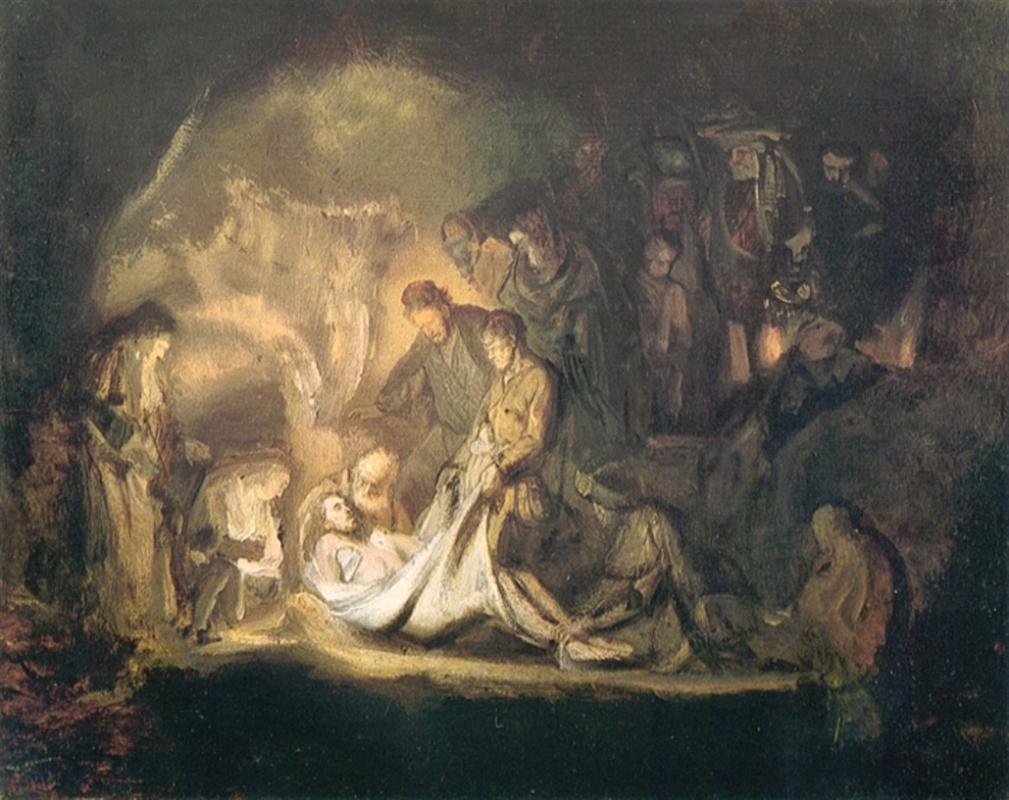
Rembrandt’s “The Entombment” (1635) is a nocturne of grief and grace. In a cavernous setting, a circle of mourners lowers Christ’s body onto a linen shroud. A lantern glow pools and spreads, defining faces, hands, and folds while the surrounding rock dissolves into darkness. The painting is compact and urgent, closer to an oil meditation than to a grand, polished altarpiece. Its power lies in the way Rembrandt makes light carry feeling—how illumination gathers the community around the body and, at the same time, becomes a theological statement about hope at the edge of night.
Historical Moment and Purpose
The mid-1630s were a period of extraordinary ambition for Rembrandt in Amsterdam. He was refining a sequence of Passion subjects and experimenting with multiple versions of key episodes—raising of the cross, descent, entombment, resurrection—often preparing intimate oil sketches as he worked out narrative, lighting, and the choreography of figures. “The Entombment” belongs to this cycle of meditation. It’s neither a casual sketch nor a courtly showpiece, but something in between: a studio picture that tries out a complete idea at chamber scale. The energy of its making remains visible in the painterly surface, and that living brushwork intensifies the scene’s immediacy.
Narrative Focus: The Work of Love
The heart of the composition is practical action. Two men at center—one bending, one kneeling—bear the weight of Christ’s torso and legs. Others steady the sheet, light the space, or kneel in prayer. Mary, the mother, and the holy women gather close, huddled by grief yet committed to the necessary rituals. This is not a tableau of static lamentation but a coordinated task undertaken with reverent urgency: lower the body, wrap it, make room in the rock, and keep the lamp from failing. Rembrandt’s faithfulness to physical labor dignifies these last acts of love.
Composition: A Stage Carved from Night
The design is built on a low, luminous crescent that arcs across the bottom third of the panel. Figures interlock in a shallow semicircle around the body, their postures rhyming gently—one bends, another kneels, a third leans—so that the group reads as a single organism moving with a shared intention. Behind them the cave yawns upward in a dark dome. At far right a second cluster of observers gathers near the tomb’s mouth, their features barely legible in the gloom. The path of the eye is clear: from the white of the shroud to Christ’s face, out to the workers’ hands, and back again. The darkness is not empty space; it is the architecture of the scene, a shell that cradles the light like a cupped hand.
Chiaroscuro: The Light That Thinks
Rembrandt’s use of chiaroscuro here is at once theatrical and contemplative. The light appears to come from within the circle—an unseen oil lamp or torch near the floor—and it lifts the shroud into a pale, almost lunar presence. Christ’s torso is modeled with gentle transitions, never cold, never anatomical for its own sake. The faces around him catch splashes of illumination that read as thoughts: a forehead glows with realization, a cheek with compassion, a hand with resolve. Shadows do the opposite work, softening edges and returning the world to secrecy just beyond the task at hand. The overall effect is intelligence made visible—light that knows where to look.
The Body of Christ: Weight and Stillness
Rembrandt paints Christ’s body with perceptible weight. The shoulders slump, the ribcage settles, the knees give to gravity. The white cloth is not a theatrical drape but a working sheet that wrinkles and bunches under strain. These choices matter because they honor both the reality of death and the tenderness of those who serve it. The body is unidealized yet suffused with dignity; it is at once a son, a friend, and the Redeemer. Viewers feel the work in their own backs and wrists, and that physical empathy serves the spiritual meditation.
Gesture as Language
Every gesture contributes to meaning. The kneeling figure at center right pins the cloth with one hand and, with the other, supports the feet—an instinctive act that reads as both competence and care. A woman at left leans inward, hands joined near her chest, her posture an embodied prayer. Someone behind the central pair reaches forward through the light, a bridge between sorrow and action. Even the anonymous onlookers in the darkness participate; their stillness gives the foreground labor its solemn context. In Rembrandt, gesture never decorates; it narrates.
Space, Rock, and the Tomb’s Mouth
The rocky hollow is not thoroughly described, yet its presence is felt. A flinty ledge catches a little light at the far left; vague tool marks or strata lines flare and vanish as the brush skims the surface. This economy allows the cave to act almost as an organ stop—dark, resonant, setting the key in which the human figures “sing.” The mouth of the tomb at right, where a few standing figures and a flicker of torchlight suggest depth, is like a secondary stage where the next scene will unfold: the stone rolled, the seal, the watch. For now it hovers as a future tense.
Color and the Temperature of Grief
Although reduced by darkness, the palette remains tender. The shroud carries warm whites rather than icy ones, preventing the body from appearing marble cold. Earth reds and muted ochres surface in sleeves, belts, and faces, each note subdued so the color feels breathed rather than applied. Cool greys and smoky greens temper the rock and the surrounding air. This temperature interplay—warm light against cool night—keeps grief human and close. Nothing in the color scheme shouts; everything murmurs.
Brushwork and the Poetics of the Unfinished
The paint handling is unapologetically open. In places a few strokes conjure a figure’s presence more persuasively than a finished contour could. The gathered crowd at the right dissolves into suggestive flickers, like memory’s own shorthand for who was there. The ghostly impressions at the far left—half-seen figures or angelic presences—are so lightly stated that they feel like breath on glass. This openness is not negligence; it is Rembrandt’s way of letting attention concentrate where it matters most while the periphery remains atmospheric, like peripheral vision in low light.
Devotional Aim: A Picture that Prays with You
The painting does not aim to overwhelm with spectacle; it invites accompaniment. Its scale, hush, and concentrated light make it ideal for sustained looking—the kind of looking that slowly turns into prayer. For seventeenth-century viewers steeped in domestic devotion, this intimacy would have been a strength. Instead of asking the eye to travel through a landscape of marvels, the picture keeps the gaze near hands and cloth, near the face of the Beloved, near the ordinary holiness of necessary work done well.
Who Is Who: Probable Identifications
Rembrandt avoids rigid labeling, but types emerge. Joseph of Arimathea is often imagined as the well-dressed man assisting with the shroud, a patron whose wealth supplied the tomb; Nicodemus may be the other principal bearer. The women closest to the body likely include Mary Magdalene and Mary the mother of James, with the Virgin herself bowed and veiled nearby. Their faces are individuated enough to feel like real people, yet generalized enough to stand for the Church at large—those who tend the broken body of Christ across time.
The Shroud as Theology
The white linen is a protagonist. It receives the strongest light, creates the central arc of composition, and prophesies Resurrection textiles—the folded cloths that will be found in the empty tomb. Rembrandt paints it with loving attention to its heft, weave, and folds, making it both practical sheet and symbolic garment. The cloth gathers up the body even as the community gathers around the cloth. In its brightness viewers glimpse the paradox at the heart of the scene: loss attended by promise.
From Descent to Entombment: A Continuum of Care
Seen alongside Rembrandt’s “Descent from the Cross” of the same year, this painting feels like the next exhale. The violent mechanics of removing the body—ladders, nails, beams—have given way to the quieter mechanics of burial. Yet the emotional thread remains unbroken: the same hands that received him from the wood now lower him to earth. Rembrandt’s gift is to calibrate the energy to match the moment. Whereas the Descent strains muscles and tests balance, the Entombment requires steadiness and gentleness. Both turn the Passion into a grammar of touch.
The Viewer’s Place in the Scene
The vantage point places us at the edge of the circle, near the floor, almost within reach of the shroud. We are not distant judges; we are present helpers or witnesses. The composition’s open left flank, where figures thin and light swells, becomes our entry. As our eyes adjust, we begin to share the task: hold the cloth, lift the feet, make room. It is a subtle invitation to participate in the work of compassion rather than merely observe it.
Silence and Sound
Although painted, the scene suggests sound: whispers of instruction, fabric sliding against stone, a sob stifled, the tiny hiss of a torch. Because the surrounding darkness damps echoes, these sounds feel near to the skin. Rembrandt’s control of density and edge makes the silence palpable. The image feels like listening, which is another way of saying it honors the interior space grief requires.
Time Held in Suspense
The painting captures a hinge in time. Death has come; burial is underway; resurrection is not yet. That middle state—between loss and promise—is where most human sorrow lives, and Rembrandt respects its duration. He refuses to rush the ritual, refuses to distract with celestial heraldry. Instead he sets the viewer inside the pause where faith is tested and love proves itself by staying.
Humanity and Hope
Perhaps the deepest effect of “The Entombment” is how human it is. No figure is idealized; everyone acts within the limits of fatigue, dim light, and a difficult task. Yet hope glows in the very act of tending. The community’s care, the lamp’s circle, the luminous cloth—all suggest that darkness does not have the last word. Rembrandt allows light to speak this hope without slogans. The theology happens through paint.
Legacy and Contemporary Resonance
Four centuries later, the picture remains moving because it feels true. Anyone who has handled a beloved body recognizes the combination of reverence and practicality, of sadness and competence. Modern viewers may also sense how the image speaks to communal acts of mourning—how people gather, each with a role, to honor the dead. In a world alert to both public ritual and private grief, Rembrandt’s canvas offers a way to look at loss that is neither sentimental nor cold.
Conclusion
“The Entombment” is Rembrandt at his most compassionate and concise. He pares the scene to essentials—body, cloth, hands, light—and lets them carry the full freight of meaning. The painting teaches us to see holiness in labor, revelation in the glow of a lamp, and hope in the curve of a shroud. It is a meditation in oil on how love behaves in the dark, and on how, even at the mouth of the tomb, light keeps finding faces.