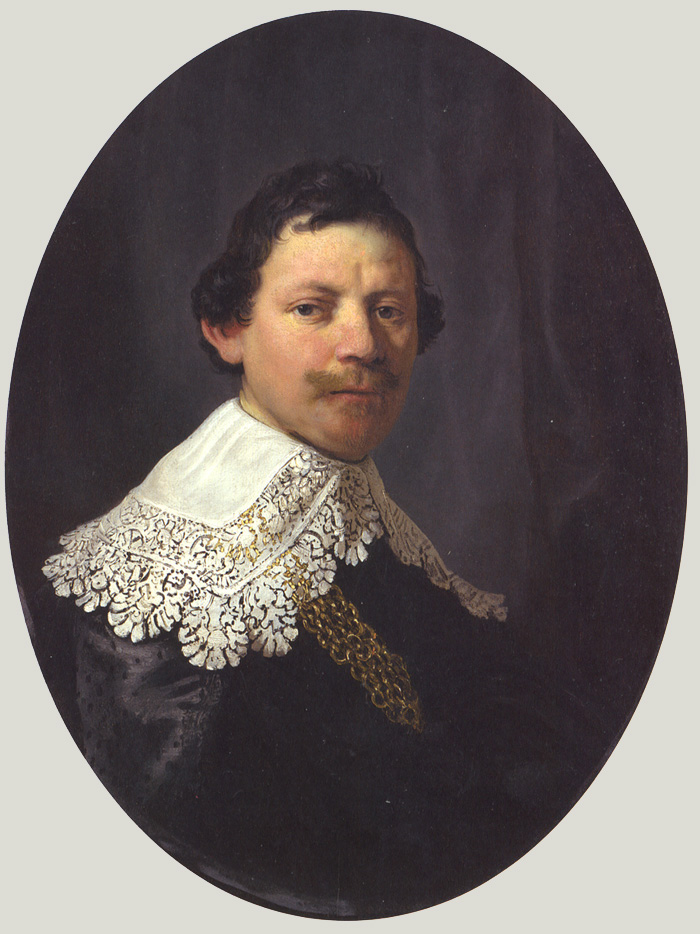
Image source: wikiart.org
Introduction
Rembrandt’s “Portrait of Philips Lucasz” (1635) is a concentrated lesson in what Dutch Golden Age portraiture could achieve when an artist joined social clarity to psychological depth. The sitter appears within an oval window against a subdued, curtain-like backdrop. He turns to the viewer with measured confidence, a calm but alert expression, and the frankness of someone used to public responsibility. Light pours across his face and the brilliant lace of his shoulder-wide collar, then sinks into the dark satin of his doublet where a heavy, gilded chain descends. No anecdotal props intrude; the portrait trusts fabric, light, and a thinking face to carry meaning. Painted in the year Rembrandt completed the pendant portrait of Petronella Buys—Philips Lucasz’s wife—the work forms one half of a pair that declared marital stature while giving each partner an independent, vivid presence.
Historical Context and the Culture of Pendants
Amsterdam in the mid-1630s was a republic of merchants, regents, and guilds, a city that commissioned portraits to stabilize status and commemorate alliances. The pendant portrait, with husband and wife painted in sympathetic formats, was a quintessential expression of Dutch domestic public life. Rembrandt, newly established in Amsterdam and eager to demonstrate mastery, adopted the oval to concentrate elegance and to echo the shape of the broad lace collars then in fashion. Philips Lucasz belonged to that prosperous civic world, and Rembrandt’s treatment aligns with the expectations of the class while quietly outstripping them. Where many pendants feel formulaic, this portrait is lucid and keen, its light disciplined to reveal character rather than costume alone.
Composition: An Oval of Authority
The oval format is not a mere fashion. It governs every decision. By trimming the corners of space, Rembrandt suppresses distraction and quickens the viewer’s progress toward the face. The head is placed slightly off-center to the left, turning back into the picture in a classic three-quarter pose. This counter-rotation animates the static geometry and builds a measured tension between profile and frontal address. The lace collar sweeps wide, almost architectural in its scalloped edge, mapping the oval’s curvature with a second rhythm. Beneath, the chain falls in a vertical punctuation that arrests the eye before it slides into the dark garment. The background, a quiet wall of smoke-colored gray, performs like a stage curtain: it grounds the sitter in sober space without competing for attention.
Light as Social Grammar
Rembrandt’s light is judicious rather than theatrical. It enters from the upper left, lighting forehead, nose ridge, cheekbones, and the fleshy turn of the lower lip. These accents read not as spotlight but as clarity—the kind of northern daylight that reveals rather than flatters. The collar, a field of white lace and tiny shadows, becomes a minor blaze in comparison, but it never outshines the face. Rembrandt manages the whites with color: cool bluish notes in shadow, warm cream along the planes that face the light. This chromatic intelligence keeps the collar alive and prevents it from flattening into graphic pattern. The light then softens over the chain and dies into the silvery depths of black satin, preserving hierarchy: intellect first, civility second, luxury last.
The Face: Calm Weather and Clear Intention
Philips Lucasz looks the viewer squarely, but without bravado. The eyes are level and slightly moist, a tiny high light at each iris giving them sentience. The mouth is firm, the mustache trimmed, the jaw set with self-possession. Rembrandt is sparing with wrinkles, choosing instead to model the planes of brow, cheek, and jaw with supple transitions that imply vigor rather than age. The coloring is subtle—rose along the cheek, a touch of ocher at the nose, cool grays near the eyes—which gives the flesh a living temperature. We register thoughtfulness and a temperament more steady than impulsive, a man accustomed to decisions and public view who nonetheless maintains privacy behind the gaze.
The Collar: Architecture of Lace
The immense lace collar—an emblem of prosperity and propriety—could easily dominate the sitter. Rembrandt treats it as architecture that frames the head while leaving character intact. Each scallop ends in a crisp, lacelike silhouette, but the painter does not draw every loop. He evokes the complexity through layers of broken strokes, clusters of tiny shadows, and judicious highlights along the pleated edge. The collar’s slight yellowed warmth at the seams and its bluish gray recesses enforce material truth: this is linen and lace, not abstract white. The collar also performs a psychological function: it declares restraint, cleanliness, and order—virtues prized by the governing classes—without turning the sitter into an allegory.
Costume, Chain, and the Ethics of Ornament
Beneath the collar, the doublet’s deep black absorbs light with velvet-like density. Rembrandt inscribes the surface with discreet, stippled highlights that suggest woven pattern without insisting on it. The gilded chain hangs in a deliberate vertical, its links caught by tiny dots and dashes of thick paint. Chains in Dutch portraiture often signaled civic honor or guild position; here it also functions as a visual brace that tethers the flaring collar to the mass of the torso. Ornament in the painting never becomes boastful. It serves poise, not pride, and this modesty aligns with the Republic’s moral imagination, which asked wealth to present itself with discipline.
Color and Tonal Harmony
The palette is a restrained harmony of grays, blacks, creams, and warm skin tones with a few disciplined golds. This limitation is a strategy for tonal eloquence: by reducing hue, Rembrandt amplifies the meaning carried by light and dark. The face and collar stand out because surrounding values whisper. At the same time, he threads color through the neutrals—cool violets in the shadowed cheek, olive in the background, honeyed notes in the chain—so that the painting feels full rather than austere. The tonal architecture mirrors the social one: clarity at the center, sobriety around it.
Brushwork and the Craft of Conviction
Seen closely, the work is a workshop in varied handling. The face is painted with soft, layered strokes that merge at the edges into the surrounding air. The mustache and hair receive quicker, more calligraphic touches that separate one texture from another. The lace is a compound of thicker accents—little risers of paint that catch real light—and thinner gray-brown shadows that emboss pattern. The chain is built with minute touches of raised paint, a metallic syntax that reads convincingly even at a distance. Everywhere the brushwork calibrates attention: when Rembrandt needs to hold the eye, he sharpens; when he wants it to drift, he softens.
Pendant Logic and Marital Dialogue
As the pendant to Petronella Buys’s portrait, this work speaks across the room. Petronella’s oval features the blaze of a millstone ruff and a pearl necklace; Philips wears lace and a chain. Both sitters gaze slightly off-center, turned toward one another in a silent, architectural dialogue. The pairing announces alliance and parity: wealth, discipline, and dignity shared between partners. Rembrandt resists the temptation to make the man overtly more “public” or the woman more “private.” Instead he gives each a self-contained authority that, when seen together, multiplies rather than divides.
Psychology Without Theater
One of the triumphs of the portrait is its psychological quiet. Nothing in the sitter’s body is exaggerated. The slight forward lean, the measured tilt of the head, the unforced gaze—these cues deliver more information than gestural fireworks. Rembrandt trusted the human face to carry its own drama. In an age of rhetorical portraiture, this restraint reads as truthfulness. Philips Lucasz appears neither severe nor ingratiating. He looks like someone who knows the budget, the bylaws, and the weather, and who prefers steadiness to display.
The Background as Breath
The gray-violet backdrop may seem empty, but it is subtly alive. Soft vertical sweeps hint at a curtain; darker passages near the oval’s edge counterbalance the collar’s blazing whites; a faint light to the left keeps the head from crushing against the frame. This atmosphere gives the sitter breathing room, the way a pause clarifies a sentence. Rembrandt refuses the still-life props that many portraits used to cue profession. For Philips, the world is the implied civic space beyond the frame, and the tools of his trade are judgment and presence.
Social Imagination and Civic Virtue
Seventeenth-century Dutch portraiture served a civic ethic as much as private vanity. Rembrandt honors that ethic by translating social virtues—sobriety, order, prudence—into visual grammar. The lace is ordered; the chain is disciplined; the blacks are deep and respectful; the whites are clean but warm. Yet the painting avoids the dryness that sometimes encumbers civic portraiture. Life presses quietly through the decorum, largely because the face is alive and the light breathes. The portrait reveals rather than announces status.
Comparisons with Contemporary Masters
Compared with Frans Hals, whose portraits of this period can flicker with bravura brushwork and witty immediacy, Rembrandt’s “Portrait of Philips Lucasz” feels more architectonic and inward. Compared with Van Dyck, whose aristocrats often lounge in silken theatrics, it is more republican and grounded. The work synthesizes Leiden precision with Amsterdam amplitude, locating a middle register where texture, light, and psychology cohere without ostentation.
Time Suspended and the Promise of Speech
Rembrandt selects the instant before acknowledgment becomes conversation. The sitter has turned, the mouth is settled, the eyes meet ours, but no utterance has begun. This suspended second lends the portrait its human magnetism: we feel we could speak and be answered. In portraiture, such timing is not trivial; it transforms the image from a static emblem into a living relation, a meeting negotiated by light.
The Lasting Appeal
Why does this portrait remain persuasive centuries later? Because it practices a kind of honesty that survives fashion. The costume may be of its time, but the measured light, the refusal of exaggeration, and the respect for the sitter’s interior life feel contemporary. We recognize in Philips Lucasz a familiar kind of authority—the trustworthy colleague, the prudent regent—rendered with sympathy and restraint. The painting teaches the viewer how to look at a person without either flattery or suspicion.
Conservation of Detail and the Experience of Distance
Rembrandt paints for multiple viewing distances. From across a room, we read strong contrasts: the illuminated face and the white collar against the sober ground. At arm’s length, the lace resolves into a virtuoso economy of marks; the chain sparkles from dabs no larger than pinheads; a faint warmth around the ear and the tiny glisten in the eye supply life. This elasticity—convincing at every scale—is a technical hallmark that supports the portrait’s credibility.
Partnership with the Viewer
The portrait assumes a viewer who is equal to the sitter—another citizen, perhaps a visitor in the same room. By keeping the viewpoint at eye level and avoiding extreme foreshortening or luxuriant props, Rembrandt organizes a meeting rather than a spectacle. The work’s ethics are built into its optics: it offers clarity, asks attention, and returns respect. In that exchange lies the painting’s durable grace.
Conclusion
“Portrait of Philips Lucasz” is a high-water mark of Rembrandt’s early Amsterdam portraiture. The oval concentrates presence; the light models authority without pomp; the lace collar and gold chain declare rank while deferring to the face; the background protects silence; the brushwork calibrates truth. As part of a pendant pair, it participates in a marital declaration of standing; as a single image, it stands as a model of civic poise. Rembrandt shows how much can be said with restraint, and how a quietly lit human face can carry the full freight of character, class, and time.