Image source: wikiart.org
Introduction
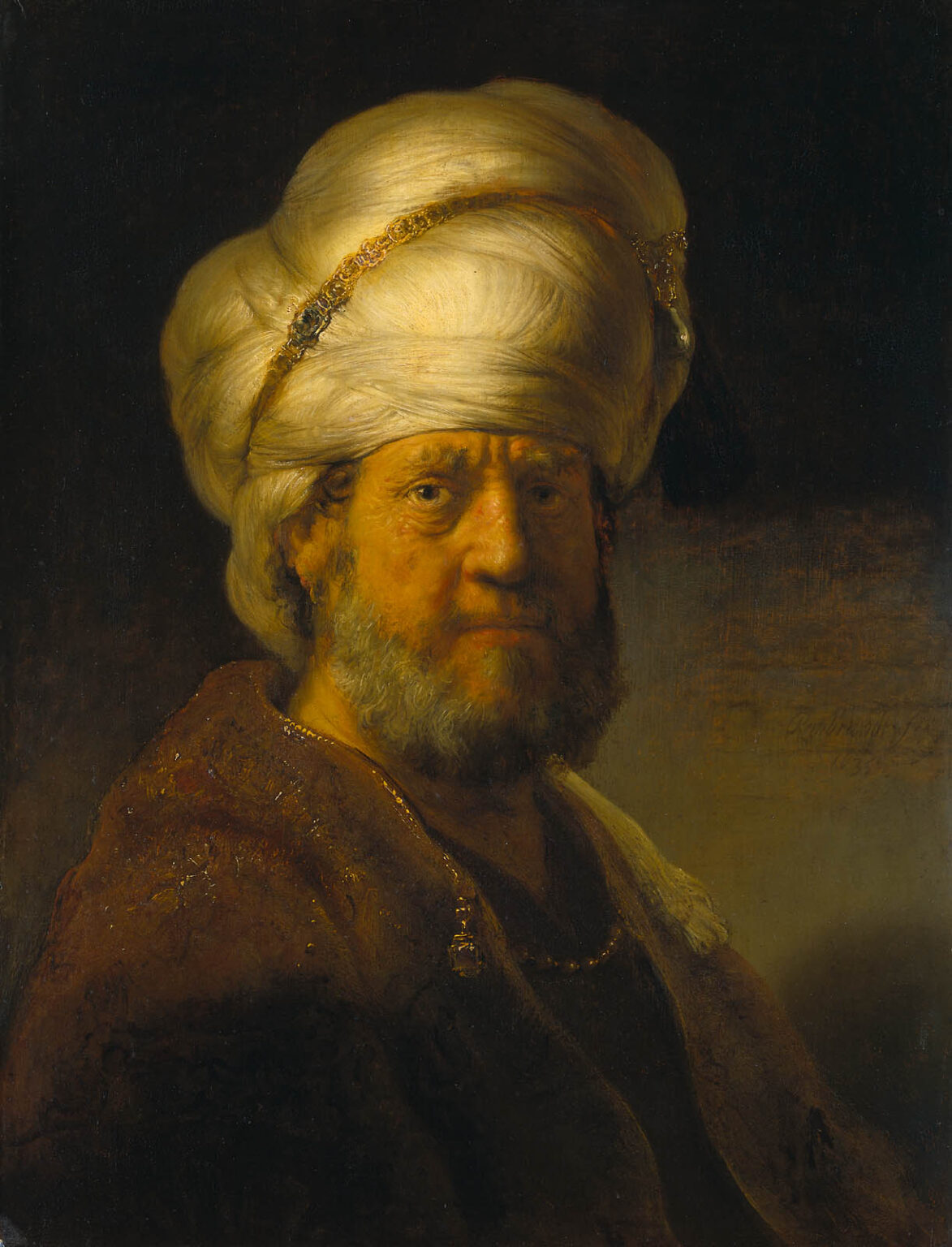
Rembrandt’s “Portrait of a Man in Oriental Garment” (1635) is a study in presence, texture, and theatrical imagination. Against a deep, velvety darkness, the head and shoulders of an older man emerge—his brow furrowed, his gaze steady, his beard catching glints of amber light. A monumental white turban wraps the skull in layered bands, each ridge modeled with buttery paint; a narrow jeweled band arcs across the fabric like a comet; and a heavy robe, slick with glazes and stippled highlights, falls across the chest. Nothing else competes for attention. The artist builds authority with light and matter alone, transforming a half-length figure into an emblem of worldly dignity. The image belongs to a group of exoticized portraits Rembrandt painted in Amsterdam during the mid-1630s, where the city’s global trade brought silks, turbans, and curiosities that fed a Northern taste for the “Orient.” Far from being ethnographic documents, these pictures are performances of status and mood. Here, the borrowed costume becomes a stage on which the artist can show what paint can do and what a face can hold.
Amsterdam, Curiosity, and the Fashion for the Exotic
In 1635 Rembrandt was newly famous in Amsterdam, a maritime hub where Turkish textiles, Persian carpets, Levantine metalwork, and Indian pearls circulated through docks and dealer’s rooms. Patrons commissioned portraits that nodded to this global commerce, often requesting that sitters be dressed “in the Turkish manner,” or that studio models be outfitted with the theatrical wardrobe that many artists kept at hand. The goal was less literal identity than a cultivated air of princely grandeur and timelessness. Turbans, in particular, were prized because they magnified the head like a crown while softening features with luminous cloth. Rembrandt seized on this fashion not as mere novelty but as an opportunity to test light against complex surfaces, to push his chiaroscuro into new registers, and to give otherwise conventional likenesses the authority of legend.
The Turban as Architecture of Light
The turban dominates the composition as a sculptural crown. It is not a flat prop; it is a topography of ridges, valleys, and twisted bands where light pools and drains. Rembrandt’s brush turns with the form, laying long strokes for the broader curves and shorter, lifted marks for the crisp edges where cloth overlaps. The palette in the turban is remarkably varied for a “white” object: cool pearly grays, warm creams, hints of buff and ocher, and minute sparks of lead-white tip-ins that catch actual light from the room. The jeweled fillet that arcs across the folds is more than ornament. It organizes the mass with a diagonal that energizes the stillness, and its tiny points of impastoed gold assert the painting’s material pleasure. Through this headgear alone, Rembrandt makes a case for painting as a way to make light feel tangible.
Costume, Texture, and the Pleasures of Surface
The robe is a deep, rusty brown that glows like seasoned leather. Rembrandt builds it in transparent glazes over warm grounds so that color seems to burn from within. Scattered flecks of thicker paint—minute beads along the chain, a slick highlight at a seam—do for the garment what the jewel band does for the turban: they punctuate the mass with signs of touch. Against this dark breadth, the lighter, feathery beard catches light in broken strokes, and a narrow triangle of inner shirt at the throat sends a cool counter-note. The whole ensemble is a symphony of textures: absorbent cloth, glossy thread, wiry hair, smooth skin. Part of the portrait’s seduction lies in how convincingly those surfaces announce themselves at different distances—sumptuous from afar, intricate inches away.
Chiaroscuro and the Drama of Emergence
Rembrandt’s early Amsterdam years are famous for bold chiaroscuro, and this painting exemplifies his control of dramatic emergence. The background is not an even dark; it softens from black into olive-brown haze, especially at the right, where scumbles of thin paint suggest air rather than wall. From that dusk the head advances, almost modeling itself. The strongest light crosses the turban’s front ridge, slides down the right cheek, and skims the beard before evaporating along the robe’s shoulder. Shadows are not emptiness; they are colored and warm, filled with half-tones that keep the face alive. This controlled theater of light does not just flatter; it confers authority. The sitter appears as if discovered by illumination itself, a person summoned from anonymity into significance.
The Face as a Landscape of Experience
Rembrandt’s genius lies in the psychological weather he can coax from bone and skin. The man is no anonymous type. His eyes carry a direct but unaggressive attention; the left eye, slightly more lit, appears moist, giving the gaze a breathing truth. The nose is modeled with unflinching candor, the mouth set in a line that suggests both patience and habitual firmness. Around the temples and under the eyes, soft puffs and creases signal age without cruelty. The beard is not a theatrical appendage; it grows from the face with convincing density, its tone warming where it approaches the skin. By refusing to idealize or caricature, Rembrandt lets the sitter’s humanity balance the costume’s theater. In this tension—between exotic dress and unvarnished presence—lies the painting’s modernity.
Portrait or Tronie?
Scholars often debate whether paintings like this are formal portraits of named men or tronies—studio character studies of anonymous models dressed in adopted costume. The truth can be both. Even when a name is lost, the head is painted with the seriousness reserved for a person rather than a mere type. The rope of individuality in the face and the respectful fall of light argue for a living singularity. At the same time, the turban and chain signal that Rembrandt is playing on the border between likeness and role, inviting viewers to consider identity as both given and performed. The category matters less than the picture’s effect: it reads as a real person granted the aura of a prince.
Composition and the Geometry of Authority
The design is disarmingly simple: a half-length set a little off-center, the head turned three-quarters toward the light, the shoulders forming a broad base for the turban’s height. Yet within this clarity, Rembrandt threads several powerfully stabilizing diagonals—the jewel band, the incline of the shoulders, the chain’s curve—so the eye moves in a controlled circuit that always returns to the eyes. Negative space is carefully rationed. The dark to the right of the face is a cushion that keeps the head from pressing against the frame, while the narrow glow at the left edge hints at a space beyond. The geometry makes the sitter feel immovable without stiffness—a rock under weather.
Color as Temperature and Feeling
Although the palette seems narrow—earth browns, ivory, olive-black—the color is deeply sensuous. The warm brown of the robe keeps the darkness from feeling funereal; it is the color of varnished wood and old leather, of things that have been touched and warmed by life. The turban’s whites are alive with color memory—a blue in the shadow, a biscuits’ warmth near the light—so the cloth reads as both cool and sunlit. Flesh is pinked at nose and ear, warmed at cheek and brow, and given tiny cool notes near the eyes so that moisture is believable. Color here is not to dazzle but to give temperature to experience.
Brushwork, Impasto, and the Signature of Touch
The painting is a treatise on how paint can be laid. On the turban, Rembrandt often pulls the brush and then lifts it slightly at the end of a curve so a ridge remains, catching actual light like a thread. In the robe, he lets glazes pool in micro-valleys to suggest sheen. In the beard, he uses short, flicked strokes and scumbles to mix pigment optically on the eye, not only on the palette. Skin is built with thinner, more blended layers whose edges are softened or sharpened depending on where the viewer’s attention should fall. These choices are not random; they are the grammar of emphasis. Where the eye must linger, the brush becomes precise; where the eye should drift, the paint relaxes. The overall effect is an image that retains the vitality of its making.
The Chain and the Question of Status
The chain across the chest, with its tiny pendant, matters. In Dutch portraiture, chains could signify civic honor or personal wealth; in “oriental” costume pieces, they could also index princely rank. Rembrandt paints this chain with sparkling economy—just a few highlighted beads and a small drop of gold modeled frontally—enough to imply weight and polish without drawing attention from the face. The chain suggests that the sitter, whether real regent or imagined potentate, possesses authority recognizable at a glance. Yet the artist’s restraint keeps this from bragging; ornament supports character rather than substituting for it.
The Psychology of Stillness
Nothing “happens” in the picture beyond looking and being looked at, yet the stillness is tense with implication. The sitter seems to have just shifted into place, meeting someone’s gaze, prepared to speak but choosing not to. The mouth’s set, the slight furrow at the brow, and the open, alert eyes construct an interior silence that is not passive. This sense of inwardness—life continuing beyond the frame—is a hallmark of Rembrandt’s best portraits. He grants a moment its depth without requiring action to justify it.
The Afterlife of Exotic Portraiture
Images like this had a long echo. Eighteenth- and nineteenth-century painters, from Tiepolo to Delacroix, would use “Oriental” costume to electrify portraiture and history painting, often with Romantic bravura. Rembrandt’s approach is quieter. His gaze is less on spectacle and more on how such costume amplifies the head and the play of light. Modern viewers, aware of the complexities of representation and cultural borrowing, can read the painting both as a Baroque fantasy and as an honest search for radiance. The painting invites us to savor texture and presence while acknowledging that the “Orient” here is a European studio idea—a costume that made new kinds of looking possible.
Why the Portrait Still Feels Contemporary
The picture’s power survives fashion because it is not primarily about costume; it is about attention. The painter looks with sympathy and rigor; the sitter returns that attention with dignity. The light is not a trick but a way to honor the face as a place where meaning gathers. In a world saturated with images, this concentrated exchange—one person fully seeing another—remains disarming. The painting proposes that presence itself, when articulated with care, is enough.
Conclusion
“Portrait of a Man in Oriental Garment” is Rembrandt’s compact manifesto on the nobility of looking. The turban’s luminous architecture, the robe’s inner glow, the chain’s discreet flash, the beard’s wiry truth, and the face’s steady weather all conspire to make a human being persuasive in a few square feet of darkness. The “Oriental” costume gives the head grandeur; the painter’s light gives it life. Whether anonymous tronie or formal likeness, the result is a portrait that treats its sitter not as a type but as a presence—someone gathered out of shadow into a sphere of clarity where we meet him eye to eye.