Image source: wikiart.org
Introduction
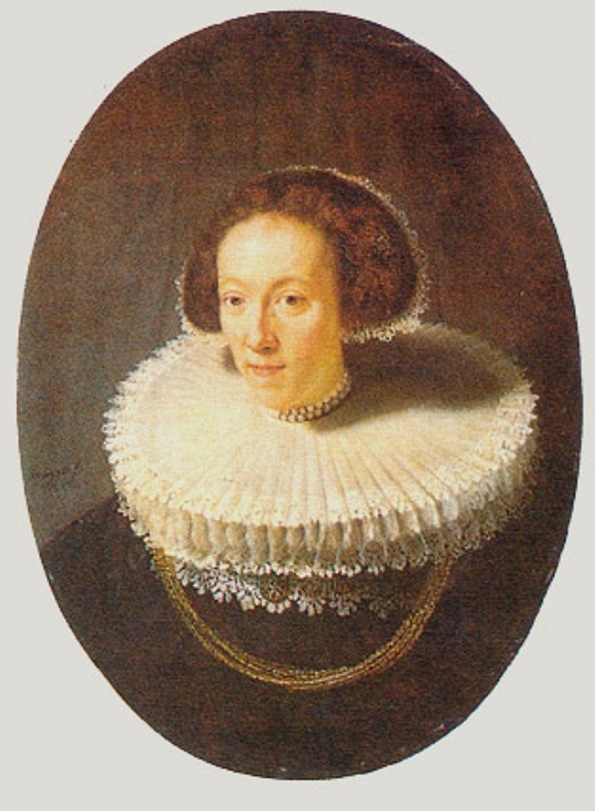
Rembrandt’s “Petronella Buys, Wife of Philips Lucasz” (1635) is a small, oval portrait that carries surprising grandeur. The sitter appears against a warm, neutral ground, her head and shoulders radiant within a millstone ruff that reads like a sculpted halo of light. A modest string of pearls hugs the neck; delicate lace frills soften the edges of the collar; faint gold chains arc across a dark bodice. Rembrandt does not crowd the picture with props or narrative; he trusts the face, the light, and the astonishing architecture of the ruff to do the work. The result is an image of poise and quiet authority, a distilled example of Dutch Golden Age portraiture at a moment when Rembrandt was translating his Leiden virtuosity into Amsterdam confidence.
Historical Setting and Commission
Painted in 1635, the portrait belongs to the years just after Rembrandt’s move to Amsterdam, where he quickly gained a reputation for portraits that combined social dignity with psychological liveliness. Petronella Buys came from a prosperous milieu, and this painting was likely conceived as the pendant to a portrait of her husband, the merchant and civic figure Philips Lucasz. Pendant portraits—husband and wife painted for display together—were a favored format in the Dutch Republic, visually uniting domestic partners and signaling patrimony, prosperity, and stability. In this context, Rembrandt’s crisp oval becomes not only an individual likeness but also a public statement of marital and social identity.
The Oval and the Art of Concentration
Rembrandt often adopted the oval format in the mid-1630s for its ability to concentrate attention and to soften the formality of conventional rectangles. Here the oval performs like a window that opens onto Petronella’s presence while excluding unnecessary distraction. The gentle curvature of the format echoes the circular sweep of the millstone ruff, creating a harmony of shapes that stabilizes the composition. The sitter is placed slightly to the viewer’s left, her gaze directed just off-center, which keeps the picture from feeling static. The oval also heightens the cameo-like preciousness of the portrait: it feels intimate yet complete, like a jewel carefully set.
Modeling with Light
Light defines everything. It falls from the upper left, washing the forehead and cheek, then catching the saw-toothed pleats of the ruff in tiny highlights that read like frost on carved marble. The transition from illuminated skin to shaded lace is so finely handled that we sense air between the face and collar. Shadows around the temples, along the lower jaw, and beneath the chin are warm rather than harsh; they keep the sitter alive, not sculptural. The background is a low hum of brown-gray, subtly modulated to push the head forward without announcing itself. It is Rembrandt’s favored chiaroscuro used not as bravura drama but as a quiet grammar of visibility.
The Face as Character
Petronella’s face is built with gravity and restraint. Rembrandt models the bone structure with planes of cool light over warm underpaint: a delicately arched brow; slim, observing eyes; a nose that meets the mouth with calm assurance; a soft chin that catches a last glint. The expression is not a smile but a poised receptiveness that feels appropriate to a public portrait—human warmth held within social decorum. There is nothing schematic about the physiognomy: pores, faint laughter lines, and the tender pink of the inner lip disclose an artist who looked hard and cared about particularity. The psychological charge comes from a slight turn of the head and the alertness in the eyes; she seems mid-breath, as if about to acknowledge someone entering the room.
The Millstone Ruff: Architecture and Air
The ruff is an engineering marvel in paint. Each pleat is a wedge of light and shadow; the lace edge is indicated with confident brevity; and the whole structure sits in believable space around the neck. Rembrandt refuses the temptation to draw every stitch. Instead he lets a few well-placed highlights and broken lines persuade the mind to see abundance. The ruff’s whiteness is not a single tone; it is a symphony of cool blues, warm creams, and silvery grays that respond to the fall of light. This attentiveness to temperature prevents the collar from flattening into a graphic device. It breathes.
Lace, Pearls, and the Ethics of Ornament
Dutch portraiture in the 1630s often advertised prosperity through textiles and jewels, yet moral culture prized restraint. Rembrandt’s costume details respect both truths. A neat string of pearls circles the throat—not ostentatious, but bright. The lace edging of collar and cuffs is delicate but not fussy. A pair of long, faint gold chains drape across the bodice in a shallow arc, their links suggested by small, rhythmic touches rather than precise description. These choices offer tactile pleasure while preserving the sitter’s decorum. Ornament enhances dignity; it does not upstage it.
Hairstyle and Edge Work
The hair is arranged in a fashion then current among Amsterdam’s elite: parted centrally, drawn back into ear-covering puffs, and controlled by lace lappets. Rembrandt paints it with short, responsive strokes that catch light along the crown and soften as they approach the netted edge. The transition between hair and background is masterly—neither sharply cut nor smudged, but feathered so that the silhouette remains crisp while refusing artificial outlines. This attention to edges, a hallmark of Rembrandt’s practice, gives the head a lifelike vibration against the dark.
Color and Palette
The palette is restrained: warm umbers and cool grays in the background; creamy whites in the collar; muted blacks and browns in the dress; quiet golds in the chains; a small constellation of pinks and ochers in the face. The limited scheme achieves elegance and focus. It places the tonal drama—the orchestration of light and dark—at the center of the experience while allowing color to function as undertone and temperature rather than spectacle. The effect is of sobriety warmed by human presence.
Paint Handling and Surface
Up close, the surface reveals a disciplined variety. The face is built with thin, layered paint that allows half-tones to glow from beneath; the ruff carries thicker, more opaque touches to catch actual light; the background is broader, brushed wet-into-wet to avoid distraction. Rembrandt’s brushwork remains visible but never mannered. The painter’s hand shapes material truth—skin, cloth, lace—without turning those materials into a subject separate from the sitter. Texture serves character.
The Pendant Logic
As a wife’s portrait intended to accompany a husband’s likeness, the painting conforms to conventions while inflecting them. In pendant pairs, men were often shown with attributes of civic role or profession—gloves, hand on chair, outdoor landscape—while women were presented indoors, emphasizing textile and jewelry. Rembrandt adheres to the type but gives Petronella equal psychological weight. Her portrait does not feel like an accessory to a more consequential male image. Within the constraints of fashion and decorum, he grants her thought and presence.
Social Identity and Moral Imagination
Dutch society’s merchants and regents valued industriousness, moderation, and piety. Portraits had to carry those virtues in visible form. Rembrandt constructs them without rote symbolism. The millstone ruff—requiring cleanliness, care, and expense—signals order and prosperity. The pearls and lace whisper of wealth; the dark dress balances with sobriety. Yet none of these details turns the sitter into a moral emblem. She remains a person who inhabits those virtues rather than an allegory that preaches them. That humane restraint is one reason these portraits still feel modern.
The Background as Space and Silence
The background reads as an architectural dusk, neither wall nor void. Subtle shifts—cooler near the top, warmer near the shoulder—suggest a real room without drawing the eye away from the head. This vagueness is strategic. It provides spatial relief and depth while maintaining the correct hierarchy: the sitter first, her environment second. The silence of the background amplifies small music elsewhere—the rill of lace, the glints on pearls, the blush upon the cheek.
Comparison with Rembrandt’s Other Women of the 1630s
Set alongside the richly costumed “Flora” (1634) or the portrait of a “Woman Wearing a Gold Chain” (1634), Petronella’s image shows Rembrandt shifting from theatrical costume pieces to a clearer, purer portrait mode. The face is less staged, the accessories more conventional, the light more sober. Yet the painter’s sensitivity to skin tone, lace, and high fashion remains. The 1635 portrait marks a synthesis: still sumptuous in technique, newly restrained in rhetoric.
Intimacy within Formality
The painting is formally composed and socially correct, but Rembrandt slips intimacy into its structure. He does so through the slight forward tilt of the head, the gently parted lips, and the way the whites of the eyes catch light asymmetrically. These small departures from icon-like fixity create the impression that Petronella is present in time. She is not frozen for eternity; she is sitting for a painter, breathing, thinking, and aware.
The Necklace and the Breath
The narrow pearl collar serves more than decoration. It visually separates flesh from the rigor of the ruff and gives the neck a gentle rhythm, echoing pulse and breath. Pearls in Dutch portraiture often carried associations of purity and constancy; here they function simply and beautifully as a hinge between life and architecture. The slight shadow cast by the necklace along the throat is one of the painting’s quietest delights.
The Ethics of Resemblance
Rembrandt’s reputation for psychological honesty arises from choices visible here: no excessive flattery, no anxious cataloguing of every pore. He presents a woman dignified by birth and station but translated into the ordinary beauty of living features. The sitter’s individuality matters as much as her role in a family and a city. For the patron, this meant truth with grace; for us, it conveys a person whose presence escapes cliché.
Conditioned Quiet and Lasting Appeal
Part of the painting’s lasting pleasure lies in its conditioned quiet. There is no emblem, inscription, or anecdote—just a person, seen well. The format invites close viewing; the small scale rewards intimacy; the textures invite the eye to linger and move. Unlike larger, more demonstrative canvases of the period, this oval persuades by patience. It is a celebration of attention—Rembrandt’s to his sitter, and ours to the painting.
Why the Portrait Still Feels Contemporary
Contemporary viewers recognize the etiquette and fashion of a different era, yet the portrait reads as fresh because it frames a perennial drama: how to look at another person with respect. Rembrandt meets Petronella with sympathy and restraint, and he paints the things she wears and owns in a way that honors their use rather than their glamour. The result is modern in the best sense: a clear, unfussy image grounded in lived reality.
Conclusion
“Petronella Buys, Wife of Philips Lucasz” is a demonstration of what portraiture can accomplish with small means and great intelligence. The oval concentrates presence; light carves human truth from silence; fabric and lace tremble with convincing life; pearls and gold modestly affirm prosperity; the ruff becomes an architecture of civility around a living face. Rembrandt’s artistry makes each element do more than identify a sitter; it persuades us to value her composure, clarity, and personhood. In the space of a few inches, the painter grants Petronella a social place and a private life—and gives us one of the most quietly satisfying portraits of the Dutch Golden Age.