Image source: wikiart.org
Introduction
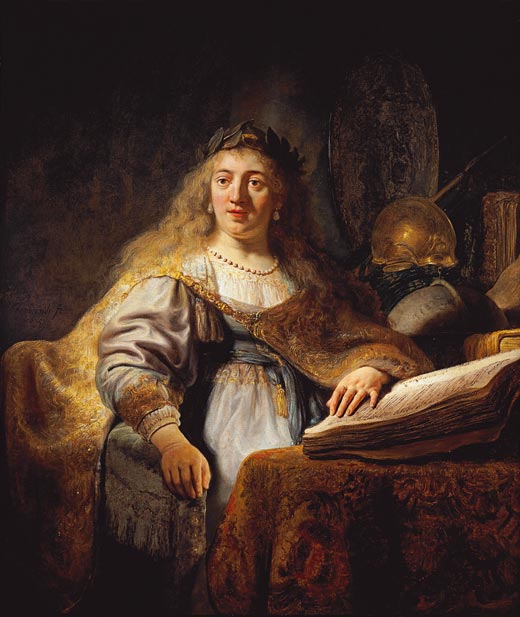
Rembrandt’s “Minerva” (1635) is a sumptuous meditation on wisdom made flesh. Rather than showing the goddess Athena in armor, striding into battle, the artist seats her in a domestic study. She turns toward us, poised between a great open folio and a cascade of golden drapery, with armor resting in the shadowed background like instruments temporarily set aside. The effect is both intimate and regal. Light sifts across velvet sleeves, brocade, parchment, and metal, binding the world of thought to the tools of power. In one of his most eloquent allegories from the 1630s, Rembrandt argues that intellect—not spectacle—grounds authority.
Minerva Reimagined
Athena/Minerva was the classical patron of wisdom, strategy, law, and the arts. Painters often emphasized her martial side—helmet, spear, aegis—arranging the goddess as an emblem of righteousness on the move. Rembrandt reframes her as the sovereign of study. The helmet remains, as do the round shield and the heavy gorget, but they are set on a stand behind her shoulder, their shine subdued by distance. In the foreground, the enormous book becomes the true attribute. Her hand rests gently on the open page, and the laurel crown on her head tilts toward the world of poets and scholars rather than conquerors. The message is clear: ideas decide the battle before weapons do.
A Portrait Under the Mask of an Allegory
Much has been made of the portrait-like vivacity of the sitter. Rembrandt was newly married in the mid-1630s, and several allegories from this moment adopt the format of a “portrait historié,” where a living person assumes a mythic role. The human specificity of the face—softly parted lips, an attentive, sidelong gaze, the warmth of the skin—pulls the goddess down to human scale. Yet the allegory holds. By giving Minerva a credible body and a plausible expression, Rembrandt modernizes her, allowing seventeenth-century viewers to see their own world’s intelligence reflected in antiquity.
Composition and the Architecture of Wisdom
The composition builds a stable pyramid with Minerva’s face at the apex. One side descends through her outstretched arm to the open book; the other drops through the arc of her golden mantle to the carved stone at left. This triangular structure stabilizes the scene even as textures flare and gleam. The book, table, and drapery form a low horizon of objects that assert the dignity of study. Behind, an oval shield rises like a second moon, while the helmet’s curved brow echoes the roundness of her laurel wreath. These circular forms keep the design breathing, softening the pyramid’s firmness with rhythmic repetition.
Chiaroscuro as a Philosophy
Light in this painting is not merely atmospheric; it argues. It enters from the left, washing Minerva’s forehead, cheek, and the pearly sleeve of her dress. It then breaks into a scattered constellation of highlights across the page edges, the brocaded tablecloth, the necklace, and the resting armor. Darkness pools behind her—an unthreatening shadow that frames the figure and throws intelligence into relief. The brightest surface is not the helmet or shield but the book’s illuminated spread. Rembrandt has painted a hierarchy of values: knowledge shines brightest, and the instruments of war must stand in its reflected glow.
Costume, Drapery, and Sensuous Intellect
Rembrandt uses costume to translate ideas into touch. The silver-lavender satin of the sleeve, the weighty gold mantle embroidered and edged in fur, the crisp white bodice and necklace—each plays a part in the drama of wisdom. Minerva’s mind is not austere; it is richly furnished. The jeweled textures do not distract from intellect; they manifest it in the world of materials, suggesting that wisdom belongs fully to embodied life. The thick brocade table covering, with its dark ochers and pomegranate motifs, anchors the foreground, a secular altar cloth for the rite of reading.
The Open Book
The folio at the table’s edge is Minerva’s true weapon. Rembrandt paints the paper with loving specificity: the deckled edge, the slight warp of the leaves, the shadow of the gutter, the barely indicated lines of text. The hand that rests upon it is relaxed, as if she has reached the pause between paragraphs—the interval where understanding deepens. Her touch is not proprietorial; it’s companionable. The book and the mind share the light, and the viewer senses that thought is a physical act performed with eyes, hands, and memory.
Armor at Rest
The helmet, gorget, and shield cluster in the shadow like sleeping actors waiting for their cue. Their surfaces catch a stingier, cooler light than the book and face; they gleam but do not flare. This is strategy, not accident. By demoting the glitter of metal, Rembrandt downplays the spectacle of war. The goddess is not disarmed—only uninterested in brandishing what she does not need to use. The military gear also gives the composition ballast, setting up a counterweight to the expanse of golden mantle on the left.
A Face that Thinks
Minerva’s expression carries the painting’s inner weather. Her eyes are set slightly apart in intention: one addresses the viewer with calm recognition; the other tips toward the book, as if some thought still holds her. The mouth is slightly open, a sign of attentive breathing rather than speech. Cheeks and chin receive the sort of humane modeling Rembrandt reserved for living people rather than allegorical types. The laurel circlet presses into her hair, and a stray highlight just inside the brow ridge animates the whole face, creating the sensation of a mind at work.
Materials and Brushwork
The surface is a virtuoso syllabus in Rembrandt’s 1630s technique. He floats thin, transparent glazes in the shadow passages to maintain air, then leaps to buttery impastos along the gold embroidery and the armored edges to catch real light. Hair is painted in elastic skeins and broken tips; the satin sleeve is constructed from long, controlled strokes that turn with the form and drop into a crisply painted cuff. The book’s pages are scumbled—dry, chalky paint dragged across a darker underlayer—to mimic paper’s tooth. The viewer experiences these passages not as tricks but as metaphors: knowledge has texture, and the world of ideas is stitched to the material with a craftsman’s care.
A Humanist Image for Amsterdam
Amsterdam in the 1630s was a republic of readers—printers, publishers, scholars, merchants—and Minerva was its flattering self-portrait. Collectors loved allegories that celebrated learning as civic virtue. Rembrandt obliges without turning pious. The painting evokes a calm studio rather than a court of pomp: books piled at the right, a quiet backdrop, an atmosphere closer to study than parade. It is an image of power that would appeal to a city defined by commerce and intelligence rather than by hereditary display.
Gender, Authority, and the Domestic Study
By placing the goddess within a study and emphasizing her engagement with books, Rembrandt complicates the gendered rhetoric of power. Female authority here is not a mythic exception but an elegant demonstration that intellectual sovereignty can wear a gown and pearls. The laurel crown—more often associated with poets and scholars than with warriors—cements the alignment. Even the hand position matters. It is not clenched on spear or shield; it rests on a page. Authority becomes the right to read and to think.
The Table as Stage
The massive table thrusts diagonally toward the picture plane, pushing the book into our reach. Its brocade acts like a proscenium curtain, rich and thick, separating viewer from goddess while also inviting entry. The perspective is just steep enough to animate space without theatrical distortion. Along the edge, Rembrandt delights in the way pattern goes slack where the cloth folds, showing his keen eye for how luxury behaves in gravity. The table is not simply a prop; it is the stage on which the drama of reading takes place.
Dialogue with Other Minervas
Earlier North European painters often showed Minerva as a crisp emblem—a figure of cold chastity, close to marble. Italian Baroque artists, by contrast, favored dynamic, martial versions. Rembrandt negotiates between traditions. He retains the symbols but cushions them in a soft, Northern light; he borrows Italian grandeur for the draperies but turns the action inward. The result is neither textbook allegory nor bravura spectacle. It is an inquiry: what would wisdom look like if you met her at a table, mid-study, prepared to talk?
Color as Meaning
The palette glows with honeyed golds, soft violets, smoky olives, and warm earths. These colors, echoing the tones of parchment, metal, and skin, create a refined harmony that rewards long looking. Even the shadows are colored—browns warmed with red, greens cooled with gray—so that darkness has temperature rather than emptiness. The gold mantle, heavily worked with impasto and glinting threads, becomes a visual synonym for illumination, wrapping Minerva like the light of comprehension.
Narrative Possibilities
Although the picture is not a narrative scene, it implies several stories. Perhaps Minerva has been reading a history of war and set the armor aside because strategy has replaced weaponry. Perhaps she has been advising a mortal hero through the pages, the way the goddess counsels Odysseus. Perhaps the armor belongs to someone she has guided, and she now studies the lessons of victory and failure. Rembrandt leaves such staging to the viewer’s imagination, providing just enough concrete fact—book, arms, laurel—to seed reflection.
The Viewer’s Position
We stand close, within conversational distance. Rembrandt has lowered the vantage slightly so that the face sits above our eye level, preserving a subtle hierarchy without creating aloofness. Minerva acknowledges us with a calm turn of the head that registers as welcome rather than challenge. The open book, placed near the edge of the table, seems extended toward us. The painting thereby enacts what it praises: the transmission of knowledge from one mind to another across a surface.
Time Suspended
Rembrandt chooses the interval between actions. No page is being turned, no spear is lifted. The stillness is taut, the way stillness feels just before a decision is made. Paintings from the 1630s often revel in frozen instants that bulge with potential; “Minerva” is exemplary. We sense that she could return to her reading at any moment, or rise to retrieve her helmet if duty calls. The balance of readiness and repose gives the picture its poise.
The Ethics of Attention
At heart, the painting is a defense of attention as the highest power. Everything here serves the focused mind: a quiet room, good light, a generous book, and tools of action patiently awaiting instruction. In presenting Minerva as a reader, Rembrandt claims that the world is best ruled by those who pause before they act, who prefer illumination to noise, and who accept finery not as a mask but as the sensible clothing of a life lived fully among things.
Legacy and Continuing Appeal
“Minerva” encapsulates what many admire in Rembrandt’s early Amsterdam years: theatrical richness balanced by psychological tact; brilliant surfaces underwritten by humane insight. Later artists looking to ennoble learning—Neoclassical portraitists, nineteenth-century academic painters—would find in this image a model for blending allegory with the felt presence of a sitter. Modern viewers, too, find the painting surprisingly contemporary. In a culture that prizes speed and spectacle, Rembrandt’s goddess recommends a slower, steadier sovereignty grounded in the page and the patient gaze.
Conclusion
Rembrandt’s “Minerva” is less a goddess in costume than wisdom at her desk—attentive, beautifully dressed, and surrounded by the textures that make thinking a pleasure. Light favors the page, the face, and the hand; armor waits in the wings. The painting proposes that true power is not loud, and that learning, when honored, becomes a kind of gold that glows from within. Standing before this canvas, we experience what the painter clearly believed: the major actions of a life often happen in the quiet where a mind meets a book.