Image source: wikiart.org
Introduction
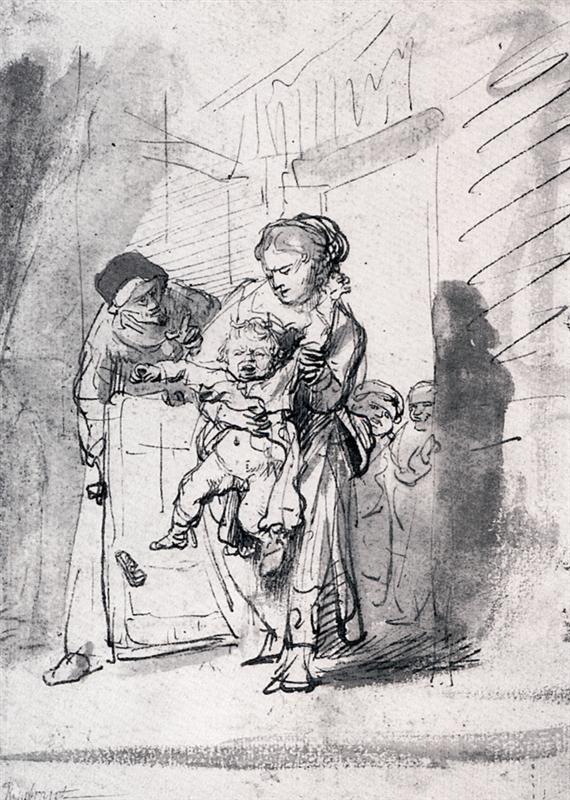
Rembrandt’s “Child in a Tantrum” (1635) is a compact burst of domestic theater. In a few nervous pen lines supported by smoky washes, the artist stages a small crisis familiar to any household: a toddler in full revolt, writhing mid-air as two adults try to carry him through a doorway. One figure braces the door, the other gathers the squirming body; faces tighten, hands clutch, and the child’s limbs pinwheel with desperate energy. Nothing about the scene is grand, yet it radiates the urgency of lived experience. The drawing reveals Rembrandt’s fascination with ordinary emotion and his genius for turning fleeting gestures into lasting art.
A Snapshot of Amsterdam Life in the 1630s
The early 1630s were Rembrandt’s first years in Amsterdam, a city teeming with families, servants, apprentices, and the spontaneous dramas of urban life. The painter watched all of it with what seems like inexhaustible curiosity. While his studio produced large commissions on biblical themes, his sketchbooks filled with street vendors, beggars, and intimate household vignettes. “Child in a Tantrum” belongs to this stream of observational drawings—a private arena where the artist tested the expressive potential of line without the etiquette of finish. The subject is not allegory but event: a moment at the hinge between private and public, the threshold of a house where domestic discipline becomes briefly theatrical.
The Composition’s Theater of the Threshold
The drawing’s architecture is minimal but decisive. A tall doorframe stands like a proscenium at the left; diagonals of siding and lintel lines suggest a shallow porch or entryway on the right. This threshold is more than backdrop—it explains the struggle. The child is being moved from one space to another, perhaps extracted from the street or carried inside after refusing to comply. Rembrandt uses the vertical of the door and the shadowed jamb as visual anchors against which the bodies torque and flail. The figures stack diagonally from left to right—door attendant, mother or nurse, child—so that the eye reads the cause-and-effect of action at a glance. The drawing is an essay in how setting creates motive.
Gesture as Language
Rembrandt’s line finds eloquence in small gestures. The child’s legs kick outward, knees bent, toes pointed, while one arm stretches toward escape—classic choreography of resistance. The head throws back in a wail; a few abbreviated curves at the mouth and brow are enough to transmit sound. The woman’s hands are placed not harshly but firmly: one under the child’s torso, the other securing a shoulder. Her face tilts down in focused concentration rather than anger. The figure at the door—perhaps a servant or relative—leans in with an anxious half-step, hands lifted as if to help or to block an attempted bolt. A pair of onlookers deeper in the passageway observe, their tiny heads supplying a comic chorus. The entire narrative is stitched out of hands and angles.
Line, Wash, and the Rhythm of Making
The drawing shows Rembrandt’s two-handed approach to notation: swift pen lines for structure and character, fluid gray washes for atmosphere and emphasis. He begins with a scaffolding of contours—the arc of the child’s thigh, the slope of the woman’s spine—then drapes them in tonal pools. Wash gathers beneath the figures to ground them; a broad, smoky vertical on the right becomes wall and shadow; light washes on the clothing suggest creases and weight. Areas of the paper are left bare to gleam as highlight: the child’s belly and thigh, the woman’s cheek, a patch on the door. This alternation of filled and saved surfaces gives the scene breath and a sense of time unfolding—wet wash drying even as the pen continues to search.
The Expressive Economy of Faces
At this small scale, Rembrandt resists detail in favor of physiognomic shorthand. The child’s face is a tangle of just a few lines—two slashes for brows, a hooked curve for the open mouth, tiny dashes for snarled hair—and yet the emotion is unmistakable. The woman’s expression is built from a lowered eyelid, a pinch at the mouth corner, and a downward tilt of the head; it reads as firm, mildly exasperated care rather than irritation. The helper’s features are more angular, his nose jutting, his brow cocked in anxious readiness. Each face exerts a distinct gravitational pull inside the drawing’s tiny universe.
Chiaroscuro and the Bubble of Drama
Even in a drawing, Rembrandt choreographs light like a director. Wash darkens the far right to create a pocket of shadow from which the figures emerge. This shadow functions like a stage curtain, isolating the bustle at the doorway from the rest of the world. Within the bubble of light that remains, the brightest things are the child’s exposed skin and the woman’s forehead, turning the tantrum itself into the visual center. The door panel receives a knotted wash that reads as wood grain and stress; the thick dab beneath the child’s feet becomes the ground the artist refuses to let him find.
The Psychology of the Adults
A key to the drawing’s humanity is the adults’ demeanor. The woman does not scold; she manages. Her body leans forward to keep the squirming center of gravity close to her own. We can sense the strain at her wrist and the careful positioning of her hip to avoid a kick. The second adult’s body language is gentler still—one hand hovers, the other steadies. Through these postures Rembrandt refuses the caricature of punitive authority, offering instead a realistic snapshot of exhausted care. The drawing becomes less a joke at a child’s expense and more an acknowledgment of the labor of keeping order.
Sound, Weight, and the Senses
Although the sheet is silent, Rembrandt makes sound and weight palpable. The child’s cry seems to ripple across the paper; the door’s wood looks as if it has just thudded open; the woman’s step presses a footprint of wash into the floor. The sudden absence of a handhold is felt in the child’s splayed fingers; the bounce of a small body mid-air hums in the lifted heels. Such sensory conviction emerges from the artist’s unerring sense of how bodies behave under stress. He understands the physics of a tantrum.
Clothing and Class Markers
Costume reads swiftly but tellingly. The woman’s long dress, tied at the waist with a sash, and her tidy hair suggest a respectable household. The man’s cap and looser tunic place him slightly lower in status—perhaps a servant or porter. The child is in a shift, legs bare, a common toddler’s outfit. These cues position the scene within a middle-class domestic interior typical of Amsterdam’s merchant neighborhoods. Rembrandt does not make a social argument; he simply places the comedy where he saw it, in a tidy home briefly overturned by a small despot.
The Door as Symbol and Device
Doors in art often symbolize transition, threshold, or choice. Here the door operates at several levels at once. Practically, it explains the wrestling—someone is being taken from one space to another against his will. Thematically, it is the line between public decorum and private reality; a tantrum belongs to the latter, but for a moment spills into the former. Graphically, the door is a flat plane against which Rembrandt can contrast curving bodies and sharp angles, a perfect foil for the tangle of limbs. Because it opens outward, toward us, we feel as if the scene has burst into our own space, implicating the viewer as witness or even reluctant participant.
Time as a Stroke of the Brush
The drawing captures an instant, but it also implies time before and after. The streak of wash along the right edge reads like a shadow that will quickly pass; the small onlookers in the hallway are poised to react; the woman’s forward motion suggests that in another second she will have the child more firmly contained. The image feels like a film still snatched from a longer sequence. Rembrandt’s talent lies in choosing the exact frame in which all relevant vectors—push, pull, resist, restrain—are perfectly visible.
Humor, Empathy, and the Artist’s Eye
There is humor here, but it never hardens into ridicule. Rembrandt’s long familiarity with the strains of family life prevents him from treating the child as mere spectacle. The toddler’s fury is legitimate to him; the adults’ effort is worthy of respect. This equilibrium—laughing with life rather than at it—has everything to do with why the drawing feels fresh. Artists of the Baroque often revel in grandeur; here the grandeur is of attention itself, the dignity of looking closely at something small and finding in it a universe.
Drawing as Research for Narrative Painting
Rembrandt frequently used drawings as laboratories for larger works. In this sheet he rehearses how to stage bodies in tight quarters, how to use a doorway to frame action, and how to pull focus with sparing light. These lessons travel directly into his narrative paintings, where clusters of limbs, diagonals of movement, and localized light carry emotional freight. Even if “Child in a Tantrum” never served as a direct study for a painting, it sharpened the artist’s instincts about timing and gesture—the raw materials of his storytelling.
Comparisons with Other Domestic Studies
Rembrandt produced a constellation of drawings on domestic themes: women nursing, men reading by lamplight, elderly figures dozing, children playing. Compared to the serene intimacy of those sheets, this drawing vibrates with disarray. Yet the underlying sympathy is the same. The artist’s line is not judgmental when cataloging human frailty—whether a nodding grandmother or a screaming child. The household, to him, is a theater of grace where ordinary bodies enact the passages of life without needing allegorical crowns.
Materiality of the Paper and the Hand of the Artist
The paper itself participates in the image. You can see where the wash buckled the fibers, leaving a tide mark that doubles as a wall. The pen catches and skips, creating lively roughness in hair and fabric. At the lower edge, two or three exploratory scratches indicate a floor line; Rembrandt decides he needs no more to convince us. This legibility of process—mist, drag, hesitation—feeds the drawing’s vitality. We watch not only a tantrum but the act of drawing it, as immediate as breath on a winter window.
The Ethics of Showing Childhood
Seventeenth-century images of children often idealize obedience or sentimental innocence. Rembrandt instead shows will, fury, and the unfiltered assertion of self. Far from diminishing the child, this candor dignifies him. Tantrums are not moral failures; they are developmental storms. The woman’s calm control models a different ethical clarity: authority that protects rather than humiliates. The drawing thus smuggles a humane pedagogy into a few ounces of ink.
The Role of Negative Space
The strip of emptiness to the left of the door panel and the broad, light area above the figures do quiet, essential work. They prevent the sheet from feeling overpacked, allow the actors to breathe, and give your eye a place to rest before returning to the fray. The gaps are a form of kindness—compositional compassion mirroring the woman’s patience. Without them, the scene would choke on its own energy; with them, the energy reads as lively rather than frantic.
Why the Drawing Feels Contemporary
Anyone who has carried a flailing toddler through a threshold knows this scene. Across centuries, the drawing reads as a message from one parent, guardian, or neighbor to another: you are not alone. The speed of the line anticipates the aesthetics of modern reportage drawing and even street photography, where truth arrives in a rush and the frame condenses chaos into meaning. The image’s refusal to assign blame also feels modern; it trusts viewers to empathize without moralizing.
Legacy and Afterlife
While celebrated primarily for painting and etching, Rembrandt’s standing among draftsmen rests on sheets like this—works that prove a sketch can carry the authority of a finished picture. Later artists, from Watteau to Daumier, learned from his capacity to capture the gist of a scene with economy and heart. “Child in a Tantrum” is often reproduced in studies of childhood and domestic life precisely because it bridges art history and common experience with rare grace.
Conclusion
“Child in a Tantrum” is a small masterpiece of observation. Rembrandt transforms a domestic struggle into a choreography of lines and washes, a poem about will and care performed on a doorstep. The door stabilizes the drama; light isolates the action; hands speak as fluently as faces; paper and ink do the rest. The sheet honors both the storm of childhood and the steady labor of those who shepherd it. Looking at it, we feel the tug on the arm, hear the cry, sense the next step—and smile with recognition. In a world that often saves its attention for the spectacular, Rembrandt reminds us that the most universal truths may be thrashing, loudly, right at the threshold.