Image source: wikiart.org
Introduction
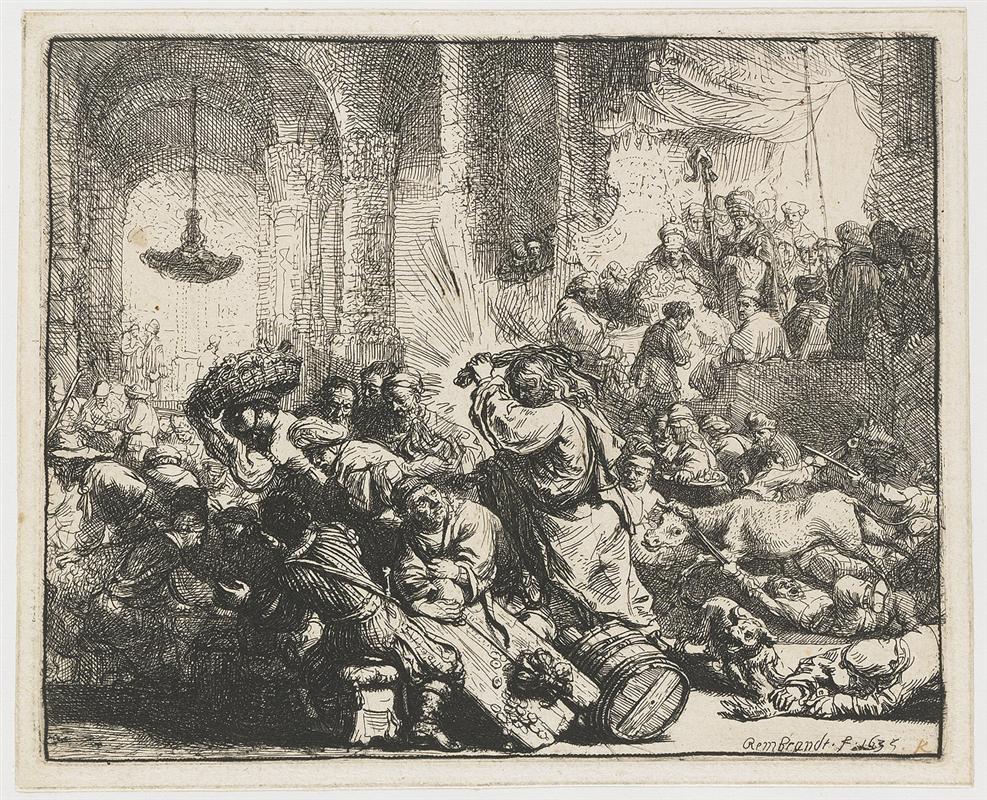
Rembrandt’s 1635 etching “Christ Driving the Moneychangers from the Temple” compresses explosive moral drama into a dense, teeming square of lines. In a single burst of movement the sacred precinct becomes a storm: Christ lashes the air with a whip of cords; merchants reel; baskets and coin bags tumble; animals bolt; a hanging lamp swings as if jarred by the uproar. The architecture soars in a honeycomb of columns and vaults that amplify the tumult below. It is a masterclass in how pure line—without color, without painterly glaze—can conjure noise, light, space, and the politics of holiness. Rembrandt chooses not the tidy aftermath or the clean before, but the most kinetic instant possible, when commerce scatters and conscience lands like thunder.
The Gospel Moment and Rembrandt’s Choice of Timing
All four Gospels record Jesus entering the Temple in Jerusalem and driving out merchants and moneychangers who had turned a house of prayer into a marketplace. Artists across centuries have approached the theme, often emphasizing the whip, overturned tables, and the scandalized crowd. Rembrandt’s version is unmistakably his: he elevates chaos to a principle of composition, but he also threads empathy through the confusion. The timing is mid-action. We hear the snap of cords, the cry of animals, and the clatter of vessels as the crowd recoils yet hasn’t fully fled. This is the moment when power meets misuse, when critique becomes action.
Composition: A Funnel of Force
The etching’s architecture arranges a funnel of energy. Two great piers frame a central void, and into that void Rembrandt pours the brightest burst of white: the flare of light behind Christ’s uplifted arm. From that fulcrum energy radiates in every direction—leftward into a pileup of bodies, rightward into a stampede of livestock and scrambling merchants, downward into a cascade of barrels, coin sacks, and tools of trade. The crowd is not a generic blur but a series of micro-dramas, each head and gesture a distinct note in the roar. A high gallery of onlookers forms a second theater, a chorus of faces pressed behind the parapet to witness the cleansing. Space is tight, breathless, convincing.
Christ: Engine of the Scene
Rembrandt avoids haloed serenity. His Christ is strong, mid-stride, arm cocked with the cords, torso twisting in the muscular logic of action. Yet he is not cruel. The raised whip strikes the air, not human flesh; the power is moral, not sadistic. The figure’s face is compacted with concentration rather than rage. In the white flare that silhouettes him, Rembrandt finds a way to make authority look like light rather than brute force. Christ is less a destroyer than a surgeon, cutting corruption out of sacred muscle.
The Crowd: Psychology in a Swarm
One of the etching’s marvels is how many distinct psychologies it contains. A merchant at left shields his head with a basket, eyes narrowed with fear. Another to his right braces as he’s shoved. A man on the floor drags a bag away in a last-ditch salvage of profit. Several figures look past the chaos, calculating a route of escape. In the upper register, priests and officials debate, their raised hands and pointing fingers announcing extraordinary breach of decorum. The crowd is not a caricatured mob; it’s a society in fast motion, revealing its interests under pressure.
Animals and the Ethics of Commerce
Cattle, sheep, and doves were part of the Temple economy—required for sacrifice and thus sold within its precincts. Rembrandt includes them with vivid specificity: a cow stumbles among sacks; a goat darts through legs; birds flutter in a panic cloud. Their presence sharpens the critique: when worship becomes transaction, living creatures become units in a spiritual marketplace. The etching’s empathy stretches even to the beasts; they are not props but participants caught in human noise.
Architecture: Theological Stagecraft
The colonnaded interior looms with a Romanesque imagination—massive piers, recessed arches, and a grand hanging lamp that echoes the celestial. This is not archaeology; it’s theater. The interior implies sanctity by sheer vertical weight and by the play of light pooling at the far apse where a priestly figure stands, remote from the brawl. The temple’s vastness makes the crowd seem both insignificant and, paradoxically, wildly intrusive. Rembrandt’s choice amplifies the offense: commerce hasn’t just crept in; it has occupied the nave.
Line, Hatch, and the Weather of Ink
As a printmaker, Rembrandt composes with densities of hatch rather than washes of tone. The whitest passages are small but decisive—the flare behind Christ, the highlights on barrels and animal flanks—while the mid-tones are knitted from parallel strokes that change direction to model volume. Crosshatching under the arcade suggests damp, ancient stone; looping strokes over figures create fur, hair, and fabric. The different “temperatures” of line (tight for stone, springy for bodies, scratchy for straw) create a multisensory experience. Even the air feels stirred, as if dust hung in beams of light.
Light as Judgment
The sheet’s luminosity emanates not from an unseen window but from moral action itself. The brightest zone, the white burst near Christ’s arm, behaves like revelation. It cuts across the crowd, picking out faces and objects with decisive clarity. This radiance makes money look suddenly heavy and tawdry, metal gone dull in truth’s beam. Areas untouched by the burst remain in murk, as if to say that corruption thrives in shade. The light is not neutral; it is verdict.
Rhythm and the Music of Chaos
Despite the bedlam, the etching is composed with musical intelligence. Curved backs echo the arc of the whip; diagonals of flight crisscross like counterpoint; heavy verticals of columns establish a bass line. The density of marks crescendos toward the lower left where bodies pile up, then decrescendos to the far apse where figures are mere whispers. This orchestration keeps the eye moving so that the viewer experiences the scene as a score: loud here, urgent there, a quiet bench in the distance where the mind can rest.
Social Commentary Without Slogan
The scene has moral clarity, yet Rembrandt avoids poster-like simplicity. He doesn’t demonize the merchants as grotesques. Their fear is human, their motives legible. Several are ordinary working people caught in a larger critique of systems, not isolated villains. This nuance preserves the Gospel’s focus: the problem is not selling per se but the conversion of prayer into profit. The etching’s empathy deepens its power; we recognize ourselves in the scramble and therefore feel the rebuke more personally.
Comparison with Earlier Traditions
From Giotto to El Greco, artists had dramatized this subject. Many placed Christ centrally with symmetrical architecture and a few overturned tables. Rembrandt multiplies figures and compresses space, bringing Northern taste for busy interiors into conversation with Italian dynamism. He also leans on his talent for street observation—beggars and vendors from his studies now repurposed as Temple traders—so the event feels documentary. The result is a hybrid: baroque energy filtered through Dutch attention to the life of markets and crowds.
States, Impressions, and the Performance of Printing
Rembrandt often reworked plates through multiple states, deepening lines or altering emphasis. Even without consulting state history, one can feel how different wipes would change the sheet’s mood: a “dirty” plate tone could float a veil over the arches, thickening atmosphere; a clean wipe brightens the flare behind Christ, sharpening the shock. Each impression is a performance of the idea, slightly different in weather, which suits a scene about the suddenness of awakening.
Still-Life Scatter and the Poetics of Debris
At the lower edge objects become characters: a barrel rolls, a coffer gapes, a jug bursts forward, coins spill in tiny, bright ellipses. Rembrandt’s still-life intelligence animates these things as evidence. They are the aftershocks of truth in motion. The material world, so orderly a moment before, is now in honest disarray. Even the money—the subject of the cleansing—refuses to shine like a prize; it behaves like pebbles being shaken out of a shoe.
Christ’s Whip and the Ethics of Force
The whip of cords is iconic, and Rembrandt handles it carefully. It cracks the atmosphere but touches no one in the visible instant. In a world eager to justify violence in the name of purity, the nuance matters. Moral action here is disruptive, not sadistic. The etching suggests a hierarchy of force: light first, gesture second, scattered property third, bodies last. Rembrandt’s Christ changes the room not by harm but by exposure.
Children and the Vulnerable
Look long enough and you find figures who tug at conscience beyond economics: a crouched child near the foreground, a toppled figure at right bracing on hands, small faces looking up from under the press of elders. Their presence universalizes the critique. When sacred spaces become markets, the vulnerable are the first to be crushed underfoot. Rembrandt doesn’t preach this; he draws it into the melee where it can be discovered and felt.
The Upper Gallery: Witness and Public Opinion
The balcony of onlookers acts like a seventeenth-century public square. Some gesticulate in outrage; others watch coolly; a few seem thrilled by spectacle. This upper register is Rembrandt’s reminder that reform is a performance judged by many eyes. Christ’s act is not private piety; it is public confrontation with corresponding risks. The crowd above foreshadows the future trial and shows how quickly a spiritual dispute becomes a civic one.
Architecture as Memory
The crumbling piers and encrusted surfaces hint at long use. Rembrandt’s Temple feels ancient, already weary from centuries of traffic. This choice creates an undertow of melancholy beneath the action. Cleansing is not a one-time event; structures attract dust again. The etching understands reform as periodic, necessary, and costly, not as a final, clean break.
Modern Resonances
The image remains painfully current: sacred spaces turned into marketplaces, institutions bent toward profit, reformers whose disruption is more honest than polite. Viewers can map the swarm of merchants onto any number of contemporary economies where ritual and commerce blend. The etching’s empathy keeps it from mere slogan; the lesson arises through looking rather than being shouted.
Why the Etching Feels So Alive
Alive art convinces us that time is happening, not merely represented. Here everything moves—hands, hooves, eyes, vessels, dust motes—yet the whole is lucid. Rembrandt’s control of traffic is astonishing. He shows that drawing can be cinema, a single frame filled with vectors of motion. And because the marks themselves carry the flavor of the hand—quick, decisive, searching—the viewer shares the artist’s adrenaline. We feel the gesture even as we read the story.
Conclusion
“Christ Driving the Moneychangers from the Temple” is one of Rembrandt’s great demonstrations of moral action as visual music. The composition funnels energy from a bright moral center; the architecture holds the noise without tidying it; the people respond with believable fear, calculation, and amazement. Animals stampede, objects scatter, and the air thickens with dust and truth. With etched lines alone, Rembrandt builds a theater where conscience takes physical form. Nearly four centuries on, the crowd still scrambles, the whip still snaps, and the light still exposes what commerce tries to hide.