Image source: wikiart.org
Introduction
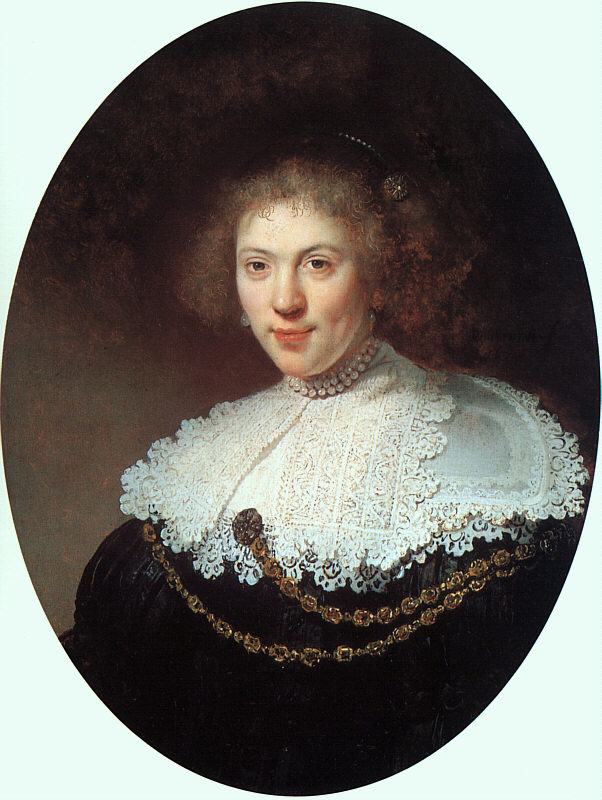
“Woman Wearing a Gold Chain” (1634) is one of Rembrandt’s most beguiling early portraits—a poised, half-smiling sitter suspended in a velvety oval of darkness, her face alive with breath and the faintest suggestion of thought. The painting’s apparent simplicity is deceptive. A soft cone of light isolates the woman’s features and the snow-white lace collar, while the rest of her costume dissolves into shadow save for a garland-like chain that drapes across the black bodice. Within this restrained arrangement Rembrandt stages a dazzling display of textures—skin, hair, lace, pearl, gold—and a psychological encounter that still feels intimate four centuries later. The canvas stands at the crossroads of his Leiden training and his newly confident Amsterdam career, combining careful finish with a bold, theatrical command of chiaroscuro.
Historical Moment and Purpose
The year 1634 is pivotal for Rembrandt. Recently settled in Amsterdam and newly married, he was entering circles of wealth and influence that demanded portraits both flattering and searching. Dutch society placed a premium on likeness and decorum; patrons wanted social presence as much as anatomy. “Woman Wearing a Gold Chain” answers that demand while quietly rewriting it. Instead of the rigid, frontal solemnity common in official likenesses, the artist gives a gentle three-quarter turn, a conversational nearness, and an atmosphere that suggests the sitter has just shifted her weight and looked up. The portrait likely commemorates status—marriageable wealth, fine lace, pearls—but it also announces Rembrandt’s ambition to make portraits that breathe.
The Question of Identity
The sitter has sometimes been associated with Saskia van Uylenburgh, Rembrandt’s bride in 1634, because of the date and the affectionate liveliness of the expression. Others regard her as an unknown Amsterdam gentlewoman or bride, portrayed in the fashionable costume of the period. Rembrandt’s portraits from these years often hover between individuality and type: the face is particular, the dress emblematic. Whatever her name, the painting constructs identity through visual signs—lace of high quality, pearls worn tight at the neck, an elaborate gold chain, and a coiffure that mixes soft curls with jeweled pins—marking her as prosperous, respectable, and very much of her time.
Composition and the Embrace of the Oval
Rembrandt chooses an oval format, a favorite device in the 1630s that functions like a window in a dark wall. The oval narrows peripheral distractions and encourages the viewer to circle the sitter with the eye, tracing the curve of her collar and the arc of her hair. The head sits slightly above center, creating space for the cascade of lace that becomes the portrait’s second protagonist. The shoulders are turned to the left while the gaze meets us from just off center, a classic baroque strategy for animating a still figure. The simplicity of the background is crucial; by refusing architectural props or landscape hints, Rembrandt commits all attention to the encounter between light and face.
Chiaroscuro and the Sculpting Power of Light
The lighting is high and soft, arriving as if from an unseen window and falling diagonally across the forehead, cheeks, and lace. The effect is sculptural. Planes of the face emerge in gradual, humane transitions rather than sharp partitions, allowing blush and warmth to carry emotion. Light takes on an ethical quality in Rembrandt’s portraits: it reveals character rather than merely outlining it. Here it also establishes hierarchy. The brightest entities—face and collar—become the twin centers of meaning, while hair, bodice, and background submit to respectful darkness. The gold chain gleams where the light glances off raised links and then retreats as the curve slides into shadow, a demonstration of how illumination can stage movement within stillness.
The Language of Costume
Seventeenth-century Dutch portraiture is inseparable from costume, and Rembrandt handles the sitter’s dress as a vocabulary of rank. The flat, spreading collar is an evolved alternative to the earlier millstone ruff, made of fine linen richly worked with bobbin lace. Its whiteness is not a generic white: cool, warm, and creamy passages are layered to suggest both laundering crispness and the faint translucency of cloth over cloth. The bodice is black—a fashionable and costly color in the Dutch Republic—and the sleeves carry a satiny gloss that reads as heavy, well-dyed fabric. The chain appears not as a single strand but as an ornamented garland pinned high at the shoulder and looping across the torso, its weight and ornament signaling wealth while its playful curve softens the severity of black.
Lace as Painterly Virtuosity
The lace collar deserves its own meditation. Rembrandt paints it not by drawing every thread, which would kill the illusion, but by alternating strokes of opaque lead white with semi-transparent scumbles and pinpricks of highlight. Voids are as important as paint: tiny reserves of ground create the perforated delicacy of bobbin lace. He calibrates focus, too. The lace nearest the face is most articulate; as the collar recedes toward the shoulder it relaxes into broader patterns. This optics-driven approach mimics how eyes truly see and prevents the collar from overwhelming the portrait. The result is a living lace that catches light, turns with the body, and frames the face like a halo of workmanship.
Pearls, Gold, and the Ethics of Display
Pearls nestle around the sitter’s neck and at her ear. They read as cool, milk-toned orbs that accept light without tossing it back harshly, perfect counterparts to the warmer gleam of gold. In the Dutch moral imagination, extravagant display was often suspect, yet portraits routinely recorded costly accessories. Rembrandt squares that circle by making jewelry serve character. The pearls dignify the throat and punctuate the line between face and collar; the chain rhythmically breaks the black expanse and leads the eye back to the countenance. Ornament becomes composition. It also becomes parable: precious materials reach their noblest function when they guide the gaze to a human presence rather than to themselves.
The Face and Its Psychology
What makes the painting unforgettable is the sitter’s expression. The mouth curves toward a smile, but not fully; it is the look of someone ready to speak or just amused, alert to company. The eyes are bright yet modestly lowered, a balance of individuality and decorum that seventeenth-century viewers would have applauded. Rembrandt paints minute coloristic variations in the cheeks and around the nose—warm pinks and honeyed half-shadows—that suggest circulation under skin. A narrow glisten along the lower eyelid conjures moisture, the spark that makes a face alive. Unlike the fixed, heroic visages of some contemporaries, this portrait gives us a person mid-thought, inviting reciprocity rather than awe.
Hair, Texture, and the Tactility of Paint
The hair frames the head in a soft aureole of curls, each suggested by broken, springy strokes. Rembrandt shifts between dry brush for flyaway wisps and richer, oily paint for denser locks, allowing texture to vary as it does in life. Jewelled pins enter as tiny constellations, small local highlights echoing the pearls. Throughout, he resists pedantic finish. Instead of linear description, he relies on deposits of tone, temperature, and gloss to communicate material truth. The viewer senses not only what things look like but how they might feel—the cool tooth of lace, the smooth roundness of pearls, the slight drag of a gold link over velvet.
Technique: Ground, Glazes, and Edges
In these years Rembrandt often built portraits over a warm ground. The warmth glows beneath translucent flesh passages, producing that “from within” illumination associated with his art. Thin, transparent brown layers define the background, while thicker, more opaque passages construct the highlights of face and collar. Edge control is meticulous. The contour of the head against the dark field is softened just enough to avoid cut-out sharpness, yet crisp enough to assert presence. The lace edge alternates crisp scallops with dissolving frays, mimicking both handcrafted irregularity and the way bright cloth bleeds into surrounding air. Such technical orchestration lets the portrait appear effortless, though it is anything but.
The Social Contract of Portraiture
Portraits in the Dutch Republic were social contracts: the sitter offered the fact of her person and station; the artist returned likeness enhanced by virtues the community prized—modesty, prosperity, self-command. Rembrandt honors that contract while expanding it. He records status without ostentation and captures modesty without dullness. The sitter is neither goddess nor mannequin. She is someone we might meet—dignified, alert, perhaps slightly amused by the day’s ritual of sitting. The portrait thus mediates between private life and public record, preserving a moment of mutual recognition between painter and sitter.
Comparison with Contemporaries
Compare this work with the crisply linear portraits of Frans Hals or the elegant, enamel-like finishes of Anthony van Dyck, and Rembrandt’s path becomes clear. He favors depth over sparkle, atmosphere over outline, and a sculptural approach to flesh that feels weightier and more interior. Hals catches movement with bravura brushwork; van Dyck elevates with aristocratic grace. Rembrandt seeks closeness and gravity. In “Woman Wearing a Gold Chain,” he uses luxury to frame personhood, not to eclipse it, a humane recalibration that would influence portraiture across the north.
The Oval Window and the Viewer’s Role
The oval does more than shape the picture; it shapes behavior. We lean in, as if peering through a porthole. The dark field acts almost like the inside of a camera obscura, making the illuminated face appear all the more immediate. Because the edges curve away, there is no corner to snag the eye; the viewer returns again and again to the face, then drifts along the lace to the glitter of the chain and back. The format therefore structures a kind of visual conversation, with the sitter at once enclosed and offered.
Symbolic Undercurrents
While Dutch portraits seldom overload overt symbolism, certain associations would have been legible. Pearls were linked to purity and prudence; lace to diligence and household economy, since even the wealthy cared that textiles represented proper management. Gold signified prosperity but, in its looped, garland form here, also suggests conviviality and celebration, perhaps hinting at a matrimonial occasion. The oval’s cameo-like presentation reinforces the sense of a precious, preserved likeness, a keepsake belonging as much to private affection as to public record.
Conservation Insights and the Life of the Surface
Paintings of this vintage often reveal, under examination, alterations in the lace or the placement of jewelry as the artist refined emphasis. Rembrandt was known to adjust costume to improve rhythm and balance, which helps explain the natural flow of the chain and the collar’s perfect alliance with the face. The surface today, with its alternation of satin and matte, whispers of historical varnishes and careful cleanings. Yet the essential harmony—a luminous face emerging from a velvety dark, punctuated by pearls and lace—remains robust, a testament to the artist’s layered method and his trust in warm grounds and resilient oil.
Legacy and Reception
This portrait exemplifies why Rembrandt’s work resonated so strongly with later centuries. It marries technical mastery to empathy, public elegance to private nearness. Nineteenth-century admirers praised his psychological truth; modern viewers praise the painterliness; collectors have long prized the oval portraits for their intimacy and decorative harmony. For students of Dutch culture, the painting is a lesson in how material prosperity and moral restraint could coexist, filtered through the temperament of a painter who cherished human presence above fashion.
Why the Painting Still Feels Contemporary
Strip away the historical costume and the portrait’s appeal is immediately recognizable. We meet a person at the moment of mutual attention, her expression open, her intelligence quietly at work. The painting offers not a mask but a conversation starter. Light does the courtesy of introduction; lace and gold announce the occasion; the face supplies the soul. In a digital age of flat images and instant impressions, the canvas rewards slow looking with increasing intimacy, reminding us that the deepest luxury a portrait can offer is time spent in the company of another human being.
Conclusion
“Woman Wearing a Gold Chain” is a triumph of balance. It honors the sitter’s social world with faithful costume and refined grace, yet never lets ornament outshine character. It demonstrates technical brilliance—luminous flesh, breathing lace, believable gold—yet subordinates every feat to the quiet drama of presence. The oval format enfolds the woman in a chamber of chiaroscuro where light touches her face as if it were a blessing. Across centuries, she meets our gaze with composure and a slight smile that suggests ongoing life beyond the frame. That is Rembrandt’s particular magic: to make paint feel like personhood, and to render status as the setting for a mind.