Image source: wikiart.org
Introduction
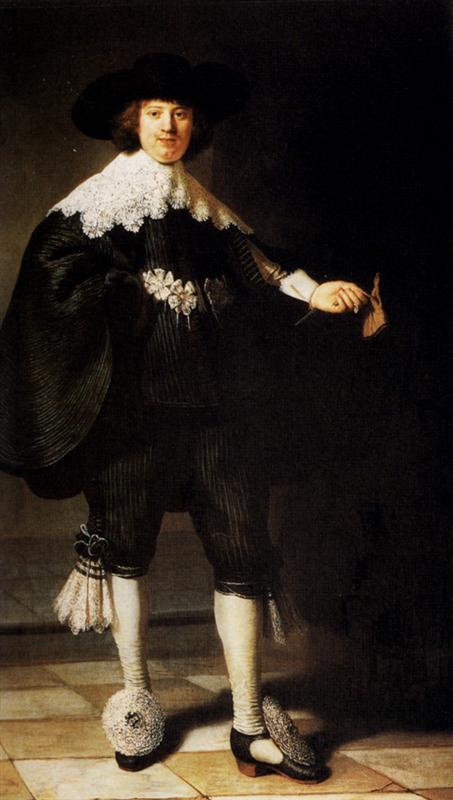
“Portrait of Maerten Soolmans” is among the most dazzling full-length portraits of the Dutch Golden Age, painted by Rembrandt in 1634, the year of the sitter’s marriage to Oopjen Coppit and the year the companion portrait was produced. The canvas showcases Rembrandt’s capacity to fuse ceremony with vitality, rendering social rank through costume and posture while allowing a convincing human presence to rise through the display. Maerten stands on a tiled floor, slightly turned, one gloved hand set jauntily at his hip and the other extending a glove as if caught mid-greeting. Black satin, lace, silvered trim, and immense rosette shoe ornaments proclaim wealth and fashion. Yet beyond finery, the portrait is a study in orchestration: a complex arrangement of textures, values, and rhythms designed to hold the eye and communicate character.
Historical Context
The year 1634 was a moment of accelerated ascent for Rembrandt, newly established in Amsterdam after formative years in Leiden. Full-length portraits were rare in Dutch civic culture, more typical of aristocratic traditions in Flanders, England, and Spain. That Maerten and Oopjen commissioned such grand images signals their ambition: they belonged to a prosperous mercantile world ready to represent itself with the scale previously reserved for nobility. Rembrandt, still in his twenties, seized the opportunity to demonstrate mastery in portraying materials, integrating the sitter into an architecturally convincing space, and controlling light across a large surface. The pair of portraits also cemented his reputation as a painter who could satisfy ceremonial expectations while delivering living likenesses.
The Pendant Logic
“Portrait of Maerten Soolmans” was conceived as a pendant to “Portrait of Oopjen Coppit.” Each figure occupies a similarly proportioned space and floor, turns inward toward the other, and projects a compatible level of finish and grandeur. The directional lighting matches; the tiled floors align; the palette balances black clothing with pale linen and warm flesh. Viewed together, the pair enact a visual conversation: Maerten’s forward gesture meets Oopjen’s reciprocal poise, suggesting the exchange of vows in pictorial form. The pendants are designed not only to be hung side by side but to complete each other thematically—wealth tempered by civility, fashion supported by dignity, individuality nested within marital union.
Composition and Pose
Rembrandt stages Maerten as if stepping into the viewer’s space. The slight advance of his right foot and the outward sweep of the black mantle create a sense of motion, while the contraposto tilt of hips and shoulders animates the figure. The left hand, placed confidently at the hip, grips the hilt of the sword hidden under the cloak; the right hand holds a glove lightly, a gesture equal parts courtly and casual. The brim of the hat forms a dark horizontal that stabilizes the head; the lace collar and cuffs act as bright punctuation; the rosette shoes anchor the lower field with almost theatrical bravura. The diagonals of cloak and arm counter the vertical of the body, producing a controlled dynamism suited to a young bridegroom eager to be seen.
The Stage of Space
The tiled pavement is more than backdrop; it is a perspectival platform that situates the sitter in believable depth. The veining and foreshortening of the tiles create a grid that marches into shadow, balancing the volumetric thrust of the figure. A warmly lit wall at left opens into darkness at right, shaping a subtle proscenium that frames Maerten without imprisoning him. Rembrandt keeps architectural details minimal so that the figure remains sovereign; the space breathes enough to feel real while maintaining the portrait’s ceremonial clarity.
Light as Architect
Light falls from the left and climbs Maerten’s figure in measured stages. It first pools on the tiled floor, then lifts the lace collar and cuffs into brilliance, touches the cheek with warmth, and grazes the satin ridges of the doublet and breeches. The black mantle receives a low luster, registering folds without sacrificing its depth. The rosette ornaments on the shoes exploit the light most spectacularly, their small metallic threads and loops erupting into scintillation that punctuates the bottom edge of the canvas. This progress of light from ground to face to ornament not only models form but narrates hierarchy: the face remains the center of human meaning even as finery sparkles.
The Symphony of Blacks
The painting is renowned for its handling of black. Rembrandt refuses to treat black as void; he tunes it across a broad spectrum. The cloak is a nocturne of satiny and matte passages; the doublet’s vertical ribs catch broken highlights; the breeches contain cooler blacks that recede; the hat is velvety and absorbent. These subtle differences allow the viewer to sense material changes and to feel the body beneath the clothing. Black becomes a field in which light can operate with extraordinary nuance, turning sobriety into richness.
Lace, Metal, and the Vocabulary of Detail
The lace collar spreads like frost across the throat and shoulders, each scallop indicated with a balance of description and abbreviation. Rembrandt resists mechanical counting; he marks key nodes of pattern and allows the viewer’s eye to complete the delicate filigree. Metal clasps, buttons, and a discreet sword hilt wink into visibility at strategic points, balancing the more diffused sheen of silk. The rosettes on the shoes—often remarked upon for their audacity—are not mere display; they serve as formal anchors and as echoes of the collar’s whiteness, knitting top and bottom halves of the composition.
Gesture and Social Signaling
Maerten’s gesture with the glove is a cultural sign, evoking readiness for polite encounter and perhaps a ceremonial introduction. Gloves could signify status and propriety; to hold one was to perform good breeding. The hand at the hip, by contrast, projects autonomy and a hint of swagger. The combination declares a complex self-image: a man of means and manners who is also at ease in his finery. Rembrandt does not exaggerate; the pose is lively without tipping into caricature.
The Face and Psychological Poise
Within the theatre of costume and posture, Rembrandt maintains the primacy of the face. Maerten’s features are youthful, the cheeks softly modeled, the mouth relaxed, the gaze steady and alert. The painter avoids hard edges around the eyes and blends flesh transitions tenderly, producing a presence that feels open rather than guarded. A slight ruddiness in the cheeks and a delicate highlight at the lower eyelid animate the likeness. This gentle humanity prevents the portrait from becoming a fashion plate; the person remains discoverable beneath the splendor.
Color Harmony
Although black dominates, the color scheme is not monochrome. Warm flesh, creamy lace, and the pale marble tiles set a key of ambered luminosity. Subtle greens and blues cool the shadows of the garments; warm browns temper the wall; tiny metallic notes in the rosettes and buttons sparkle like percussion. The palette avoids garish contrast; it prefers a refined harmony where color deepens rather than distracts. The tonal design—dark mass against pale accents—keeps the image legible from across a room, while close viewing rewards the discovery of small color shifts.
Brushwork and Surface
Rembrandt varies his touch to suit each material. The satin doublet is built from parallel strokes that ride the ribs of fabric; the cloak is laid with broader, more enveloping passages; the lace is picked out with small, crisp touches and reserved highlights; the flesh is woven from short, translucent strokes that leave a sense of living moisture. Even the floor records different pressures of the brush, with sharper edges near the front and more dissolved joints as space recedes. The surface remains active but not fussy, displaying confidence appropriate to a grand commission.
Fashion, Identity, and Ambition
Clothing in seventeenth-century Holland functioned as social text. Black signaled wealth and sobriety; lace and metallic accents signaled cosmopolitan taste; the scale of rosette shoes and the sweep of the mantle hinted at courtly aspiration. The portrait translates these codes without irony. Maerten is presented not as an abstract ideal but as a specific young man who invests in his image. Rembrandt’s task is to make that image credible. He does so by allowing finery to operate as a stage set on which personality can move, rather than as armor that seals it off.
The Ethics of Display
Grand portraits risk empty spectacle, but Rembrandt mediates that risk through honesty of light and a refusal of excess anecdote. There are no architectural columns or allegorical props; the tiled floor and plain wall suffice. The drama arises from how light meets texture and from how gesture opens the figure to the viewer. The painting thereby aligns with a broader Dutch ethic that prized prosperity tempered by restraint. It is luxurious, but its luxury is pictorial rather than propagandistic—located in the act of painting as much as in the things painted.
Relationship to Other Full-Lengths
Rembrandt did not often paint full-length single figures; commissions of this scale were expensive and logistically demanding. In the few instances where he did—most notably with this pendant pair—he adapts international portrait conventions to Dutch tastes. Compared with Flemish examples by Van Dyck, Rembrandt’s figures are grounded rather than ethereal; their weight is felt through floor and fabric. Compared with Spanish court portraits, which often emphasize impenetrable decorum, Maerten appears approachable. The synthesis is distinctly Rembrandtian: grandeur framed by the physics of light and the psychology of encounter.
Tactile Narratives
Every surface in the painting tells a tactile story. The glove in Maerten’s hand feels supple and thin, capable of folding into a pocket; the lace collar is crisp, almost audible in its starch; the mantle’s satin suggests coolness to the touch; the marble tiles carry faint sheen where light skims them. These tactile cues transform viewing into a form of imagined contact, further humanizing the grand scale. Rembrandt’s accuracy never becomes pedantic because it is in service of sensorial persuasion.
Time, Motion, and the Instant
Despite the stillness inherent in portraiture, the painting implies an instant: a step forward, a pivot of the torso, a glance caught as the sitter prepares to greet. The lifted glove is mid-gesture; the cloak seems to have just swung. This suggestion of time gives the portrait a cinematic energy unusual for the period. It also refines the sitter’s identity: Maerten is not frozen; he is socially active, poised to participate in the world beyond the edge of the canvas.
The Floor as Moral Ground
The tiled pavement carries ethical resonance. Its order and cleanliness mirror civic values prized in Amsterdam households: clarity, geometry, and steadiness. Standing squarely upon it, Maerten appears founded on the virtues of the home and the city, even as his attire aspires to aristocratic display. Rembrandt’s decision to emphasize the floor’s geometry reins in the portrait’s flamboyance and roots it in Dutch domestic space.
The Interplay of Youth and Ceremony
The portrait’s charm lies partly in the tension between youthful softness and ceremonial grandeur. Maerten’s face is that of a young man still rounding into maturity, while his clothes claim a fully formed status. Rembrandt captures this tension with kindness. He lets the costume sing but ensures that the face remains gentle, preventing any hint of arrogance. The painting reads as an image of promise—of a life stepping forward into public significance.
Conservation and Patina
Over time, the blacks have mellowed, the whites of the lace have warmed, and the overall harmony has deepened. Such patina suits a portrait built on refined tonal contrasts; it fuses the materials into an even richer chord. The surviving surface reveals Rembrandt’s original bravura and planning: pentimenti in cloak edges, subtle adjustments in hand placement, and layered glazes in the satin reflect a painter thinking on the canvas, not merely filling a template.
Legacy and Reception
“Portrait of Maerten Soolmans” has long fascinated viewers for its combination of Dutch sobriety and international glamour. It exemplifies how portraiture can serve as both social document and high art. For Rembrandt’s career, it stands as evidence that even in the idiom of courtly display he could remain fundamentally himself: a painter of light, texture, and true presence. For contemporary audiences, the image still feels legible—its codes of wealth, taste, and youthful confidence understandable across centuries because they are framed by the universals of human bearing and honest observation.
Conclusion
“Portrait of Maerten Soolmans” is a triumph of balance. It harmonizes ambition with restraint, ceremony with motion, surface splendor with psychological quiet. Rembrandt builds a stage from light and space, populates it with the most eloquent blacks and the crispest whites, and sets a young man before us who is richly dressed yet convincingly alive. As part of a pendant pair commemorating marriage, it celebrates union; as a standalone work, it exemplifies the painter’s early mastery. The portrait remains compelling not because of its finery alone but because of the intelligence with which paint becomes fabric, light becomes character, and display becomes a form of truth.