Image source: wikiart.org
Introduction
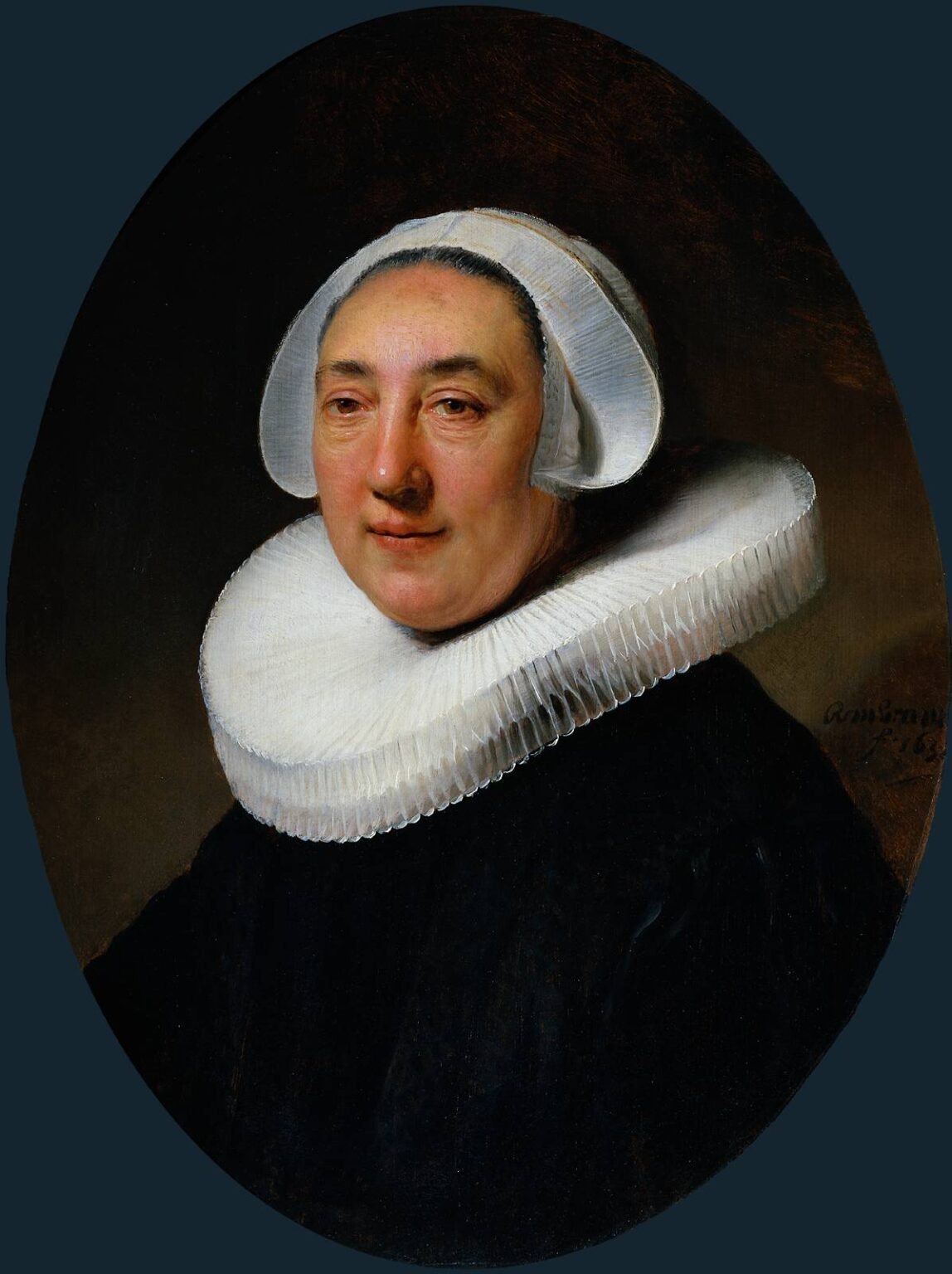
“Portrait of Haesje van Cleyburgh” is among the most refined portraits from Rembrandt’s early Amsterdam period, painted in 1634, when he was in his late twenties and newly famous for rendering personality with astonishing directness. The image is an oval, half-length likeness of a woman in sober black with an immaculate white cap and ruff. Light glides across the ruff’s pleats, grazes the sitter’s cheeks, and dissolves into a quiet, brownish ground. The composition is simple, almost austere, yet the economy is deceptive: within the bare setting Rembrandt orchestrates a drama of materials—linen, skin, and shadow—and a drama of inwardness that still feels intimate and contemporary. The portrait announces not only the sitter’s social standing but also the painter’s command of nuance, rhythm, and psychological tact.
Historical Context
The year 1634 sits near the beginning of Rembrandt’s Amsterdam career, a moment when commercial prosperity and Calvinist sobriety shaped the city’s taste. Portraits of merchants and their families favored restraint: black clothing, white linen, and a calm level of decorum. These conventions could become stale in lesser hands. Rembrandt, however, turned them into a living language. He refined black into a spectrum of tones, treated linen as a luminous architecture, and positioned faces within a chamber of gentle light that allowed mood to breathe. In this portrait, he honors social codes without surrendering to formula, presenting a sitter whose dignity rests upon observation rather than ornament.
The Sitter and Identity
Haesje van Cleyburgh appears without jewelry or overt heraldry, and yet her identity is vividly legible. Her clothing speaks the vocabulary of respectable Dutch womanhood—modest, clean, precisely tended—while the expression suggests steadiness and humane intelligence. The mouth holds a delicate softness at the corners, the eyelids are modeled with sympathetic care, and the gentle turn of the head creates a conversational angle. Rembrandt rejects theatrical sentiment. He does not press the sitter into a type; he lets a particular person emerge within the frame of propriety.
The Oval Format and Its Effects
The portrait’s oval support shapes the viewer’s experience in subtle but decisive ways. The curve encloses the sitter like a lens, narrowing attention to the head and ruff while trimming extraneous space. Ovals are hospitable to faces—there are no corners to snag the eye—so the gaze circulates smoothly along the cap, the cheek, and the ruff’s ring. Rembrandt seats the head slightly high within the shape, granting air above the cap and a broader field for the ruff to unfurl. The result is calm concentration: the figure is not hemmed in but gently held, as if the format itself were a breath the picture takes and sustains.
Light as the Main Character
Rembrandt’s light in 1634 tends toward clarity rather than the later, smokier atmospheres. Here it falls from the left, a tender beam that clarifies form without spectacle. The forehead receives a cool wash; the cheekbones and bridge of the nose capture a warmer note; the upper lip and tip of the chin are barely touched, avoiding glare. The cap’s gauzy wings catch translucent highlights that confirm their diaphanous weave. Most astonishing is the ruff, whose pleats are tuned like a musical scale—cool in shadow, pearly at the turning edge, and brighter where each pleat’s ridge meets the light. Light is not a spotlight but a narrator: it tells the truth of surfaces while suggesting a temperament of composure.
Color and Tonal Discipline
The palette is beautifully restrained. Blacks in the dress are deep but never dead; they carry faint greenish and blue undertones that enliven the shadow. The ground is a quiet brown, subtly modulated to prevent flatness. Whites in the linen move across a range from leaden gray through pearl to bright ivory. Flesh tones are built from warm ochres and cooler pinks with a hint of blue around the jawline, creating the illusion of circulating blood under skin. Rembrandt’s limited color only increases sensitivity to temperature changes, so that a small bit of warmth at the cheek or a cool glimmer along the ruff becomes expressive, even eloquent.
The Architecture of Linen
The ruff is a triumph of controlled exuberance. Each pleat is indicated with small, confident strokes, more suggested than counted, giving the collar firmness without mechanical repetition. Where the ruff turns around the neck, the rhythm accelerates, like music moving to a refrain; where it recedes into shadow, the intervals widen and soften. The cap, in contrast, is a study in translucency: a fine mesh of white that holds the head gently and frames the face with modesty rather than constraint. Together, ruff and cap form a double halo—one crisp, one gauzy—through which Rembrandt stages the encounter between public role and private presence.
Modeling of the Face
Rembrandt constructs faces as if modeling clay with light. Observe the delicacy around the eye sockets: the upper lids are slightly heavy, producing a shadow that meets, but does not swallow, the glint on the moist lower lid. The nose turns gracefully, its lit ridge and shaded flank making a hinge where the head turns away. The mouth is marvelously poised—neither strict nor smiling—its softness secured by a gentle, warm glaze. The fullness beneath the chin is described with tact; rather than drawing a hard line, he shifts temperature and value to imply that soft flesh rests upon the ruff’s crisp edge. The overall effect is empathy rendered as accurate form.
Composition and Balance
The sitter is turned three-quarters toward the light, creating a diagonal movement from lower right to upper left. This movement is countered by the ruff’s circular thrust and the cap’s raised wing, which returns the eye to the face. Rembrandt leaves the costume below the collar barely indicated; the absence of detail there is strategic. It sets up a quiet triangle of dark that supports the brilliant ellipse of linen, which in turn supports the head. The portrait balances weight and buoyancy: the dress is gravity, the ruff is architecture, and the face is the living apex.
The Background as Atmosphere
The background is neither wall nor void; it is a softly breathing atmosphere. Rembrandt modulates it from a warmer brown near the right edge to a cooler gray toward the left, where the light source resides. This gradient creates depth without insisting on a specific interior. The sitter appears situated but not trapped, present but timeless. The background is also the stage on which edges dissolve or sharpen—a soft merge along the cheek’s contour, a crisp parting at the ruff’s lower rim—so that space feels both enveloping and articulate.
Brushwork and Surface
Close study reveals brushwork that alternates finesse with freedom. The ruff contains tiny, vertical touches that mimic starch-stiff pleats, while the cap’s edges are feathered wet-into-wet to catch translucency. Flesh is knit from small strokes whose directions change with the turning forms, so that brushwork becomes anatomy. In the black dress, Rembrandt is looser; he floats thin layers over a dark ground, allowing the pigment beneath to breathe upward and suggest volume without explicit detailing. The surface remains lively at every scale—a hallmark of the young painter’s confidence and a guarantee that the painting rewards both distant and intimate viewing.
Psychological Nearness
What first feels calm soon reads as intimate. The sitter’s gaze meets the viewer with gentle steadiness, unconcerned with display. The slight parting of the lips and the softened set of the jaw hint at an inwardness that is neither stern nor sentimental. Rembrandt has learned how to let small asymmetries suggest life—the marginally higher eyelid on the illuminated side, the tiny shift in the line of the mouth, the faint deepening at the nasolabial fold. These subtleties persuade us that we are in the company of a person, not a symbol.
The Language of Modesty and Status
Dutch portraiture of the period deploys clothing as moral language: black announces temperance, white linen signals cleanliness and domestic order, covered hair proclaims modesty. In this portrait, those codes are not mere costume. The ruff’s disciplined geometry feels like a visual analogue to conscientious living, while the cap’s softness suggests tenderness within restraint. The absence of jewelry does not deny wealth; it recasts wealth as good stewardship. Rembrandt plays the dialectic between social ideal and individual presence so gracefully that the sitter’s character appears to grow from her attire rather than be smothered by it.
Comparison with Contemporary Works
Seen alongside Rembrandt’s other portraits from 1634, this painting registers both kinship and distinction. It shares with them the luminous handling of white linen, the warm-brown atmospheric ground, and the deft modulation of flesh. Yet the present work is unusually serene. Where some portraits from that year heighten drama with deeper shadows and sharper contrasts, “Portrait of Haesje van Cleyburgh” prefers equilibrium. The light is measured, the modeling unhurried, and the mood reflective. It anticipates the painter’s later, more introspective portraits while retaining the early period’s clarity.
The Ethics of Attention
Rembrandt’s true innovation is not a trick of technique but a kind of ethics. He looks at faces with patience, neither flattering nor exposing, and allows the viewer to practice that patience too. The painting’s quietness is an invitation to slow looking: to watch how the highlight on the lower eyelid is just bright enough to moisten the gaze; how the cap’s inner hem turns cool where it meets shadow; how the ruff’s pleats, rather than being counted, are felt as a rhythm that tightens and releases around the neck. To linger with such details is to share the painter’s respect for another person’s presence.
Material Meaning
Every material carries symbolic weight. Linen, with its crisp order, stands for discipline and care; black cloth, with its absorption of light, stands for gravity and permanence; flesh, with its subtle color, stands for life’s passing warmth. Rembrandt neither overstates nor evades these meanings. He lets the materials speak through paint and trusts the viewer to read their inflections. This humility—this willingness to allow objects their quiet eloquence—keeps the portrait from feeling programmatic. It breathes.
Aging and Compassion
The sitter’s age is represented without apology. The fullness around the jaw, the mild puffiness under the eyes, the delicate web at the corner of the mouth—these are transcribed with affection rather than emphasis. Age here is not a theme but a condition of being, rendered with the same truthfulness as linen or shadow. The portrait thus holds a paradoxical power: it is both a document of a particular life stage and a timeless meditation on the beauty of accuracy.
The Signature and Date
In the lower right, Rembrandt signs and dates the work, a customary guarantee of authorship that also signals confidence. At this early peak, he had already aligned meticulous craft with a unique sense of human presence. The inscription anchors the painting in 1634 while the sitter’s bearing lifts it beyond a single year, into the broader arc of Dutch civic identity and into the perennial human desire to be seen clearly.
The Experience of Scale and Viewing
Although the oval tends toward intimacy, the portrait commands space. The ruff widens the field around the head, and the black dress drops into a gravity that makes the sitter feel solidly there. Viewed at appropriate distance, the whites knit into a single, hovering aura; at close range, the brushstrokes separate into crisp slivers and soft veils. The painting is constructed to satisfy both readings, a structural generosity that accounts for its enduring appeal in galleries where viewers drift between macro-impressions and micro-discoveries.
Legacy and Enduring Appeal
What keeps this portrait alive is not a single feature but the interdependence of many: the oval’s embrace, the orchestration of linen and flesh, the harmonious austerity of the palette, and the ethical steadiness of Rembrandt’s gaze. It is a portrait that respects the sitter’s social world while letting an individual flicker through. It teaches a way of looking—quiet, attentive, humane—that answers the rush of contemporary experience with a persuasive counterexample: slowness as illumination.
Conclusion
“Portrait of Haesje van Cleyburgh” demonstrates how Rembrandt could distill character from the most disciplined means. The sitter’s presence emerges from an interplay of light and restraint, precision and atmosphere. The ruff’s architecture, the cap’s translucency, and the softly modeled face collaborate to stage a meeting between viewer and person that feels both ceremonial and personal. Painted in a culture that prized sobriety, the portrait finds radiance in honesty. Its beauty lies not in ornament but in attention—attention to fabric, to skin, to the soft pulse of life that moves just beneath the surface of things.