Image source: wikiart.org
Rembrandt’s “Flora” (1634): A Garden Made of Light, Fabric, and Memory
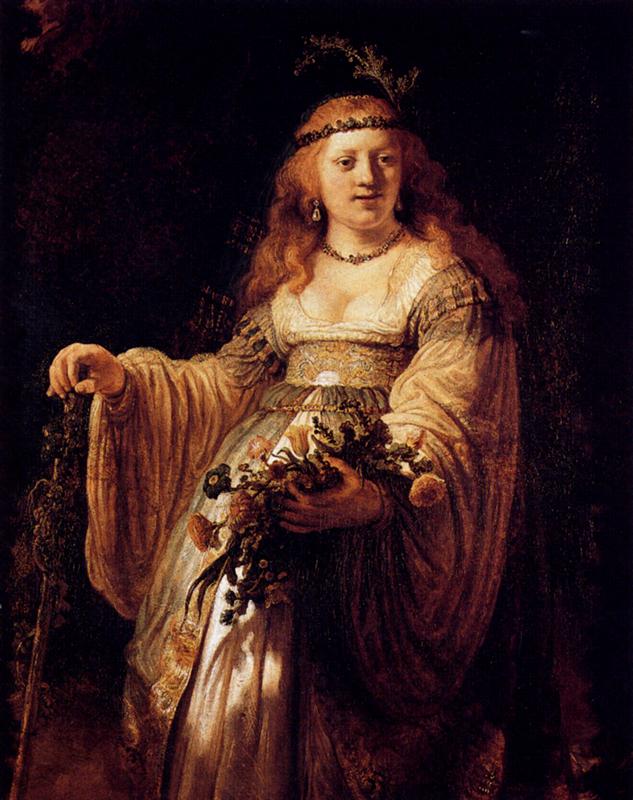
Rembrandt’s “Flora” of 1634 is one of those rare paintings that feels like a room warming as you enter it. A young woman stands in three-quarter view, her body softly turned toward us, dressed in an opulent costume that glows as if the very threads were spun from sunlight. In her left hand she loosely holds a staff or garlanded shepherd’s crook; in her right, a small bouquet and trailing sprigs of greenery tumble forward. Her gaze is steady, curious, and welcoming rather than grand. The title identifies her as Flora, the Roman goddess of spring and flowering, yet what Rembrandt gives us is not a marble deity but a living person inhabiting the role with ease. He folds mythology, portraiture, and still life into one image and binds them together with a chiaroscuro that turns pollen into paint.
A Likeness Wearing a Myth
By the early 1630s Rembrandt was experimenting with portraits disguised as allegorical or mythological figures. “Flora” is among the most persuasive results. Many historians recognize the model as Saskia van Uylenburgh, the artist’s future wife, whom he married later that same year. Whether or not Saskia posed for this specific canvas, Rembrandt clearly treats Flora not as a distant antique ideal but as a contemporary woman dressed for a pageant or procession. This choice matters. The goddess is not an abstraction; she is a person whose breath rounds the fabric at her chest and whose fingers actually weigh the stems she carries. Where other painters translated Flora into a cool emblem of fertility, Rembrandt warms her into someone you might meet in a doorway on a sunlit afternoon.
Composition That Moves Like a Garland
The figure fills the vertical format, yet nothing feels cramped. The painting’s movement is a gentle S-curve that starts with the floral circlet in the subject’s hair, flows through her tilted head and shoulders, and continues down through the bouquet to the hem of the gown. The left arm opens outward, the hand resting lightly on the garlanded staff so the pose breathes rather than stiffens. The right arm returns inward with the flowers, completing a circular rhythm reminiscent of wreath-making. Because these motions are slow and rounded, the eye circulates through the figure as if following a vine, discovering new petals of detail with each pass.
Chiaroscuro as Season and Stage
Rembrandt’s light here is theatrical and tender at once. It falls from the left, bathing face, chest, and the upper swell of the sleeves, then slides down the satin skirt to catch on embroidered trims and seed-like beads. Behind, the dark ground is neither empty nor dead; it is the damp soil of a garden at dusk. That darkness lets the warmed flesh tones and pale blues read vividly, yet it never overwhelms the softness of the model’s expression. In “Flora,” chiaroscuro is not about violent contrast; it is a climate. We feel spring sunshine touching a shaded grove, with the figure blooming at the boundary.
Color That Breathes Like Petals
The palette is a slow chord of honeyed golds, fleshy peaches, creamy whites, and mossy greens, crossed by a cool, silvery blue in the skirt. These colors do two kinds of work. First, they build the illusion of weight and texture—silk that catches, velvet that drinks, lace that floats. Second, they carry symbolic warmth. Flora’s season is spring moving toward summer; Rembrandt mirrors that with colors that ripen rather than shout. Notice how the blue satin, a cooler note, pools downward and steadies the composition, while the warm sleeves roll and billow like clouds at sunset. Even the shadows carry reflected color, a reminder that in Rembrandt’s world darkness is still full of light.
The Costume as Living Landscape
Rembrandt paints clothing as if it were its own terrain. The sleeves are broad meadows of light punctuated by tiny topographies of pleats; the bodice trims form a border of vines; the sash glints like a narrow stream. Nothing is flat. Within the lace and borders you sense the painter’s small, exact touches of impasto, where highlights ride just a hair above the surface of the canvas. Those thicker strokes lend brilliance to pearls and brooches, while more transparent glazes open the depths of shadow. He puts the vocabulary of still-life painting at the service of portraiture, so the costume functions like a blossoming field around the person.
Hands That Explain the Role
Flora’s hands tell the story as clearly as her headband of greens. Her left hand rests with loose authority on the staff, not gripping it as a weapon but steadying it like a garden tool or ceremonial emblem. The right hand cups the bouquet, fingers curved slightly upward so that the stems naturally drape and the blossoms face out. The hands are not mannered; they are practical. They make you believe she could distribute posies or bind a garland at any moment. Because Rembrandt is meticulous about knuckle, nail, and the slight stretch of skin across tendons, the goddess’s identity feels enacted rather than announced.
Flowers as Narrative, Not Decoration
Rembrandt knew flowers were a Dutch passion and a painter’s challenge. Here he uses them sparingly and purposefully. The bouquet is modest—no encyclopedic parade of species—but within it you feel the mix of bud and bloom, leaf and seed. The scattered blossoms that dangle from the gathered bunch hint at Flora’s power to propagate, to sprinkle life wherever she walks. He paints stems and petals with deft, broken touches, so the bouquet reads like a living thing, not a catalog entry. Crucially, the flowers rhyme with flourishes elsewhere: the lace motifs, the curling hair, the embroidery. The painting behaves like flora in more ways than one.
The Psychology of a Soft Gaze
Rembrandt refuses to give Flora a courtly stiffness. Her expression blends playfulness with composure. The head tilts slightly, and the mouth relaxes, as if she has just been praised for the elegance of her costume and acknowledges it with wry pleasure. She is neither coy nor stern. The mood is that of a young woman temporarily inhabiting a role she enjoys. That psychological plausibility grounds the myth; you meet a person first and a goddess second, which is why the illusion works.
Portrait Historié and the Amsterdam Stage
In Amsterdam of the 1630s, citizens delighted in masquerades, allegorical pageants, and portrait historié—the fashion of having oneself portrayed as a figure from history or myth. “Flora” belongs to that culture, but Rembrandt elevates the convention. Where some portrait historié pictures show sitters simply wearing exotic props, Rembrandt designs a costume whose forms, colors, and textures embody the theme from head to hem. Even the composition participates: the full figure presses forward from darkness like a flower emerging from shade into morning.
A Conversation with Titian and the Venetians
Rembrandt almost certainly knew of Italian images of Flora, especially Titian’s famous half-length beauty with loosened chemise and fistful of flowers. He borrows the idea of a sensuous yet dignified goddess but sends it through a Northern filter. Instead of the warm Venetian atmosphere and soft dissolves at the contour, Rembrandt offers tactile textures, sculpted light, and a sturdier, more architectural costume. The result is not a copy, but a debate: Rembrandt shows that North Sea light and Dutch cloth can make a myth every bit as persuasive as Mediterranean glow.
Brushwork You Can Feel at Two Distances
At a few paces, the painting reads as a single, blooming form. Up close, it breaks into lively marks. The hair is constructed with looping, flame-like strokes and warm glazes that sink into the underpaint, while the gleaming pearls are minute points of thick paint that catch incident light. The satin’s sheen comes from long, loaded strokes dragged across a darker base; the velvet’s depth comes from scumbled passages that blur into shadow. The bouquet is a flurry of calligraphic dabs, each suggesting a petal without drawing one petal by petal. This dual readability—coherent from afar, thrilling up close—is one reason Rembrandt’s surfaces feel alive.
The Body As Source, Not Spectacle
Flora’s bodice feels frank but unexploitive. Rembrandt acknowledges the body’s warmth and weight while resisting theatrical display. The neckline opens to admit light, but the figure’s authority resides in her posture, hands, and steadiness of gaze. This balance between sensual presence and moral poise is a hallmark of the painter’s best portraits and keeps the image from sliding into mere costume piece.
The Dark That Protects the Light
The background is almost entirely swallowed by a rich, warm darkness, broken only by a faint suggestion of foliage. That dark accomplishes several things at once. It acts as a velvet case for the luminous figure. It silences any competing narrative so the viewer’s attention doesn’t drift to secondary anecdotes. And it lets the smallest highlights register with extraordinary force: a glint on a pearl, a bright vein in a petal, a touch along the knuckles. In Rembrandt’s hands, shadow is not absence but shelter.
The Year 1634 and a Painter in Full Bloom
The date 1634 places the work in Rembrandt’s first flush of Amsterdam success. He was twenty-eight, recently connected to a circle of prosperous patrons, and soon to wed Saskia. The canvas radiates that confidence. It is daring in scale, rich in surface, and assured in its storytelling. Yet it also whispers. The brush never shouts for attention; it simply lets light collect where affection for the subject is greatest. You sense a painter delighting in the act of honoring someone he loves, whether as model, muse, or imagined goddess of the city’s spring.
Reading the Symbolic Garden
As goddess of blossoming, Flora stands for renewal, fertility, and gentle abundance. Rembrandt tucks those ideas into the painting without pedantry. The leafy circlet reads like living laurel. The staff, garlanded and perhaps once a pruning branch, suggests cultivation rather than conquest. The bouquet, modest and mixed, hints at variety and the continuity of seasons. Even the satin’s cool blue could be read as the fresh morning after rain. Nothing is forced, yet everything harmonizes with the idea of spring understood as patient, humanly tended growth.
How the Painting Works on the Viewer
The experience of looking is cyclical, like the growing season. The eye lands first on the illuminated face, then moves down the cascade of sleeve to the bouquet, across the skirt’s glimmering plane, and back up the staff to the headband’s small leaves. With each circuit, more textures and transitions appear. The painting keeps giving because Rembrandt designed no single, climactic revelation; instead, he composed a round dance of discoveries. That circularity is why the picture remains as fresh on the tenth viewing as on the first.
Modern Resonances in an Early-Modern Goddess
“Flora” remains contemporary wherever people negotiate the balance between self-presentation and selfhood. A person tries on a role and becomes, for an evening, a version of a goddess. The pleasure is real; the person remains. The painting respects that play and makes it meaningful. In a time when images can flatten individuals into types, Rembrandt’s Flora insists on specificity—on the micro-expressions of the mouth, the subtle pinch of fingers around stems, the slight forward lean that invites conversation. She is emblem and individual at once.
Closing Reflection: A Bloom That Doesn’t Fade
In “Flora,” Rembrandt cultivates light like a gardener and lets paint behave like petals, silk, and skin. The results are tender and persuasive. You do not need to know Roman myth to feel the rightness of her presence; you need only stand before the painting long enough to let your eyes adjust to its climate. Then the goddess steps forward as a young woman fluent in spring, and the studio becomes a garden where time briefly flowers.