Image source: wikiart.org
First Encounter With Flight And Refusal
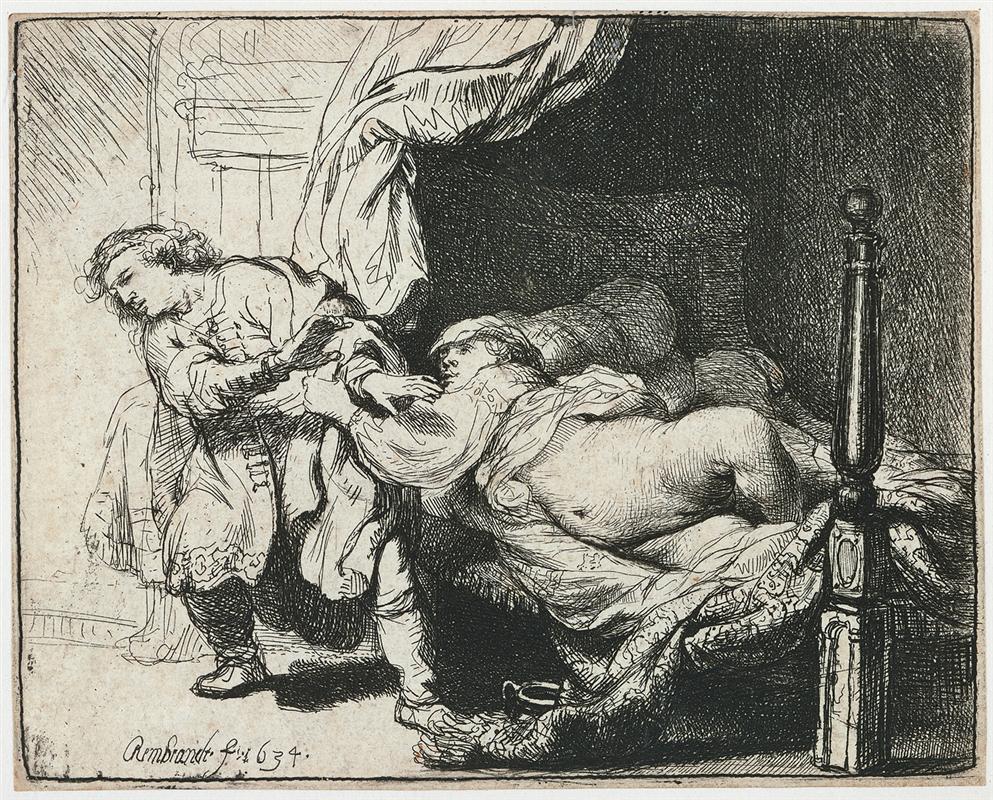
Rembrandt’s 1634 “Joseph and Potiphar’s Wife” condenses a charged biblical episode into a single, explosive instant: a young Hebrew servant twists away from his master’s wife as she grabs his garment and lunges from the edge of a bed. The scene takes place in a private chamber whose heavy canopy and carved bedpost act like stage scenery, focusing attention on the collision of bodies at center left. With a few square inches of etched copper, Rembrandt builds a room dense with air, fabric, and consequence. The drama is kinetic—Joseph’s foot pushes off the floor, the woman’s grip tightens, sheets churn beneath her—but the meaning is crystalline: this is a picture of refusal, witnessed by a bed that will soon be used as evidence.
A Composition Anchored By Diagonals And Barriers
The etching’s scaffolding is architectural, but its energy is diagonal. The bed runs from right to left, filling almost half the image with dark crosshatching, while the canopy drops like a curtain over the mattress. Against this horizontal mass, Joseph’s body cuts upward and outward, his torso twisting in a reverse S that carries the eye to the left margin. Potiphar’s wife counters him with a lunging diagonal, hands clawing at his sleeve. The massive bedpost on the right acts as a visual barricade, pinning the scene to the ground and marking the space as private. Because the diagonals fight and the verticals hold, tension never dissipates. The viewer experiences escape as a problem of geometry solved at the speed of desire.
The Story In A Glance
Genesis recounts how Joseph, a slave in Potiphar’s house, earns trust through diligence, only to be pursued by his master’s wife. When she seizes his garment and says, “Lie with me,” he flees, leaving the garment behind; she later uses it to accuse him falsely. Rembrandt chooses the pivot, not the aftermath. He wants our eye to feel the decision in muscle and cloth. The choice avoids moralizing; it delivers ethics in anatomy and motion.
Etching As Theater Of Touch
Rembrandt’s etching needle is a choreographer of contact. The tight, knotted hatching around the woman’s gripping fingers intensifies the pressure on Joseph’s sleeve. The paler, nearly unworked flesh of her stretched torso contrasts with the dark churn of bed linens so that we sense skin slipping on fabric. Joseph’s sleeve, drawn back by force, forms a taut triangle that captures the physics of resistance. Even the floor receives attention—short, dark strokes pool beneath Joseph’s foot, announcing weight and speed. Without a single caption, the lines tell us exactly what the hands are doing.
Chiaroscuro That Thinks Morally
Light in this print is not neutral illumination. It is a judge. Joseph’s face and chest receive the clearest light, as if truth has found him. Potiphar’s wife lies half occluded beneath the canopy’s shadow, her face modeled but embedded in darkness. The bed itself is a dense block of tone, a low thundercloud of crosshatching that throws the white of Joseph’s shirt into relief. Rembrandt’s value structure guides not only attention but sympathy: we feel the cost of resistance in the bright clarity of Joseph’s exposed body and the danger of temptation in the enveloping dark.
Bodies Made Credible By Strain
No one in this picture is static. Joseph’s shoulder yanks, the hip rotates, the knee flexes; the line at his jaw tightens as he leans away. Potiphar’s wife twists to follow him, one knee buried in the mattress, abdomen tensing as she stretches. Her gesture is not coy; it is predatory. The frankness of the pose, the open mouth, and the grasping hands banish the sentimental. Rembrandt paints desire as force and shows virtue as flight, not discourse. Because the bodies are persuasive, the moral is felt rather than proclaimed.
A Room That Compels Secrecy
Rembrandt details the chamber enough to make it real but not so much that the eye strays. The carved bedpost, the churned-up patterned coverlet, the heavy canopy, and the faint lines of a high window or wall hanging give the space depth and texture. These fixtures also imply privacy and power: this is a wealthy woman’s room, secured from servants’ eyes. The setting sharpens the stakes; Joseph is not merely escaping contact but a trap that could end his career or life. When the print later shows the garment left behind, we already know how its presence will read in such a room.
The Garment As Narrative Fuse
The grip on the sleeve is the print’s hinge. The fabric binds plot and motion: it is the tether that will soon become evidence. Rembrandt renders the sleeve with elastic line, deeper where it bites under her fingers, lighter where it begins to slip. You can almost hear the stutter of threads under strain. The viewer anticipates the next second—the sleeve tearing free, the garment staying behind—and understands how the truth of refusal will be rewritten as proof of guilt.
Gendered Power And The Politics Of Accusation
The etching does not exonerate men or demonize women in the abstract; it studies a particular imbalance. Potiphar’s wife acts from the security of status and space; Joseph’s safety depends on speed and distance. The moment captures a perverse inversion: the powerful pursues, the powerless obeys the ethic that endangers him. When she later speaks, the household will hear rank, not truth. Rembrandt’s room is therefore also a courtroom in embryo, and his lines predict how quickly a story can be made to lie.
Drapery As Engine Of Drama
The heaped blanket is not mere backdrop. Its rolling, patterned surface magnifies the bed’s presence and makes the woman’s lunge feel surf-like, a swell rising to swallow Joseph. The canopy above pushes forward like a wave about to crash, while a dangling tassel and looping cord echo the tangle of arms below. Rembrandt always understands fabric as action; here, textiles behave like accomplices. Their weight makes the room heavy with intent.
The Etcher’s Vocabulary Of Speed
One of Rembrandt’s gifts in printmaking is his ability to make the needle move at different speeds across copper. Fast, long strokes describe the canopy, as if the pen itself were slipping over cloth. Short, compressed strokes create the bed’s dark core. Quick parallel hatches snap across Joseph’s leggings to suggest motion blur. In a medium that freezes time, he invents motion cues that make the eye feel the instant passing.
Hands As Litany Of States
Track the hands and you read a sequence of psychological states: the woman’s clawing insistence, Joseph’s restrained countergrip that peels her fingers away, the free left hand that braces against the bed for leverage, the absent hands of any witnesses. Rembrandt paints innocence as work—each finger must act correctly; each grip must be measured enough to break free without striking. There is nothing passive about Joseph’s virtue; it is physical prudence inside danger.
The Face As Weather Vane
Joseph’s face turns away, eyebrows pitched in a mixture of alarm and resolve. His mouth is set; no speech will help him here. Potiphar’s wife’s features are more ambiguous—a mix of impatience, frustration, and predatory focus. Rembrandt keeps enough ambiguity for the viewer to project motive but clears away any possibility that this is playful. The tilt of each head, small as it is, sets the moral wind’s direction.
Cropping And The Ethics Of Closeness
The image is cropped tight, especially at the left where Joseph’s flight is almost pinched by the plate’s edge. This claustrophobia increases urgency; there is nowhere to go but out. At the right, the solid bedpost seals the space like a gate. We stand too close for comfort, practically in the arc of Joseph’s exit, forced to feel the physicality of escape rather than watch from the safety of scenic distance. The print makes complicity impossible; our eyes are in the room, and the room is small.
Comparison With Other Versions And With Tradition
Artists before Rembrandt often chose the aftermath—Potiphar’s wife holding the garment aloft before her husband, the lie in full speech. Others eroticized the encounter, fettering the moral with spectacle. Rembrandt’s 1634 etching steps back to the hinge. He rejects the idealized nude and comic coyness, favoring truthful anatomy, credible furniture, and the tempo of a real crisis. By doing so, he renews an old subject: the image works on modern nerves without any explanatory text.
Light That Moves Like Conscience
Note how light shapes a path from Joseph’s illuminated shirt and face across the woman’s pale torso to the gleam on the bedpost. This zigzag guides the eye through the moral topography of the scene: the refusing person, the grasping act, the object that will harden into testimony. Shadow, meanwhile, functions as secrecy, pooling in the bed’s hollow and in the canopy’s underbelly. Conscience travels in light; the lie prepares itself in dark.
The Plate As A Study In Texture
Rembrandt relishes the opportunity to distinguish surfaces. The smooth, turned bedpost gleams with long highlights; the brocade falls into small, nested patterns; the skin is left relatively open, articulated by discreet contour and a few interior strokes. This hierarchy of textures isn’t decorative. It ensures that bodies read as vulnerable amid objects that will last longer and be believed more readily. In a story about evidence and accusation, surface credibility matters.
1634 And The Young Master’s Nerve
Made in the same year as ambitious canvases and other dramatic prints, this etching displays the young Rembrandt’s appetite for risk: compressed space, violent diagonals, unidealized nudity, and a moral theme carried by movement rather than emblem. He is already a virtuoso of printmaking—capable of delicate drypoint-like hairlines and robust burin-like depth even when working primarily with the etching needle. The plate proves how fully he had integrated drawing, painting, and print into a single language of narrative force.
Lessons About Virtue That Avoid Piety
What the print teaches is practical. Virtue sometimes means leaving your cloak behind. Words may fail in a room where rank owns the story; motion must carry the truth instead. Keep your hands engaged but controlled; avoid the violence that can be used against you; trust speed, not debate. These are not homilies; they are tactics made legible by line.
Why The Image Still Stings
The story remains contemporary wherever power can convert refusal into accusation. The small room, the private encounter, the garment turned evidence—all resonate with modern cases of harassment and reputational harm. Rembrandt’s refusal to make a spectacle out of the woman’s body, his concentration on hands and hatching rather than titillation, and his close crop that keeps viewers honest, give the print an ethical clarity rare in images of sexual coercion.
Closing Reflection On Escape, Evidence, And The Light That Stays
“Joseph and Potiphar’s Wife” is a picture of an instant that will decide a life. The bed’s shadow swells, the sleeve stretches, the foot turns, and the truth runs. Already, the garment is halfway to becoming a lie. Rembrandt’s etching halts that second so we can study it—how the body chooses, how fabric betrays, how light remains loyal to what is right. In a few quick lines he finds the human hinge where ethics is neither word nor symbol but force directed outward, away from harm and toward an uncertain safety.