Image source: wikiart.org
First Encounter With Quiet Wonder
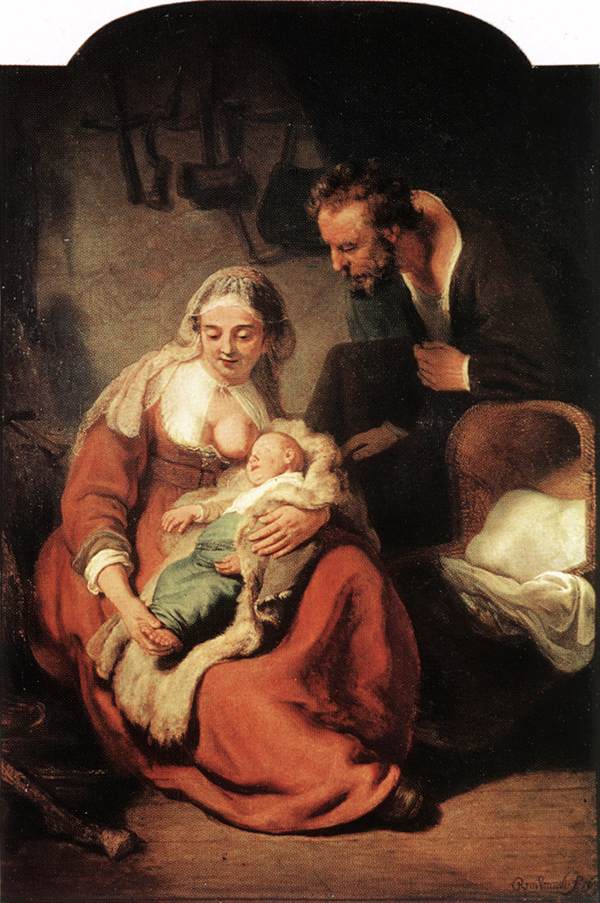
Rembrandt’s “Holy Family” (1634) greets the viewer not with celestial spectacle but with a hush. In a modest interior, a young mother in a russet dress settles a swaddled child across her lap while a weary father bends forward to look. Tools hang on the dim back wall. A cradle waits at the right. The mood is domestic and immediate, as if we have stepped into a real room where warmth, breath, and the faint creak of a chair make holiness tangible. Rembrandt reframes the Nativity as an act of ordinary care, inviting us to meet divinity at human scale.
A Domestic Nativity For A Dutch Home
Unlike gilded altarpieces or wide landscape nativities, this painting is intimate and vertical, built to hang in a living room or “constkamer.” The arch at the top softens the scene into a chapel-like window, yet everything below is frankly homely: wood floorboards, rough plaster, workman’s implements, and everyday fabric. This setting echoes Protestant Netherlands sensibilities in which faith was lived in the household rather than centered on church grandeur. Rembrandt locates the miracle where Dutch viewers most trusted it—in the ethics of family life.
The Composition’s Lullaby Curve
The composition turns on a gentle s-curve that runs from Joseph’s bowed head through Mary’s angled torso down to the rounded cradle. Mary’s lap forms the painting’s glowing center, her arms making a cradle within the cradle. Joseph’s body leans diagonally into that light, forming a protective canopy. Rembrandt balances the mass of Mary’s russet dress with the negative space of the cradle and the shadowy wall, so that the eye swings rhythmically from watchful father to tender mother to sleeping child. The effect is a lullaby made of lines.
Chiaroscuro That Sanctifies Touch
Light pours in from the left as if through an unseen casement, collecting on hands, cheeks, and the baby’s swaddling. Rembrandt’s chiaroscuro is not theatrical glare but hearth-like glow. It brightens where touch happens: Mary’s supporting hand beneath the infant’s shoulders, Joseph’s knuckles resting on the chair back as he leans close, the fur’s nap catching tiny points of light where it meets skin. The darkness behind the family is warm, not void; it protects rather than threatens, as if the night keeps watch with them.
Color As Human Temperature
The palette is a harmony of earth reds, tobacco browns, olive blacks, and creamy whites, punctuated by the quick green of the infant’s little garment. Mary’s russet dress anchors the scene with bodily heat; fur trims and linen kerchief cool and brighten the warm field. Joseph’s muted greens and browns recede, letting his concern and posture register more than his costume. The small notes of white—the baby’s cap, the pillow in the cradle, the fold at Mary’s throat—act like breaths of air across the surface, freshening each glance.
Mary’s Body As Shelter And Theology
Mary is not posed for iconography; she is seated and slightly weary, her head inclining with maternal focus. The generous fall of her dress and fur-lined mantle makes her a landscape of protection. A glimpse of nursing breast is practical, not provocative; it announces that the Incarnation means hunger met and a body cared for. Rembrandt’s Mary teaches doctrine without words: sacred love expresses itself as competence—holding, warming, feeding, soothing.
Joseph’s Watch And The Ethics Of Nearness
Joseph bends from the shadow like a question answered. His face is roughened by work; his hair shows streaks of sweat and travel; his hand on the chair back is relaxed yet ready. He is not relegated to the margins; his nearness is part of the miracle. In Rembrandt’s hands, Joseph embodies a quiet masculinity—protective, attentive, deferential. The painter transforms the biblical “just man” into a model of presence: holiness includes showing up, staying close, and letting the light fall on someone else.
The Baby As A Small, Credible Sun
The infant is tiny, bundled, and genuinely asleep. No unnatural glow emanates from him; rather, light arrives and rests there. Rembrandt paints the child as a believable newborn—soft features, heavy lids, the weight of sleep relaxed entirely into the mother’s lap. Because the baby is so real, the mystery he represents becomes more available. The viewer believes the miracle precisely because the painter refuses to inflate it.
The Cradle’s Empty Readiness
At the right, the cradle stands ready with a pillow and blanket pulled back. Its emptiness is poignant: for now the child is safer in Mary’s arms. The curved hood echoes the arch at the top of the panel and the curve of Mary’s dress, reinforcing the theme of shelter. In a few minutes, the baby will be laid there. By showing the in-between moment, Rembrandt gives the scene time; we sense the rhythm of evenings in which tasks and tenderness trade places.
Tools On The Wall And The Labour Of Love
The back wall carries a row of tools—saws, adzes, chisels—shadowed yet legible. They locate Joseph’s identity as craftsman and mark the room as a working space. Spiritually, the tools connect labor to love; practically, they create a rough halo around the family, the work-world turned into witness. Their dark silhouettes also prevent the upper background from dissolving into an empty blur; they give the night weight and history.
Fur, Linen, Wool: Textures That Speak
Rembrandt’s sensitivity to materials serves both optics and meaning. The fur lining that wraps the child is rendered with little flicks that catch and release light, telling our fingertips what our eyes see. Linen gleams where folded; wool drinks light where packed into shadows. These textures cue the senses—warmth is felt, softness implied, the small rasp of working cloth imagined. In a painting about care, surfaces that care for the body matter.
The Arched Top And The Chapel In The Home
The panel’s rounded crown converts domestic space into a devotional niche. Without adding angels or gold, Rembrandt lets framing do the sanctifying. It is as if the viewer stood before a tiny altar made of everyday life. The shape encourages a slower, steadier gaze, lifting the scene from anecdote to prayer while keeping intact its household truth.
Space, Perspective, And The Intimacy Of Scale
The shallow depth brings us close—floor, stool, knee, infant. No sweeping perspective pulls us away to shepherds or stars. The room is near to the picture plane, the figures nearly life-size in relation to the furniture. This proximity fosters empathy; our bodies know these distances. We can feel how far Joseph must lean, where Mary’s arm must strain, how the cradle could be rocked by a fingertip.
Sound And Time Imagined
Although the painting is silent, Rembrandt’s choices let the scene develop sound in the mind. You can hear the baby’s slow breathing, the soft shush of a mother’s voice, the faint scrape of wood as Joseph draws the chair closer, the rustle of fur. These imagined sounds delay the viewer’s looking, allowing details to emerge sequentially like the minutes of an evening.
A Conversation With Earlier Nativities
Where earlier Northern artists often produced didactic symbolism or crowded adoration scenes, Rembrandt pares back. He owes something to Netherlandish domestic realism but replaces emblem with experience. No bales of straw glow with mystical fire; no choir hovers. The painter trusts that tenderness will carry theology if shown truthfully. By turning away from spectacle, he renews the story.
The 1634 Moment And Rembrandt’s Young Confidence
Painted during his first Amsterdam years, the work shows the young Rembrandt at full expressive strength: generous chiaroscuro, command of human gesture, and a sculptor’s love for volume. He is already the poet of hands and faces, already the dramatist of light. At the same time, he is still acutely attentive to finish—edges are carefully managed, fabrics convincingly weighty, flesh modelled with soft transitions that anticipate his later, looser authority.
Brushwork You Can Feel
Up close, the surfaces reveal a choreography of strokes. Thin glazes build the warm air of the room; thicker, worked paint gives body to fur and highlights; short, soft dabs on cheeks and infant’s forehead suggest living skin. Rembrandt’s brush never becomes mannered; it serves perception. The hand records what the eye discovers, and the viewer senses the painter’s presence in every passage.
Psychological Realism And The Theology Of Care
The painting’s emotional power arises from psychological realism. Joseph looks with attentive concern, but also with fatigue. Mary looks with warmth, but also with the focused concentration of a mother managing a small, sleeping body. The baby rests, wholly dependent. The result is a theology of care: love pays attention, and attention is labor. Holiness is not only in the subject matter but in the way the figures look at one another.
Light As Grace, Shadow As Shelter
Rembrandt’s light is grace in action, finding faces and hands without humiliating anything else. Shadow does not punish; it draws a circle of protection around the family, excluding the world’s bustle. The viewer is brought into that circle for a moment, as if invited to hold the quiet with them. Few painters make darkness feel this friendly.
Lessons For Modern Viewers
The canvas teaches several ways of seeing. Attend to hands; they tell the story. Let clothing, not ornament, carry character. Trust small objects—the cradle, the tools—to set the moral weather. Use light to dignify work and touch rather than to sculpt spectacle. Most of all, make space for time; paint the moment between larger moments where humanity shows itself.
Why The Painting Still Feels New
It feels new because it answers questions we still ask. Where does the sacred meet the everyday. How do bodies hold one another up in unremarkable rooms. What does love look like after the shepherds have gone home and before the wise men arrive. Rembrandt’s answer is concrete: it looks like this mother, this father, this child, this light. The specificity keeps the story alive.
Closing Reflection On Warmth, Work, And Wonder
“Holy Family” is a hymn sung softly at the edge of night. It replaces the thunder of angels with the friction of linen and the weight of a sleeping child. By trimming the frame to a household’s scale, Rembrandt draws our eyes to the sacrament of attention. The room is small, but the tenderness is vast. The miracle is not removed from the world; it is swaddled in it—held, warmed, watched, and loved.
