Image source: wikiart.org
First Encounter With a Stage of Power and Pity
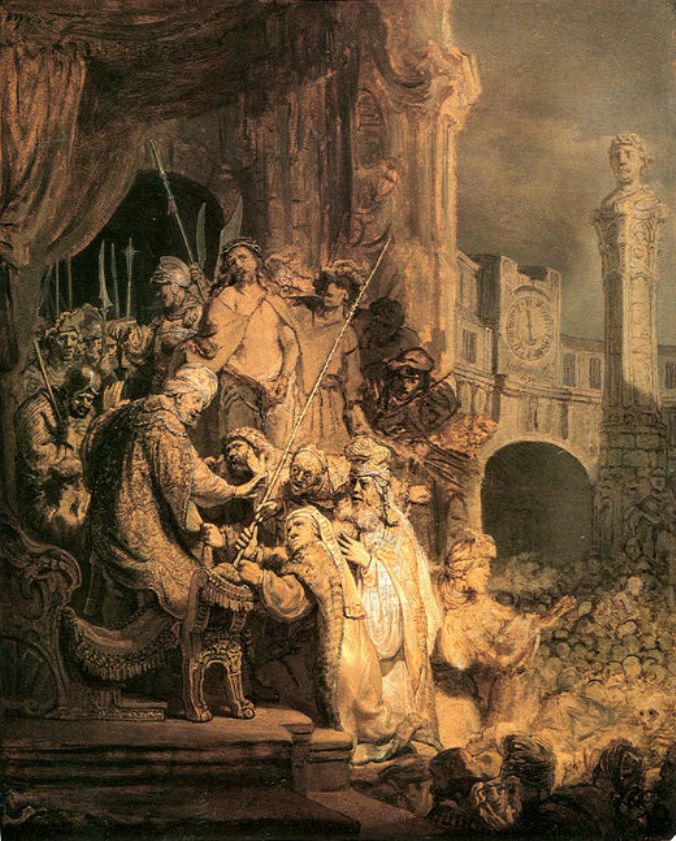
Rembrandt’s “Ecce Homo” (1634) opens like a curtain rising on a public ritual. At the top of a flight of stone steps, the Roman governor presents Christ to a seething crowd. Draperies swell, lances flash, officials lean and point, and in the middle distance an archway and clock fix the scene in civic space and measurable time. The first sensation is theatrical: this is a drama displayed for an audience both within the painting and beyond it. The second sensation is ethical: light selects faces and hands with an almost judicial clarity, demanding that we weigh what we see.
The Gospel Moment and the Meaning of the Words
“Ecce Homo”—“Behold the Man”—names Pilate’s enactment of power. He offers the scourged Jesus to the people as evidence and warning, expecting the sight of suffering to satisfy wrath. Instead, the presentation exposes a deeper violence. Rembrandt seizes this hinge in the Passion narrative, where politics, public opinion, and human vulnerability meet. The painting treats the words not as a caption but as an action: everything in the composition instructs the eye to look, to judge, to decide what the spectacle means.
A Tiered Composition That Teaches the Eye to Climb
The design is a cascade of platforms and ledges. At the lowest register, a mass of figures swirls in dim light. Above them, a tier of officials and temple leaders press toward the seated authority. At the summit, Christ stands nearly bare, flanked by soldiers. The steps that lead upward are not merely architectural; they are moral gradients. As the eye climbs, the crowd becomes individuals; as it reaches the top, the stage narrows until nothing is left but the man presented and the hands that offer him. Rembrandt turns perspective into a pedagogy of attention.
Chiaroscuro as Judgment
Light organizes the crowd like a verdict. It bathes Christ’s torso and face, giving human clarity to a figure otherwise reduced to a prop. It strikes the velvets and brocades of officials below, making visible the texture of authority. It grazes Pilate’s hand and scepter as they extend, dramatizing the act of display. Meanwhile, the outer edges sink into warm shadow. Darkness is not a void; it is the public’s anonymity, the cloak of a crowd that chants without owning its words. The painter’s value structure becomes an argument: the person who suffers is seen most clearly.
Pilate’s Gesture and the Mechanics of Power
Seated on a richly carved chair beneath heavy drapery, Pilate leans forward. His arm extends in a measured arc, neither tender nor violent, the practiced movement of a man accustomed to presenting decrees. The scepter he touches or passes is less a symbol of goodness than of authority’s inertia. Around him, counselors and clerics lean in with urgent counsel, fingers raised as if to punctuate a case already decided. Rembrandt refuses cartoon villainy; instead, he shows the banality of administrative gesture—the way a wrist can become a fate.
Christ at the Apex of the Stair
Christ is upright but not monumental. A robe hangs loosely, the crown of thorns barely catching light, the hands bound. His head inclines, and the line of his shoulders accepts the architecture of the scene without bending to it. Rembrandt avoids haloed spectacle here; the dignity comes from a calm that resists the stage. Compared with the ornate fabrics below, the body’s near-bareness carries a different wealth—the wealth of unadorned humanity. The eye, trained by light, recognizes that wealth even as the crowd fails to do so.
Architecture as Civic Theater
To the right, an arched gateway and clock tower make the space unmistakeably public. The clock is not simply picturesque; it is a reminder that crimes of conscience happen at particular hours, in daylight, with a schedule. The columns and cornices act as scenery and as stone memory: buildings that will outlast the day’s verdict. Rembrandt binds the biblical event to a city of his own imagination, a hybrid of antiquity and contemporary civic pride, so that the viewer cannot dismiss the scene as merely ancient. It looks like a place where crowds still gather to be persuaded.
The Crowd’s Psychology in Rings of Attention
Rembrandt never paints a faceless multitude. Even in shadow, the crowd subdivides into rings of attention. Closest to the steps, some strain upward with hands extended, as if verdict were a physical thing they might seize. Farther back, men confer, turned three-quarters away, already translating the event into rumor. Near the extreme right, a figure throws up both arms, perhaps in fervor, perhaps in helplessness. The painter distributes postures on a spectrum—from the pleading to the implacable—so that public opinion looks like what it is: a tangle of motives carried by bodies.
Costumes That Speak Before Voices Do
Brocades, fur trims, embossed leather, and metal helmets flash wherever power concentrates. Rembrandt paints texture with relish, but never for ornament alone. Silk lit from the side becomes a readable sign: this person has influence; this one speaks for a faction; this one belongs to the machinery that will roll forward when the crowd has gone home. The play of light across fabric contrasts with the matte, living surface of Christ’s skin. Wealth cannot keep its secrets around such light.
Spears, Staves, and the Grammar of Lines
Upward-thrust weapons puncture the air behind the dais, giving the vertical accents a military sharpness. Against these lines, the diagonals of arms and scepters create a web of vectors all pointing toward Christ. Even the drapery’s falling folds help shape the cone of attention. Rembrandt composes this grammar of lines with such certainty that the eye could navigate the scene even in reduced color: every angle insists—look here.
The Drapery as Mobile Sky
On the left, a heavy canopy falls behind Pilate like a portable sky. Its edge forms a shadowed proscenium that frames the central group and distinguishes the administrative space from the world outside. The curtain’s baroque swell suggests both luxury and fragility; it can be raised, lowered, or torn. The message is clear: the grandeur that presents judgment can be packed away, while the human consequence it unleashes cannot.
The Time of Day and the Temperature of Light
The light has the color of late afternoon, warm enough to gild stone and skin but low enough to lengthen shadow. That temperature matters. It carries the melancholy of a day nearing its end, underscoring the sense that the decision announced here darkens into evening and will not be undone before night. Rembrandt’s palette—amber highlights, brown-olive depths, muted grays in the distance—keeps the image grounded in breathable air rather than allegorical timelessness.
The Distance Between Name and Face
The title asks us to behold, but what does a crowd behold? Many do not see a person; they see a category: a threat, a heretic, a problem to be solved. Rembrandt counters that flattening by insisting on faces at every scale. A bearded elder peers with knitted brow; a soldier’s cheekbone catches a brief light; a woman in the lower right turns, mouth open, as if mid-cry. The painter’s craft performs a moral: when you paint people attentively enough, generalities become impossible.
Echoes of Stage and Print
The scene’s stepped platform, side curtain, and audience marshaling might recall contemporary theater, while the carefully tiered arrangement anticipates Rembrandt’s later prints on the theme. But this painting keeps its own tempo—broader, more architectural—while preserving the intimacy of recognizably human gesture. The fusion of stagecraft and civic space makes “Ecce Homo” feel both composed and overheard, like a public play that has suddenly become too real.
The Scepter’s Path and the Chain of Responsibility
Follow the scepter from hand to hand and you trace a chain: empire to provincial governor, governor to local elites, elites to crowd, crowd to soldiers, soldiers to the man at the top of the steps. Rembrandt composes that chain visually, which means he also lets us see how it might be broken. If any hand refused its part, the gesture would fail. The insight is contemporary: political violence depends upon small compliances.
Christ’s Stillness as Countertheater
Against the bustle below—the pointing, pleading, and consulting—Christ’s stillness reads almost like silence in a noisy square. The calm is not defiance; it is a refusal to join the grammar of display. Rembrandt’s restraint here is crucial. He does not place rhetoric in Christ’s posture; he removes it. The result is an attention that feels less like pity and more like recognition: whatever happens next, a person stands here.
The Clock and the Weight of Irreversibility
That clock face in the background is easy to miss, but once noticed it will not let go. It quantifies the moment, makes it historical, fixes guilt to hour and minute. In a narrative obsessed with eternity, Rembrandt chooses to nail the scene to a specific time. This emphasis increases the painting’s dread: the hands are moving; decisions harden when time expires; history records without blinking.
A Palette that Puts Gold Beside Dust
The painter sets the warm luster of metals and brocade beside the matte, dusty stone of the steps. The contrast does more than please the eye. It exposes the physical cost of ceremony—stairs worn by public use, stone darkened by smoke and weather—against the impermanent gleam of finery. The stone will still be here when costumes fade. In that juxtaposition, Rembrandt locates the witness that architecture bears against human pomp.
Why the Scene Still Feels Modern
Crowds, officials, a platform, a mic-less speech, and a person made into a problem: the components are alarmingly familiar. The painting speaks to debates about public shaming, the power of images to harden opinion, and the ethics of spectatorship. Rembrandt refuses to flatter the viewer as a righteous outsider; he seats us in the plaza. We are part of the “behold,” complicit in the machine that turns people into objects of display.
Lessons for Looking and Living
The painting teaches a way of looking that resists the crowd’s appetite. It asks us to follow the light, to register hands and faces before words and banners, to see the person where a program is being sold. It is also a lesson in how pictures work: values choreograph attention; diagonals speak; textures argue; space itself can vote. In “Ecce Homo,” craft and conscience are inseparable.
Closing Reflection on Beholding
“Behold the Man” is neither a pious caption nor a scornful taunt in Rembrandt’s hands; it is a question addressed to anyone standing within view. What do we behold when the world presents a suffering person as a lesson? Do we admire the stage or notice the body? Do we accept the narrative issued from the chair or let the light revise it? By carving platforms from darkness and laying beams of light across human faces, Rembrandt makes beholding an act of conscience and turns a civic spectacle into a mirror.