Image source: wikiart.org
First Encounter With Moonlight, Myth, And A Crowd Of Stories
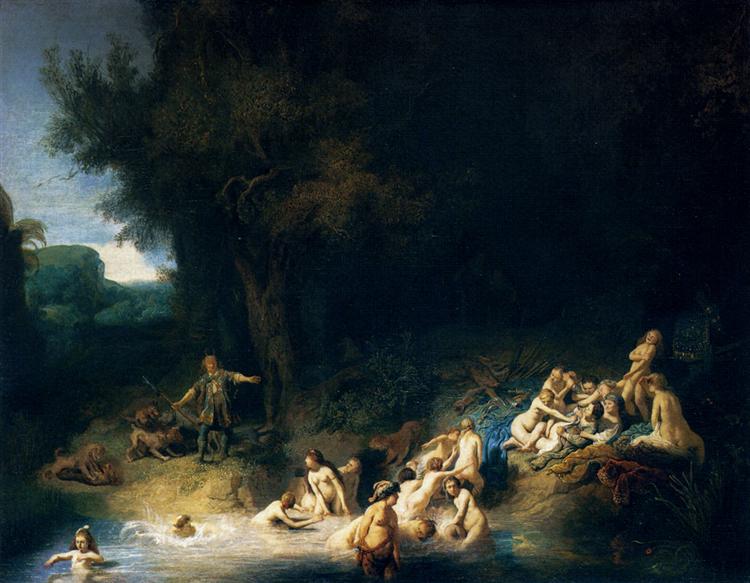
Rembrandt’s “Diana Bathing, with the Stories of Actaeon and Callisto” (1634) is a rare, panoramic drama in which the painter braids two Ovidian tales into one nocturnal landscape. At first glance, a pool glows at lower left, where a knot of nymphs splash and bend; to the right, more attendants lounge on cushions and patterned fabrics; at the far left, a hunter pushes through the trees with dogs at his heels; and on the bank near the reclining women, a separate commotion rises around a singled-out figure. The painting gathers these incidents beneath a canopy of deep foliage and uses light like a narrator, passing its lamp from episode to episode so that the eye reads the scene in time as well as space. What begins as a sparkling bathing party quickly discloses two violations—one of sight, one of trust—and the implacable sovereignty of a goddess who rules both.
A Double Myth Compressed Into A Single Stage
The title announces the twin sources: Actaeon’s accidental gaze upon Diana and her nymphs, and the unmasking of Callisto, the chaste attendant secretly pregnant by Jupiter. Rembrandt refuses to paint two separate canvases. Instead, he composes a single, continuous theater where the left half carries Actaeon’s intrusion and the right half dramatizes Callisto’s exposure. Diana herself is present among the reclining women, the cool axis of the group, while attendants crowd, gesture, and point. This choice is more than a clever economy; it lets the painting argue that both crimes—the voyeur’s transgression and the nymph’s compromised vow—are symptoms of the same pressure: the difficulty of protecting female community in a world of hungry eyes and predatory power.
A Composition That Reads Like A Sentence
Trace the painting’s syntax from left to right. At the extreme left, the pool’s bright surface hooks the viewer with the most accessible light. We meet the nymphs as bodies in motion, their luminous skin turning the water milky blue. From there the eye climbs diagonally up the sloping bank where attendants dry hair, draw on stockings, and lower shoulders into loose robes. The central, massive tree halts the flow for a beat, then becomes a hinge that tips us toward the deeper right bank where cushions, patterned cloths, and a small chest of treasures catch glints. Here, a cluster forms around a woman whose belly betrays a secret. Above, the canopy of leaves is so dense that the sky appears only as a pale wedge at the distant left. Finally, as our eye resets, we see the hunter in the shadows—Actaeon—with his dogs and staff. The sentence is complete: the pool’s innocence, the tree’s barrier, the revelation at right, and the intruder at left. The order teaches us how to apportion sympathy and judgment.
Chiaroscuro As Narrative Authority
Light is Rembrandt’s plot device. It falls most clearly on bodies and fabrics, skimming the bank so that each figure registers as a small flare of incident. But the light also withholds. The forest depth is nearly opaque; Actaeon is only half-emerging from the dark; the upper canopy swallows moon and stars. Such control over value allows Rembrandt to stage simultaneous moments without chaos. We believe each event because the light gives it the right amount of emphasis: the bathers gleam, the call-out around Callisto burns brighter still, and the hunter warns us with a dimmer, peripheral glow that feels like a first rustle before catastrophe.
A Palette In Which Flesh Is The Color Of Speech
Against cool blacks and greens, flesh becomes the painting’s language. Warm ochres, pale rose, and pearl tones shape legs, backs, and shoulders with modest but undeniable heat. Fabrics—saffron, peacock blue, wine—counterbalance the skin and become islands of color that lead the eye across the bank. In the pool, flesh colors are cooled by reflection; on the cushions, they are warmed by the nearby golds and reds. This orchestration of temperature keeps the crowd legible and invests nudity with seriousness rather than titillation. Rembrandt’s nudes feel weighty and specific: knees dimple as they bend; shoulder blades rise under the skin; hair clumps when wet. It’s myth held at human temperature.
Bodies In Different Registers Of Awareness
No two figures carry the same mental weather. In the water, a nymph leans forward to scoop, oblivious to anything but the fun of the pool. On the bank, one twists to wring long hair; another studies her foot; a third gathers a robe. Near Diana, however, attention tightens: hands press against Callisto’s body to reveal the truth she hoped to hide, while faces harden into a jurisprudence of sisters. Across the clearing, Actaeon raises one hand in a half-apology, half-defense, already flanked by dogs whose energy glances ahead to the punishment Ovid describes—his metamorphosis into a stag and death by those same hounds. Each posture is timed to a different second of the story, and together they create the sensation of an hour unfolding.
Diana As Axis And Ethic
Diana’s presence is quiet but absolute. She sits slightly apart, not the most dramatically lit body but the most composed. Her head turns toward Callisto’s unveiling; her arm’s line completes the arc of attention around the fallen nymph. Rembrandt denies her the theatrical wrath common in other versions; he gives her judgment that reads as order restored, not rage. This Diana is the keeper of boundaries—of spaces where women may bathe unharried, of vows that sustain community, of sight that must be governed. The composition ratifies her authority by arranging the other figures around her implied command.
The Dogs And The Physics Of Fate
The inclusion of dogs near Actaeon is not a mere storytelling courtesy. They are engines of inevitability. As they sniff and strain at the leash, they prefigure the speed with which a harmless mistake—wandering into a glade—will accelerate into doom. Rembrandt’s hounds are not idealized; their ribs show; their muzzles turn. They anchor the moment in earthy fact: this is a hunt, even if the quarry is about to change. By building fate from living anatomy rather than allegorical gadgetry, Rembrandt makes tragedy feel grown from the soil rather than dropped from the sky.
Fabrics That Behave Like Memory
Cushions, throws, and robes form a secondary drama. See the peacock-blue mantle tossed across a rise of earth, or the golden patterned cloth half-covering a reclining figure at right. These textiles record the pleasures of repose—the small luxuries of clean skin, soft weave, cool shade—now interrupted by revelation and alarm. Their folds and arabesques trap pockets of light that act as visual rest stops between clusters of bodies. They also mark the bank as feminine territory, briefly secured against the world of boots and dogs. When Actaeon enters, he brings dirt, noise, and the masculine world of the field; the fabrics show how fragile the encampment of calm really is.
Landscape As Curtain And Conscience
The dark forest is a curtain that both hides and reveals. It hides a viewer’s long look, preserving modesty by swallowing detail. It reveals by framing incidents in ovals of light, a natural proscenium. The narrow wedge of distant sky at left gives us scale—a reminder that this glade is small compared to the world—and suggests the time of day: late afternoon tipping into dusk. Rembrandt’s Northern eye gives the woods a Dutch gravity rather than an Italian fantasy; trunks are gnarly, leaves dense, ground uneven. The myth lands not on Olympus but in a plausible clearing whose realism makes the transgression sting.
Sight, Secrecy, And The Economics Of Looking
At its core, the painting is an ethics lesson about seeing. Actaeon’s problem is not merely that he looks; it is that he looks where he has no right to be. The Callisto episode mirrors that lesson internally: secrets kept inside a community have consequences when they breach shared commitments. In both cases, Rembrandt paints looking from both ends: the watcher caught by what he sees, and the community forced to look at itself. The viewer is implicated as well. We, too, look upon a bathing scene. Rembrandt solves this by building modesty into the composition: our vantage is oblique; bodies turn away; darkness shelters more than it exposes. He gives us enough to understand the story, not enough to collaborate in Actaeon’s crime.
A Pictorial Conversation With Titian And Rubens
Titian famously painted separate, monumental treatments of the Actaeon and Diana–Callisto myths, full of Venetian color and lustrous flesh. Rubens, too, staged the moment with roaring baroque muscle and silk. Rembrandt acknowledges these precedents but takes a different approach: a horizontal, cinematic sweep; a nocturne rather than a sun-washed revel; and a psychological tempo in which small gestures carry narrative weight. Instead of single, climactic shock, he gives us a long, complex glance during which several human dramas break the skin of a summer afternoon.
The Wetness Of Paint And Water
In the pool, the brush thins into quick, horizontal strokes that flash like ripples. Nearer the bank, pigment grows denser, making foam at a nymph’s elbow or the pale crescent of a knee lifting from water. Rembrandt’s relish for materiality—thick highlights on shoulder, scumbled shadows under leaves—keeps the scene tactile. You can almost feel the cool suck of the pool, the damp slap of hair on a back, the scratch of bark under a bare foot. Texture is not decoration; it’s the path by which myth enters the skin.
Timing, Suspense, And The “Before” Of Catastrophe
Rembrandt freezes the story at a dangerous moment—before Actaeon is transformed into a stag, before the nymphs have fully processed the scandal among them. Suspense thickens the hanging air: what you see is about to become something else. The choice makes the painting feel modern; we are asked to imagine consequences rather than watch them illustrated. That invitation engages the viewer’s moral imagination and memory of Ovid’s tale without forcing a single, didactic outcome.
Female Community In A Real Landscape
Despite the intrusion and the scandal, the painting honors the women’s community. They talk, help each other bathe, share cloth and jewelry, and hold one another literally and figuratively. The bank is arranged as a gentle amphitheater where bodies relax into natural grace rather than stagey display. Even the exposure of Callisto is not painted as cruelty but as the painful honesty groups sometimes must practice to remain themselves. The scene contains sympathy along with judgment.
1634 And The Young Amsterdam Master
Painted soon after Rembrandt moved from Leiden to Amsterdam, the work shows a confident storyteller expanding his scale. He is comfortable with a populous composition, yet he holds it together with paths of light and carefully tiered detail. The subject—myth seen through a moral and psychological lens—suits a merchant city that prized learning and picture-collecting. It is easy to imagine this canvas hanging in a “constkamer,” where friends would stand before it and trace the plot lines aloud.
The Logic Of Dogs, Nymphs, And The Hunter’s Staff
Objects behave like verbs. The staff angles forward as if already turning into antlers. The dogs’ limbs splay in alternating diagonals that rhyme with the swimmers’ gestures and the tree’s roots, tying the field to the glade. Jewelry scattered on a cloth glints like temptations of visibility: adornments that delight in private but invite the ruin of a public gaze. Even the small chest at far right acts like a thesis on secrecy—locked, decorated, and perhaps recently opened.
Water As Mirror, Boundary, And Baptism
The pool is more than a setting. It is a mirror that refuses to mediate Actaeon’s look: he cannot see the women in reflection; he must cross the bank’s threshold. It is a boundary that organizes the women’s world, a line between play and approach. And it is a kind of baptism, cleansing after the hunt, renewing bodies for the next day; that makes Actaeon’s intrusion feel doubly profane—he trespasses not merely on privacy but on ritual. The pool’s bright crescent therefore becomes the painting’s moral center, the little moon of Diana herself.
Why The Painting Still Feels Contemporary
The canvas speaks to present concerns—consent, public versus private space, the policing of female bodies—without anachronism. Rembrandt’s sympathy with the nymphs’ world, his refusal to eroticize their vulnerability, and his interest in the aftermath of wrongdoing give the picture an ethical steadiness rare in mythological scenes. He understands the cost of careless looking and the complexity of communities under stress. That relevance, combined with his orchestration of light, keeps the work alive for modern eyes.
Closing Reflection On Moonlit Justice And Human Frailty
“Diana Bathing, with the Stories of Actaeon and Callisto” is a forest of meanings. In it, a goddess keeps watch over a fragile peace; an outsider’s glance cracks the air; a sisterhood confronts a wound; and the water continues to shine as if the world could be clean again. Rembrandt does not sermonize. He lets light do the judging, and bodies do the speaking. The painting leaves us with a sharpened sense of how sight carries responsibility and how communities endure by telling the truth, even when that truth hurts. We walk away aware that beauty flourishes best where boundaries are honored, and that crossing them—whether from folly or force—has consequences swift as dogs.
