Image source: wikiart.org
First Encounter With A Queen And A Cup Of Memory
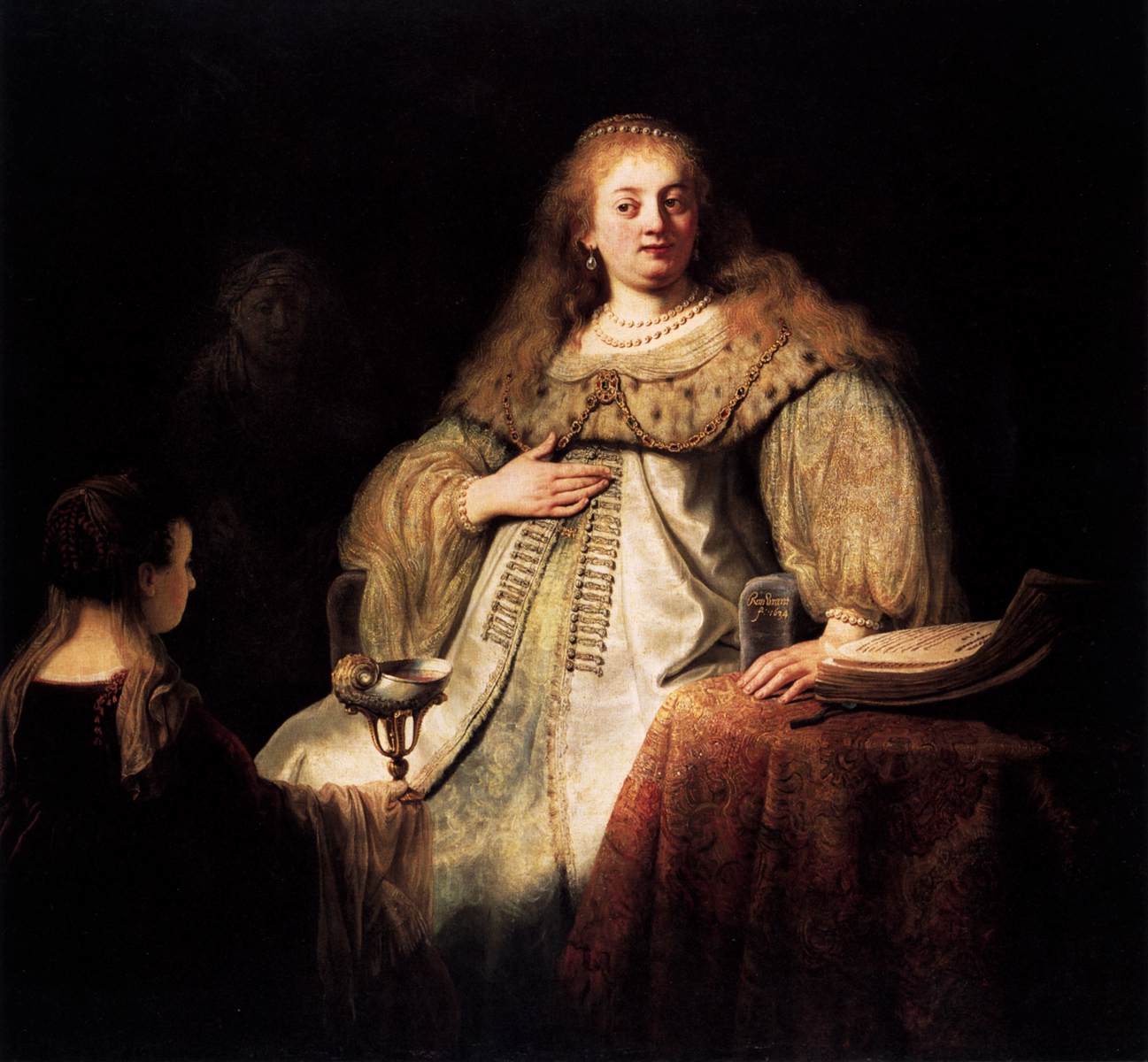
Rembrandt’s “Artemisia” from 1634 stages a nocturnal court in which grief is crowned with gold. A richly dressed woman sits at a draped table, her right hand resting on stacked folios while the left rises to her breast in a gesture midway between oath and ache. At the lower left a young attendant advances with a lidded, shell-like cup supported by a sculptural stem. The scene is engulfed by darkness that recedes before a concentrated surge of light settling on silk, pearls, and skin. What begins as an opulent portrait quickly discloses itself as a drama about loyalty, mourning, and sovereign will.
The Legend Behind The Cup
The title identifies the sitter with Artemisia II of Caria, the ancient queen who reputedly mixed the ashes of her husband Mausolus into wine and drank them, fusing bereavement with devotion. Seventeenth-century painters often played with this subject and its cousin, the story of Sophonisba, who chose an honorable death by poison brought in a cup. Both narratives pivot on a chalice and a woman’s resolve. Rembrandt leans into this ambiguity to widen the picture’s resonance: whether ashes or poison, the vessel signifies a decision carried out in private ritual, at once intimate and monumental. The attendant’s approach and the sitter’s lifted hand plot the precise interval where choice becomes act.
A Composition That Hangs On A Diagonal Of Will
The design turns on a diagonal that runs from the attendant’s cup through Artemisia’s hand and up to her illuminated face. This line is buttressed by the counterweight of the table at right and by the dark, almost unearthly background, where another shadowed presence seems to hover. The triangular relationship among the attendant, the queen, and the piled folios stabilizes the stage while giving the eye a path: from offering to acceptance to remembrance. The single strongest vertical is Artemisia’s torso, which reads like a column holding the room’s moral architecture upright. Furniture, textiles, and servants orbit that column; the decision at the center stills them.
Chiaroscuro As Sovereign Climate
Light enters like a verdict from the upper left, threading pearls and catching lace before settling in a calm blaze across Artemisia’s satin bodice. Rembrandt’s chiaroscuro does more than model volume; it establishes justice. The face and chest, where decision is housed, receive the highest illumination; secondary lights strike the cup, the jewelled clasp, the folio edges, and the embroidered tablecloth. Everything outside this path sinks into a materially specific dusk—enough shadow to feel the room, not enough to distract the conscience. The blackness behind the queen opens like a moral abyss into which she refuses to fade. Her light is chosen, not bestowed.
Gesture And The Grammar Of Resolve
The left hand, turned palm down on the folios, anchors us in the world of documents—history, vows, dynastic contracts, or letters of state. The right rises to the breast, fingers splayed with the controlled tremor of someone steadying breath. Together they write a sentence in the language of gesture: I remember and I commit. The attendant’s careful advance, the head lowered in deference, keeps the drama human-scaled. This is not spectacle; it is a ceremony that allows two women to enact power as duty, not as display.
Costume As Testament
Rembrandt renders clothes as if they, too, could swear. Artemisia’s gown is a triumph of layered fabrics: translucent sleeves gathered into delicate cuffs, a bodice whose satin takes light like a still pond, and a mantle scalloped with gold embroidery. Pearls trail around her neck and crown the coiffure, their cool luster tempering the warmth of skin. Far from being mere luxury, the costume performs several symbolic tasks. Pearls were long associated with tears and constancy; satin’s untroubled sheen suggests the public calm required of rulers; gold thread stitches private sorrow into civic splendor. The queen is not costumed for seduction but for remembrance.
The Servant, The Cup, And The Architecture Of Ritual
The cup’s stem is an elaborate miniature sculpture, part shell, part trophy, topped with a lid that promises secrecy. Its design elevates the act beyond ordinary drinking into rite. The young attendant’s presence prevents the scene from being a private meditation; it is a witnessed vow. Rembrandt is attentive to the intimacy between their roles: the queen’s right hand rises as the girl’s left hand presents, two halves of a single movement. The servant’s shadowed face ensures that the viewer’s moral attention does not drift; we are placed where the servant stands, within reach of the cup but beyond the weight of the choice.
The Table As Memory Theatre
At the right, a heavy cloth cascades in deep crimsons and browns, patterned with a complexity Rembrandt relishes. On it lie a small book and a fan of folios, their edges catching light. The table is more than furniture; it is a mnemonic stage. Folios imply the archive of a reign or the private records of a marriage. The book, compressed and personal, may be prayer, testament, or a keepsake. Rembrandt lets paper behave like a secondary kind of light—pale planes that hold the past and throw a cool reflection onto the queen’s wrist. Memory is not airy; it weighs and glints.
Rembrandt’s Paint As Tactile Witness
Stand close to the surface and the picture changes from court scene to choreography of touch. Thick, buttery passages articulate the richest whites; scumbled, semi-opaque veils build the shimmer of gauze; tiny impasted pearls sit like punctuation marks across the skin. The tablecloth’s reds are woven from glazes that deepen into shadow at the fold’s base. Flesh is constructed from crushed warm and cool tones that make room for blood beneath. Because the paint feels handled rather than merely applied, the whole image becomes credible to the fingers. Tactility turns devotion into something the viewer can almost hold.
A Face That Negotiates Between Court And Conscience
Artemisia’s face is not melodramatic. Rembrandt shapes it with even light and hits clean accents at eyelid, nostril, and lip. The gaze pulls slightly to one side, as if she hears the world beyond the frame—the counsel of ministers, the murmur of subjects, or simply the tap of the servant’s step—and chooses, nevertheless, to attend to the inward ceremony. There is a small flush at the cheek, balanced by the steadiness of the mouth. Her expression refuses both the saint’s trance and the courtesan’s flirtation. It opts for a third, rarer register: public gravity made personal.
The Shadowed Presence And The Drama Of Negative Space
Behind Artemisia, barely stated, a figure seems to hover—a matronly attendant or memory itself. Rembrandt keeps this presence in steep shadow so that it works as negative space more than as character. The surrounding dark is not emptiness; it is witness, a kind of architectural hush that makes the lit surfaces articulate. By choosing void over architecture, the artist sets the action afloat in moral rather than physical space, where choices echo longer.
Ambiguity As Intention, Not Accident
Viewers and scholars have long debated whether the scene is Artemisia drinking her husband’s ashes or Sophonisba accepting a cup of poison. Rembrandt’s painting keeps both possibilities alive by refusing to specify contents while focusing on gesture, vessel, and gaze. That ambiguity is not a lapse but a strategy that lets the picture reach beyond antiquity to the seventeenth-century present—widowhood, political sacrifice, and the theater of virtue were not rare in Dutch and European courts. The queen becomes an emblem of any life in which love and duty collide and are resolved with steady hands.
The Year 1634 And The Artist’s Circle
Painted at a moment when Rembrandt was sealing his place in Amsterdam’s elite with marriage and major commissions, “Artemisia” shows him translating the dramatic chiaroscuro of his biblical and historical scenes into a more concentrated chamber piece. The sophistication of textile painting echoes the portrait market he was then conquering; the psychological tact foreshadows the inward depth of later masterpieces. The work might have resonated with contemporary patrons who prized images of constancy and righteous sorrow. It also allowed Rembrandt to demonstrate mastery in three arenas prized by collectors: flesh, fabric, and story.
Textiles That Teach Light How To Behave
Rembrandt uses the gown’s different fabrics as laboratories for light. Satin, with its long highlights, teaches the eye about unbroken planes; gauze, with its knotted transparency, demonstrates how light can be held and released; velvet drinking shadow at the folds’ core shows how darkness thickens. The tablecloth’s relief pattern lets him flirt with abstraction—little coherent islands of red and brown—without derailing narrative. By orchestrating materials, the painter composes a visual music in which the melody of the face is supported by a harmony of cloth.
Jewelry And The Arithmetic Of Glints
The pearls, bracelet, and jeweled bodice clasp are not sprayed around the figure as glitter. They are placed like metronomes to control the picture’s tempo. Small glints walk the viewer’s eye from temple to ear, down to the necklace, across the bodice’s fastenings, and toward the hand resting on paper. These measured lights confirm that Rembrandt is not simply describing wealth; he is using reflected points to guide attention from spirit to act, from thought to document.
The Iconography Of The Cup Revisited
Return to the cup and watch how the painting makes it central without enlarging it. Its metallic shell catches a narrow highlight along the rim; the stem, carved like a trophy or mythic creature, sits assertively in the servant’s hand. The vessel is both intimate and public. As emblem, it declares the theme; as object, it belongs to a treasury of court tableware that would have real history and weight. The cup therefore links domestic ritual and state ceremony, the privacy of grief and the publicity of virtue.
The Servant’s Braided Hair And The Social Ladder
The attendant’s braid is carefully lit, strands picked out against the dark so that we feel the preparation behind service. She is not a generic silhouette but a person with a day’s work, a body’s care, and a place in the ritual. The choice to give her specific hair rather than a hooded anonymity collapses social distance and reminds us that sovereign rituals are enacted by many hands. Artemisia’s decision becomes a communal act, not just a queen’s performance.
Space Without Architecture And The Invention Of Intimacy
There is no detailed palace setting here, no carved pilasters or gilt cornices. Rembrandt replaces architectural proof with emotional proof. The space is convincing because the light is coherent and because objects behave under it with truth. This distilled environment frees the picture from period decoration and leaves the essential human triangle—woman, servant, cup—glowing in a darkness any century could understand. The choice makes the painting modern: intimacy trumps stagecraft.
Comparison With Contemporary History Painting
Seventeenth-century history paintings often stage virtuous heroines with loud gestures and theatrical color. Rembrandt counters with a low-voiced intensity. Where many artists press bodies to the front of the picture plane, he lets blackness breathe; where others choose thin, emblematic fabrics, he paints cloth that convinces the fingers; where moralizing allegory can feel distant, he works through portraiture’s closeness. His Artemisia does not declaim; she decides.
Reading The Face For The Second Time
Look again at the mouth’s slight asymmetry and the eyes’ sideways cast. There is a touch of worldly humor in that glance, as if Artemisia knows that rituals exist partly to help us do what we could not otherwise do. It prevents the canvas from freezing into emblem. The queen is not a marble exemplar; she is a woman who understands both the gravity and the artifice of ceremony and employs both to keep faith with the dead.
Paint As Time
Rembrandt’s layered method allows the picture to hold time—thin underpaintings for large masses, then revisions and enrichments in glazes, finally impasted lights that sit like newly spoken words. This temporal stacking suits a scene about endurance. We register in the surface the sequence of looking, deciding, and affirming. The paint itself becomes a memorial, thickening where the story requires emphasis and thinning where the mind has already passed.
The Viewer’s Role As Witness And Participant
The seat left vacant at the bottom edge, the angle of the table, and the servant’s approach place us within the geometry of the act. We are neither explicitly addressed nor dismissed; we are positioned as silent witnesses whose presence confirms the rite’s publicity. The painting’s power lies partly in this careful inclusion. It allows us to keep faith with Artemisia by watching steadily as she does the same.
Closing Reflection On Devotion, Power, And The Light That Decides
“Artemisia” is a chamber opera of light and textiles in which a cup becomes an oath. Rembrandt builds a world where grief wears pearls without apology and where duty is carried out with the intimacy of touch. The queen’s raised hand, the attendant’s offering, and the patiently painted surfaces converge on a single theme: fidelity—of spouse to spouse, of ruler to virtue, of artist to truth. The painting leaves us with an image of power that is not loud but luminous, not theatrical but deliberate, and therefore doubly persuasive.
