Image source: wikiart.org
First Encounter With A Circle Of Listening
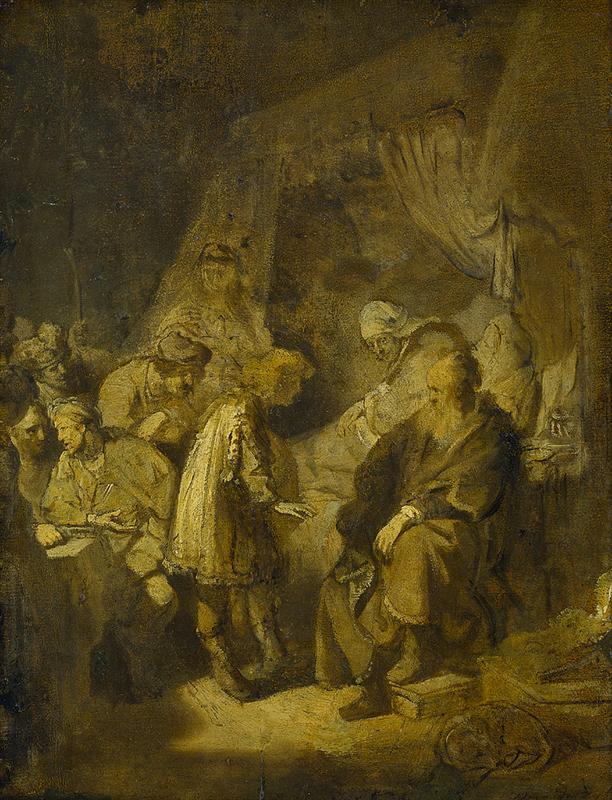
Rembrandt’s “Joseph Tells His Dreams to His Parents and Brothers” surrounds a single, fragile act—speech—with a ring of bodies, glances, and shadow. In a low-lit interior, the young Joseph steps forward into a pale island of light and extends his hands as if weighing the words he has just spoken. Around him, men bend toward tablets, mutter to neighbors, or retreat into thought. At the right, the patriarch Jacob sits high on a step, robe pooling at his feet, his head inclined in a wary, considering pose. Drapery gathers above like a canopy, half-domestic, half-theatrical, as though a tent of narrative has been raised for one night only. The first sensation is not spectacle but atmosphere: talk made material, breath visible in light and dust, a family held in the weather of a dream.
The Biblical Moment And Why It Matters
The painting compresses Genesis 37 into one charged hour. Joseph recounts two dreams—sheaves bowing to his sheaf and the sun, moon, and eleven stars bowing to him—visions that his brothers interpret as a claim to rule and that his father rebukes while “keeping the saying in mind.” Rembrandt chooses the telling, not the aftermath, because it is the most human interval. We watch the prophecy become offense in real time. In choosing the unheroic moment of narration, he makes interpretation the subject: how people hear, what they fear, and how a single image uttered aloud can begin to tilt a family history.
A Composition Built On Concentric Attention
The design pulls the eye inward in rings. The outer ring is darkness held in check by rough walls and the deep pocket of drapery. Within that, a crowded middle ring of brothers leans and murmurs, a geometry of bent backs and inclined heads that behaves like a murmuring hedge. At the center, a bright ellipse of ground holds Joseph’s small figure facing Jacob’s seated mass. The line from Jacob’s hand to Joseph’s hands forms a low arc across the light, a crescent of judgment and hope. Because the brothers straddle darkness and light, we experience them as undecided—already threatened, not yet violent.
Chiaroscuro As Family Weather
Rembrandt’s chiaroscuro works like climate. The light is local, almost hearth-like, and it clarifies whoever enters its circle. Joseph looks newly minted within it, youthful and slightly overdressed, a boy enjoying the echo of his own speech. Jacob sits half in that clarity, half in a dusk that keeps his face sober. The brothers evaporate into shadow at the edges, their plots literally born in darkness. There is no allegorical sunbeam pointing to a predestined ruler; instead, Rembrandt lets the household’s lamp teach us who is present to meaning and who is hiding from it.
Stagecraft, Not Pageantry
The room reads like a traveling stage. A low platform under the patriarch, a gathered drape, benches and steps that corral figures into conversational clusters—Rembrandt converts domestic architecture into a playhouse. This suits the story, since dreams themselves are theater in the mind. He avoids monumental architecture, preferring a scrim of linen and the human scale of stools and tablets. Because the set is modest, the drama feels close, almost audible.
Joseph’s Body As A Grammar Of Youth
Joseph’s body speaks before his words are heard. He leans forward with more eagerness than tact, both hands palm up, a gesture that offers and demands at once. The costume sparkles with small highlights along seams and trim, the kind of festive garment a favored son might receive. The shoes are quick, the stance almost dance-like. Rembrandt does not caricature him as vain, but he allows a recognizable adolescent pleasure in being interesting. That pleasure is the grain of sand around which jealousy will crystalize.
Jacob’s Seat And The Weight Of Judgment
Jacob’s pose is all gravity. One hand grips the robe’s edge; the other rests near the knee; the head tilts into thoughtful rebuke. He is elevated only by a step and cushions, yet the lift feels ceremonial. A quieter light turns his brow, cheek, and beard into planes for the viewer to read. Rembrandt gives him inwardness without paralysis. Jacob is not merely offended; he is evaluating, translating vision into responsibility, a father trying to shepherd brothers without smothering a gifted son.
The Brothers: A Scale Of Reactions
Every brother is a sentence in a paragraph of response. One writes or scratches notes on a tablet, as if collecting ammunition; another clamps a hand to chin, already calculating; one leans across a shoulder to gossip; a pair in the back become a single muttering shape; a figure at the far left almost looks out of the picture, creating the sensation that rumor will leave the room. Rembrandt avoids mirrored expressions. Resentment is personal, and he makes it so by giving each man a private angle to the same provocation.
Light On Paper, Ink On Conscience
Papers, tablets, and scrolls lie open in the gloom and flare briefly in the lamp’s path. Those little sheets behave as moral instruments. They catch light, implying literate minds and the temptation to turn words into weapons. They also project futures: contracts of sale, forged narratives, the letter home from Dothan dipped in goat’s blood. Rembrandt does not draw the future; he gives us the tools out of which the future will be written.
A Palette Tuned To Dust And Whisper
The color key is narrow and persuasive: earths, yellowed creams, softened olives, and the kind of warm grey that grows in rooms where smoke and breath have been. Against this subdued field, a few notes lift—Joseph’s pale garment, a warmer glint on Jacob’s sleeve, a sudden pearl at a headscarf. Because color does not shout, light and temperature do the expressive work. The result is a scene whose quietude holds more tension than noise could summon.
Brushwork That Feels Like Speech
The handling is open, exploratory, and alive with revisions. Figures are massed by broad, buttery passages, then tipped into legibility by sharp, loaded touches at a nose, the bridge of a hand, the edge of a beard. Drapery moves from general to particular in the space of an inch. This variability feels like conversation: the painter leans forward to sharpen a face, relaxes into a wash for the wall, then jabs again to fix a gesture. You can almost hear the cadence of the tale in the cadence of the brush.
Symbolic Readings That Grow Out Of Use
Objects in Rembrandt rarely arrive as symbols first. The canopy is a curtain before it is a heaven; the seat is furniture before it is a throne; the papers are practical before they are prophecies. Because the painting persuades at the level of use, it can bear the allegory of Joseph’s rising and the family’s bowing without strain. The light that ennobles Joseph is the same light that lets his brothers read his face, and the same light that will later gleam on the silver pieces paid for him. Morality is woven into ordinary seeing.
The Psychology Of Speaking Aloud
Rembrandt’s choice of moment lets him analyze the dangerous physics of saying something true before it is safe. Dreams in Genesis often require the mediation of time and setting. Joseph lacks both. He speaks with the nakedness of a dream and the naivety of youth to an audience primed for humiliation. The painting, therefore, is about timing as much as about destiny. The prophetic can be socially unwise; the wise can mistake vision for arrogance. Rembrandt holds both errors in one quiet room.
Kinship, Distance, And The Architecture Of Space
Look at the literal distances. Joseph stands three or four paces from Jacob, close enough for confidence, far enough for judgment. The brothers cluster shoulder to shoulder, intimacy fermented into faction. A woman’s veiled head in the back—a household presence often identified as Rachel or a servant—adds a vertical counterpoint and a soft, watchful tenderness. These spatial relations are the painting’s true architecture: kinship stretched into roles, proximity becoming pressure.
Echoes Of The Stage And The Market
The scene’s dramaturgy reflects Amsterdam’s culture of storytelling—public theater, rhetorical societies, and a market where news was performed as much as printed. The brothers’ body language reads like spectators at a booth drama, Joseph the eager actor, Jacob the magistrate. Rembrandt deftly pulls that civic energy into a biblical room, suggesting that ancient jealousies and modern rivalries share a grammar of glances.
Texture As Morality
Surfaces in this painting carry ethics. Jacob’s robe holds its folds like experience; the canopy’s cloth is heavy enough to keep drafts off sleeping bodies; Joseph’s garment is ornate in a thin, brittle way that reads as new favor rather than old honor; the rough wall eats light, the way resentment eats talk. Such tactile truth allows the viewer to feel the difference between dignity and display, solidity and show.
A Dream About Work, Not Only Rank
Though the content of Joseph’s dream is authority, Rembrandt weaves labor through the room. Tablets, writing, counting, the heaviness of cloth and wood—the brothers are not princes, they are a working family. This matters because the offense comes not from a threatened crown but from the disruption of a settled economy of regard. The painting understands that families are schedules and roles long before they are myths.
The Sound In The Silence
If this picture had sound, it would be the soft rasp of linen, a low murmur, the scratch of a stylus on wax, a father’s brief exhale before speaking. Rembrandt renders that soundscape by refusing hard edges in the wrong places and sharpening them where meaning needs syllables. The image therefore reads as both silent and murmurous, as dreams are when retold in the dark.
Continuities With Rembrandt’s 1633 Language
The year 1633 finds Rembrandt at full early power: dramatic diagonals, judicial light, figural crowds thickened into moral atmospheres. In the same year he paints the raising of the cross with muscular cooperation and designs etchings where beams of light fall like verdicts. This canvas belongs to that language, but it whispers instead of declares. The same tools—light, grouping, touch—are used for the politics of a family.
Why The Painting Still Feels Current
The scene is modern because it studies how groups react when one member announces unusual promise. Workplaces, classrooms, and families still tilt on such moments. Who gets to speak? How do elders encourage without fostering arrogance? How do peers hear without shrinking into envy? Rembrandt offers no program; he gives us a mirror. To watch the brothers is to remember our own murmurs; to watch Jacob is to feel the fatigue of leadership; to watch Joseph is to recognize the thrill and risk of being seen.
Closing Reflection On Vision And Its Listeners
“Joseph Tells His Dreams to His Parents and Brothers” captures the hinge where vision meets hearing. A boy steps forward with a story; a father sits between rebuke and wonder; brothers begin the long translation from irritation to plot. Rembrandt builds that hinge from dusk, dust, and the careful placing of hands. Nothing flamboyant happens, and yet the future is already moving. That is the painter’s secret: to make consequence visible at the exact moment when it still looks like talk in a room.
