Image source: wikiart.org
First Glance: Poise, Light, and the Language of Lace
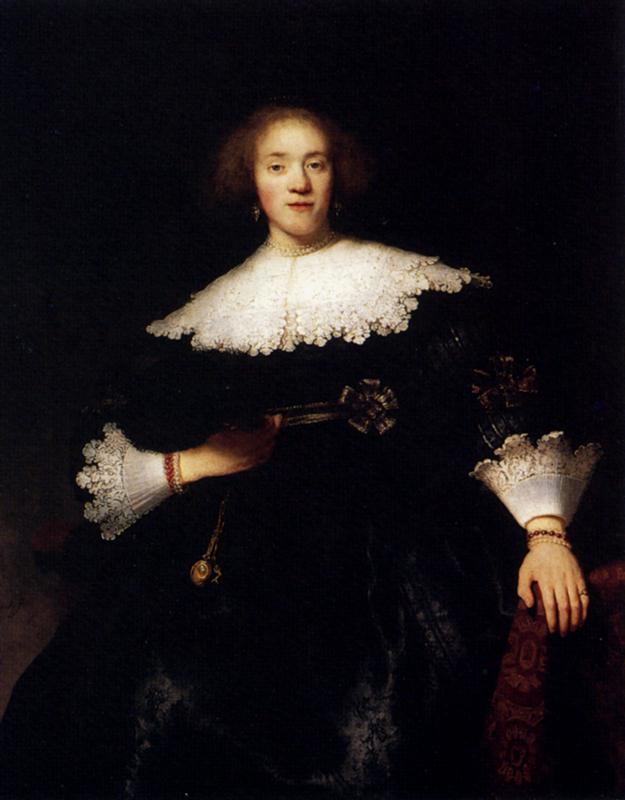
Rembrandt’s “Portrait of a Young Woman with a Fan” presents composure as a kind of radiance. The sitter occupies a dark, breathable interior, her face and elaborate lace collar catching a steady light that clarifies without glare. A folding fan, held with unhurried assurance, becomes both accessory and conductor’s baton for the portrait’s rhythms. Rembrandt offers no narrative setting, no emblematic backdrop. Instead, he trusts the collaboration of light, textile, gesture, and gaze to communicate presence.
Composition That Centers Quiet Authority
The composition is an elegant triangle. The apex is the face—small, luminous, and calmly frontal—while the broad base is formed by the black satin gown, whose volume pools into the lower register. Two arms articulate the flanks of the triangle: at left, the forearm lifts the fan across the torso; at right, the hand descends to rest on an upholstered armrest whose patterned fabric adds a restrained flourish. This triangulation gives the portrait a grounded stability even as the fan introduces a diagonal that keeps the eye moving.
The Fan as Gesture and Meter
The fan is not merely decorative. Positioned across the midline, it reads like a pause mark in a sentence—an elegant rest in the sitter’s social music. Its ribs and folded leaves create a measured cadence of dark-on-dark, interrupted by small glints at the guard and rivet. The angle of the fan echoes the jawline and collar edge, aligning objects and anatomy into a subtle choreography. With this one prop, Rembrandt captures a moment between readiness and repose: the fan could open, the sitter could stand; for now, she holds both possibilities.
Lace as Architecture of Light
The wide collar and deep cuffs are feats of painterly engineering. Their scalloped edges meet the surrounding darkness with crystalline definition, while interior cutwork and rolled pleats ebb into soft greys where the light declines. Rembrandt avoids fetishistic detail; he organizes the lace into legible clusters that carry the texture of needlework without drowning the portrait in pattern. As architecture, the collar lifts the head and stages the face; as light-catcher, it distributes brightness across the upper body so that the dark gown reads as depth rather than void.
Chiaroscuro That Breathes
Light enters from upper left, modeling forehead, cheeks, and the bridge of the nose with judicial calm. The underside of the hatless hair and the throat step into tempered shadow, ensuring form without drama. The black dress is aerated with mild reflections and satin bloom—cool, olive-tinged blacks near the torso; warmer, denser blacks in the skirt’s recesses—so that the garment breathes. Chiaroscuro here is not theatrical spotlighting; it is the plausible atmosphere of a real room in which a person sits.
The Social Language of Dress
Seventeenth-century Amsterdam read clothing fluently, and this portrait speaks the dialect of decorum and means. The starched lace, pearl jewelry, bracelet, and sober black silk align with urban ideals of cleanliness, order, and restraint. The patterned armrest and gilded fan fittings acknowledge wealth without flamboyance. Rembrandt is faithful to this code while keeping the sitter sovereign over it. Costume frames personhood; it never replaces it.
Eyes That Attend Rather Than Perform
The sitter’s gaze is neither coy nor severe. It addresses us at eye level with an intelligent neutrality that feels modern—curiosity without audition, openness without display. A tiny highlight at each pupil, soft moisture along the lower lids, and the most delicate modulation around the mouth keep the expression in the middle register where personality is most believable. Rembrandt understood that portraiture’s deepest truth often resides between big emotions.
Flesh as Living Climate
Rembrandt paints flesh as microclimate rather than porcelain. Honeyed lights gather at the cheekbones and forehead; cooler greys firm the jaw and sides of the nose; a modest flush warms the lips and the plane above the chin. Translucent veils allow light to seem as if it comes through the paint, not simply across it. This optical honesty makes youth persuasive without sentimentality.
Hands That Declare Temperament
The left hand, angled across the torso with the fan, is decisive but unhurried; the right, resting on the armrest, is relaxed yet articulate. Rembrandt never over-draws fingers; he lets bone and tendon catch the light where necessary and allows edges to soften where they turn away. From these hands we infer a temperament that values control without stiffness—the social poise expected of a prosperous household and, more importantly, the sitter’s own sense of ease.
The Bowed Pendant and the Necklace of Time
A small pendant hangs from the waist by a slender cord, catching a quiet flash of light—a visual metronome that links upper and lower registers. Around the neck, a string of pearls bends with gravity and pushes minutely into the skin, demonstrating Rembrandt’s attention to the physics of fit. These details are not merely “correct”; they are narrative in miniature, telling us that the sitter lives in her clothes rather than posing beside them.
Black That Contains Color
The gown’s “black” is a symphony of restrained color: bottle-green cools in the shadows, prune-brown warmth near the knees, hints of blue-black in the sleeves. These undertones keep the dress present as matter, not a painted hole. They also provide a foil for the whites of lace and flesh so that the portrait’s palette can remain narrow without becoming impoverished.
The Upholstered Armrest as Tactile Counterpart
The upholstered armrest to the right hosts a discreet pattern—rust, umber, and wine tones that whisper rather than shout. It locates the scene in a furnished interior and gives the right hand a credible perch. The fabric’s softness echoes the softness of flesh; the geometric motif counterbalances the organic intricacy of the lace. This small corner of textile keeps the composition from floating and quietly speaks of domestic prosperity.
The Psychology of Sitting
Rembrandt rarely treats the seated pose as a static endpoint. Here, sitting is a stance of readiness. The torso leans a fraction forward, as though drawn by conversation; the fan’s diagonal introduces potential energy; the chair supports without declaring itself. We are witnessing the social grammar of a visit in progress—someone composed, alert, and fully present.
Early Amsterdam Rembrandt and the Rhetoric of Splendor
Dated 1633, the portrait arises from Rembrandt’s early Amsterdam years, when he mastered a rhetoric that paired sumptuous surfaces with humane clarity. Lace, satin, pearls, and subtle metalwork satisfy the era’s appetite for finely rendered things; the sitter’s directness satisfies a deeper appetite for true likeness. The painter’s bravura remains disciplined: he is at his most dazzling where the portrait most needs him—collar, cuffs, fan—while he lets face and hands speak with quieter eloquence.
Brushwork That Records Decisions
Close viewing reveals a spectrum of touch. Short, lifting strokes form the edges of lace scallops; thin glazes and soft scumbles build the satin’s bloom; tiny, bright punctuation marks animate jewelry and fan hardware; broader, unified strokes establish the gown’s large planes. Nowhere does Rembrandt allow “technique” to become a spectacle of its own. Every mark answers a question: how does this substance accept light, and how much information does the portrait require at this spot?
The Ethics of Omission
There is much Rembrandt declines to show: no window, no architecture, no narrative props beyond the fan and the chair. This omission is ethical as well as aesthetic. It prevents the sitter from being drafted into allegory and preserves the integrity of her presence. The dark ground is not empty; it is protective silence in which the portrait’s music can be heard.
Edge Control and the Sense of Shared Air
Edges pulse like breath. The outer rim of the lace meets the darkness with bright definition; the inner concavities soften into shadow. Hair frizzes into the surrounding air with feathery articulations, then dissolves entirely where it turns to darkness. The right sleeve disappears into low value, then reemerges at the cuff. These modulations keep the portrait alive to space, ensuring that the figure seems to inhabit the same air we do.
Youth, Status, and the City’s Ideals
The sitter’s youth is framed by markers of status but not subsumed by them. The portrait exemplifies the city’s civic ideal: wealth acknowledged, character prioritized. The fan—an import of fashion and global trade—quietly nods to Amsterdam’s mercantile reach, while the modest jewelry and disciplined palette honor a culture that prized dignity over display. Rembrandt’s genius is to translate those ideals into paint without losing the individuality of the person who wears them.
The Viewer’s Place in the Etiquette of Looking
The composition invites an encounter on equal terms. We stand at conversational distance, neither looming above nor peering up. The gaze meets ours; the fan’s diagonal acknowledges our presence; the open darkness around the sitter keeps the space courteous. The painting models a humane etiquette of looking—attention without intrusion, admiration without appropriation.
Why the Portrait Still Feels Contemporary
Modern viewers recognize the portrait’s confidence in simple means: a face, a field of lace, a dark gown, one articulate accessory. It trusts observation more than spectacle and respects the sitter’s privacy even as it offers clarity. In a culture saturated with performance, the painting’s calm, untheatrical presence reads as strikingly fresh.
Closing Reflection on Presence Held in Balance
“Portrait of a Young Woman with a Fan” is a study in balanced forces: brightness and depth, ornament and restraint, readiness and rest. The fan gathers potential; the lace disperses light; the dark gown keeps dignity; the face reconciles them all. Rembrandt builds a world where splendor serves personhood and where a young woman’s poised intelligence, under a steady light, becomes the painting’s true luxury.
