Image source: wikiart.org
First Encounter With A Face In Lace
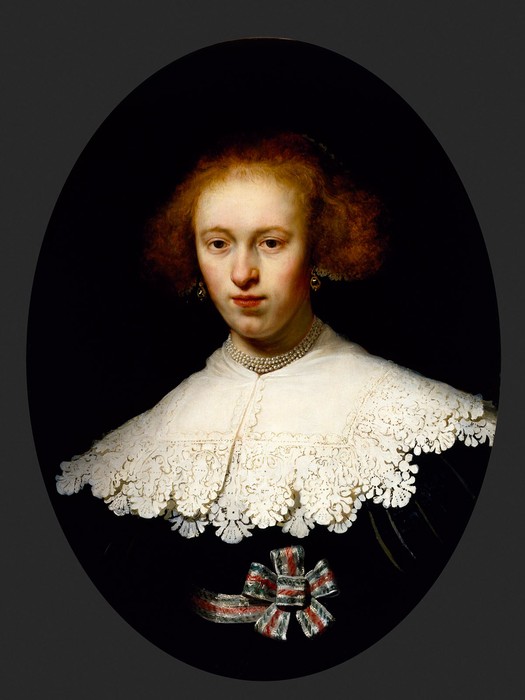
Rembrandt’s “Portrait of a Young Woman” greets the viewer with a quiet, concentrated radiance. Framed within an oval, the sitter leans slightly forward from a field of deep shadow, her pale face emerging with the unforced clarity of daylight. A luminous cartwheel collar of lace and a double string of pearls lift the portrait’s brightness, while a striped bow at her bodice adds a small, surprising accent of color. Nothing in the background competes with her presence. The composition is an exercise in restraint, designed to let light, lace, and a living gaze carry the image.
The Oval Format And Its Psychological Pull
The oval does more than shape the edges; it calibrates how we look. Its uninterrupted curve guides the eye in a continuous circuit around the head and collar, creating a chamber of attention without corners where focus might dissipate. Within this lens-like frame, Rembrandt positions the head slightly high and centered, so the viewer meets the eyes at a natural level. The body turns a touch to the right while the face returns toward us, a classic pose that produces both depth and engagement. The oval’s dark surround behaves like soft velvet, pressing the figure forward without theatrical shock.
Light As Gentle Authority
Light arrives from the upper left with judicial calm. It models the planes of the forehead and cheekbones, catches a precise highlight on the tip of the nose, and settles into subdued half-tones along the jaw and neck. The illumination is neither flattered nor severe; it is patient, descriptive, and kind. Pearls amplify the light’s rhythm in small, measured glints; the lace collar accepts it in complex waves, turning the portrait into a demonstration of how different substances translate the same illumination. By keeping the background unlit, Rembrandt lets the young woman’s face act as the room’s true source of clarity.
Lace As Architecture Of Brightness
The collar is a minor miracle of observation and design. Its scalloped edge floats like a cloud around the shoulders; inside that perimeter, cutwork and needlepoint patterns flicker between light and shadow. Rembrandt avoids the temptation to describe every thread. He establishes a legible hierarchy—crisper strokes at the outer rim where lace meets darkness, softened notation where the textile folds back into shadow—so that the collar reads as both delicate and structural. It behaves like an architectural cornice for the portrait, supporting the head while staging the light that defines it.
Color That Whispers And Persuades
The palette is restrained to persuasive effect. Creams and cool whites build the collar and pearls; warm flesh notes range from honeyed lights to quiet rose half-tones; the dress recedes into a deep, bottle-green black; the small bow introduces muted stripes of red and silver-grey that keep the lower register from monotony. Because the chroma is limited, temperature shifts become eloquent: a cooler grey under the eye firms structure; a faint blush at the cheek acknowledges youth; a slightly warmer echo of skin tone touches the inner edge of the collar where linen catches reflected light.
The Bow As Compositional Accent
Near the bodice, a meticulously painted bow offers a rare note of play. Its striped ribbons curl with convincing tactility, their satin catching small, decisive highlights. The bow is not a distraction but a foil: it anchors the lower field and balances the collar’s dominant brightness above. Its stripes also modulate the portrait’s rhythm—regular pattern below, intricate lace above—so the eye cycles between order and filigree before returning to the face.
Hair, Earrings, And The Soft Envelope Of Air
The sitter’s hair, a warm, reddish halo, seems to soften into the surrounding dark. Rembrandt tames the outer edges into a breathable blur, then sharpens individual curls where light kisses them. Tiny gold earrings, each a small, shining dot within a delicate hoop, provide additional punctuation in the shadowed zone beside the neck. These small metals do not announce wealth so much as confirm presence. They help the portrait breathe, giving the dark air around the head a subtle constellation.
Eyes That Think Rather Than Pose
The gaze is attentive, unforced, and inwardly steady. Rembrandt paints the moist rim of the eyes and a pinprick highlight that carries the pupil’s life without melodrama. The eyebrows sit low and calm, keeping expression in the realm of contemplation rather than display. This psychological middle register—neither flattered nor guarded—lets the viewer feel in conversation with a thinking person, not with a painted emblem of youth.
Flesh As Living Climate
The skin reads as a living climate rather than a polished surface. Thin, translucent passages allow light to seem as if it comes through the paint, not only across it. Subtle modeling along the philtrum, chin, and jaw prevents sweetness from sliding into blandness. A whisper of coolness under the lower lip and around the nostrils keeps the face structurally sound while letting softness prevail. The result is a persuasive sense of breath moving beneath skin.
The Social Language Of Dress
Seventeenth-century Amsterdam read clothing fluently, and this portrait speaks that language with clarity. The broad lace collar, the disciplined dark dress, the pearls, and the small earrings all signal decorum and means without ostentation. The sitter’s fashion aligns with the city’s civic ideal: cleanliness and order as virtues, ornament held in check, individuality expressed through quality rather than display. Rembrandt honors that ideal, yet his touch ensures that dress remains a frame for personhood, not a substitute for it.
Youth Rendered With Respect
Youth in this image is not sentimentalized. The lips are closed and gently firm, the posture upright without stiffness, the gaze level. Rembrandt avoids the sugary bravura that can flatten young faces into porcelain. Instead, he attends to small truths—the faint shadow under the collarbone, the near-transparency at the ear, the temperate flush at the cheeks—that communicate health and self-possession. This respect for the sitter’s intelligence is part of what keeps the portrait modern.
The Possibility Of A Pendant Pair
Rembrandt often painted pendant portraits of married couples or betrothed pairs in the early 1630s, each set within matching ovals and similar lighting schemes. The present work carries that flavor. Its format, angle of light, and measured luxury suggest it may have been conceived to face a companion portrait. Whether or not the pendant survives, Rembrandt composes this image with relational tact: the sitter is presented as the equal of any counterpart, neither overshadowed by costume nor softened into anonymity.
Brushwork That Records Decisions
Close looking reveals a surface alive with varied touch. In the lace, short, lifting strokes lay down high points like stitched thread; in the pearls, tiny daubs and linear highlights alternate to simulate roundness and gloss; in the hair, dragged, elastic marks ride over darker underlayers to catch a luster; in the flesh, veils of thin paint transition into firmer swipes along bone. The painting does not advertise technique, but it lets the attentive viewer read the artist’s choices, each adapted to the truth of a different material.
The Background As Ethical Silence
The uninflected dark behind the sitter is not a void; it is a silence chosen for ethical reasons. By refusing a narrative setting—no column, no drapery, no window—Rembrandt keeps the spectacle in check and the person at the center. The darkness cradles the light and leaves room for thought. It also reflects the taste of patrons who prized modesty, allowing identity to be carried by face and bearing rather than by allegorical props.
The Neck, Pearls, And The Physics Of Fit
The necklace is painted with a delicate understanding of weight and fit. Beads nudge the skin slightly where they sit, spacing changes as the strand rounds the neck, and the clasp’s tension is implied by a subtle difference in bead alignment. The collar rises behind like a starched horizon. These small physics demonstrate Rembrandt’s habit of respecting how things actually behave, which in turn persuades us of the portrait’s deeper truthfulness.
The Psychology Of The Turn
Although the figure is largely frontal, a slight turn creates the feeling of a conversation caught between breaths. The shoulders rotate to the right; the head inclines minimally toward the viewer; the lower face projects just enough to suggest readiness to speak. It is a poised moment, suspended at the edge of interaction. The painting offers the dignity of someone addressed, not displayed.
Early Amsterdam Rembrandt And The Rhetoric Of Clarity
Painted in 1633, the work belongs to Rembrandt’s early Amsterdam period, when he had recently arrived from Leiden and was mastering a rhetoric of clarity: immaculate light, subtle texture, luxurious but disciplined costume, and a psychological tone that respects the sitter. In this canvas, that rhetoric is refined to an almost musical balance—brightness above, depth below; ornament present yet governed; likeness faithful yet elevated. The painting delivers what the city expected from a prestigious portrait while quietly asserting the artist’s own ideals about presence and truth.
The Poetics Of Edges
Edges control the portrait’s breath. The lace’s outer scallops meet the dark with decisive crispness, while inner scallops soften as they roll into shadow. The hairline dissolves into the background in tiny feathery breaks, and the contour along the shoulder is alternately hard and soft to keep the figure from reading as a cutout. These calibrations are part of Rembrandt’s larger project of making the image feel inhabitable; the sitter seems to occupy the same air we do.
Time Held Without Sentiment
Everything in the picture implies a specific hour and a single sitting—the angle of illumination, the freshness of the skin, the faint sheen on the collar’s starch—yet the image does not rely on momentary anecdote. It holds time without sentiment, allowing the likeness to stand for itself beyond occasion. This balance is one reason the portrait remains compelling: it is at once exact and general, a person in a moment and a person beyond it.
Why The Portrait Still Feels Contemporary
The painting’s freshness comes from its confidence in simple means. Dark, light, a face, and a field of lace suffice. The sitter is granted privacy even as she is clearly seen. The image embraces restraint, trusts observation, and declines both spectacle and flattery. In an age saturated with staging, such clarity reads as modern. Viewers today recognize in the work a humane ideal: to represent someone truly while allowing her to retain her depth.
Closing Reflection On Light, Lace, And Personhood
“Portrait of a Young Woman” achieves its authority by aligning the theater of lace with the quiet of a living mind. Light performs across linen and pearl but settles, ultimately, on a face that meets ours with candid steadiness. The bow anchors ceremony to the body; the dark ground protects mystery; the oval gathers attention without pressure. Rembrandt’s art here is not to dazzle but to recognize. The portrait is both splendid and modest, both precise and gentle, and it allows the sitter to remain sovereign in her own image—a triumph of presence rendered through paint.
