Image source: wikiart.org
First Encounter With Presence Under a Wide Brim
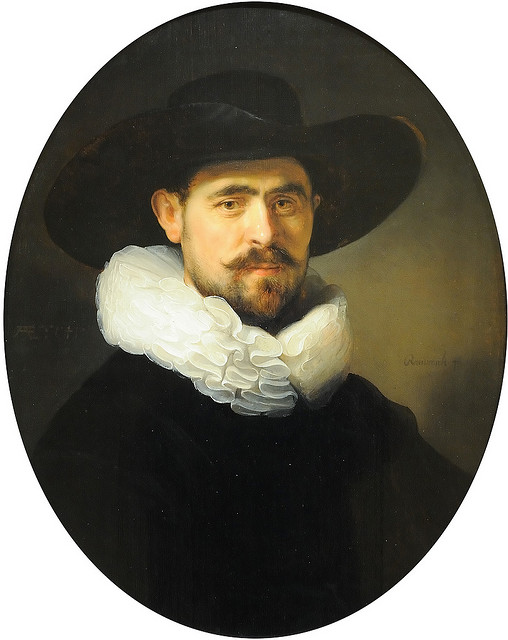
Rembrandt’s “Portrait of a Bearded Man in a Wide-Brimmed Hat” meets the eye with a quiet certainty. The sitter’s head turns slightly toward us within an oval field, the brim of his black hat forming a dark halo that pushes his face forward into light. A sumptuous white ruff rises like carved marble from a sea of black cloth, introducing a ceremonial radiance beneath the calm, attentive gaze. Nothing distracts: no architectural ledge or decorative prop competes with the face. The painting is an exercise in paring away until presence is the subject.
The Oval As Chamber Of Attention
The oval format shapes how we look. Unlike a rectangle—which can read as a room or a stage—the oval behaves like a locket or lens, cupping the sitter in a private chamber. Its curve guides the eye in a continuous circuit around hat, ruff, and visage, with no corners where attention can snag or dissipate. Rembrandt takes advantage of this to establish a measured tempo of viewing: the gaze moves from the shadowed brim to the luminous ruff, up through the planes of the cheek and nose, and rests in the eyes before circling again. The format itself becomes part of the portrait’s psychology—intimate, concentrated, and nondisruptive.
Composition Balanced Between Mass And Light
The composition is a study in weighed opposites. A dark hat and garment create a stable mass, while the ruff and face deliver luminosity. The head’s slight turn to our left gives depth and life without theatrical flourish; the body aims away as the face returns, a classic Rembrandt configuration that grants agency to the sitter. The hat brim establishes a firm horizontal near the top of the oval, answered by the scalloped rhythm of the ruff below, so that the face sits poised between two strong visual bars—shadow above, brightness below.
Chiaroscuro As Ethics Of Looking
Rembrandt’s light is a gentle authority. It falls from the upper left, modeling the brow, cheekbone, and nose with soft but decisive transitions. The eyes, sheltered under the hat, are still lucid; the beard is warmed by low light that preserves texture without fuss. Shadows here do not hide; they dignify. They let the face keep its privacy while stating its structure clearly. The painter refuses the flattering blaze that would flatten personality into sheen; he opts instead for a moral chiaroscuro that respects how people actually appear in rooms.
The Hat As Canopy And Stage
The wide-brimmed hat is more than costume; it is a stage device. By projecting a disk of darkness above the face, it concentrates illumination on the features and makes the pupils glitter like small lamps. The brim’s soft rim dissolves into the oval’s upper curve, preventing any hard cutoff that would make the head feel pasted on. The black felt reads through fine gradations rather than a single flat note; slight pressures of light along the crown locate real space above the skull. In wearing the hat indoors, the sitter signals status and decorum, but for Rembrandt it also becomes a compositional canopy under which character steps forward.
The Ruff As Sculptural Engine Of Light
The ruff is a triumph of painterly engineering. Its accordion of linen is not merely white; it is a landscape of cool shadows and warm reflected lights that churn around the neck. Each folded lobe catches illumination differently, so Rembrandt scores it like music—repeated forms with subtle variation. This ring of light does three jobs at once: it counterbalances the hat’s darkness, it lifts radiance into the picture without invading the face, and it acts as a reflector, pushing soft illumination under the chin and jaw. Far from fussiness, the ruff is an instrument that orchestrates the portrait’s atmosphere.
Flesh, Breath, And The Microclimate Of The Face
The face is handled with a mix of restraint and generosity. Brushwork around the eyes and nose is minute and disciplined; over the cheek and temple it loosens into soft, breathable passages where paint thins and warms. A cooler half-tone at the jaw prevents the head from ballooning; small rose tints at the cheek and lips suggest blood close to the surface. The short beard and mustache are briskly indicated—elastic strokes curl and settle, letting underlying warm greys supply the density of hair. Nothing is over-described; the impression is of skin that lives in air.
Eyes That Think Rather Than Pose
The sitter’s gaze is steady, open, and unforced. Light gathers at the moist rim of the eyes and in a pinpoint highlight that makes each pupil a tiny world. The eyes do not challenge or perform; they attend. This psychological neutrality—alert without theatrical emotion—gives the portrait its lasting generosity. We do not feel scrutinized or courted, but met. Rembrandt found in such middle registers an enduring truth: a person’s mind showing at the surface.
Color As Ceremony Without Noise
The palette is narrow—ebony, ivory, warm flesh, and a trace of brown in the beard—yet it reads as ceremonious. The black is not a hole; within it live cool blues and soft browns that keep the garment’s planes legible. The white is not chalk; it carries pearly greys and faint reflected pinks from the face. Because chroma is restrained, tiny temperature shifts speak loudly. A warm note on the ear, a cooler wash under the eye, a honeyed glaze on the cheek: these variations keep the painting vivid without a chorus of colors.
Edge Work And The Illusion Of Breathing
Edges govern the portrait’s pulse. The brim bites a little harder into the background near the temple where light meets dark; elsewhere it feathers out, letting air slip by. The ruff’s outer edge oscillates between crispness and blur as it rolls toward and away from us; the shoulder’s contour relaxes into the garment’s body so the figure doesn’t silhouette too sharply. This modulation prevents the head from reading as a cutout; it seems to breathe within the oval’s air.
Social Signals And Self-Possession
Costume and grooming signal the sitter’s world: a prosperous Amsterdam citizen or professional, fashion-conscious without ostentation. The hat attests to standing; the ruff to cleanliness, order, and expense; the trimmed beard to care; the black garment to sober taste. Yet none of these signals eclipse individuality. The portrait’s most striking quality is self-possession—an ease that comes not from flaunted wealth but from the settled way the man inhabits his appointments.
Early Amsterdam Rembrandt And The Rhetoric Of Restraint
Dated 1633, the portrait belongs to Rembrandt’s early Amsterdam period, when he achieved rapid success with portraits that mixed lustrous handling and psychological depth. Many works from these years revel in decorative bravura; here, the bravura is disciplined. The ruff is brilliant yet functional; the hat is grand yet quiet; the face is meticulously true. This measured rhetoric—splendor in service of presence—would become a signature of Rembrandt’s best portraiture.
Brushwork That Records Decisions
Look closely and the surface tells a story of choices. Broader strokes build the black garment in unified planes; smaller ones knit the eyes and nostrils; lightly dragged strokes on the ruff catch minute ridges of impasto that sparkle like linen threads. Scumbles soften transitions at the temple and cheek; glazes enrich the shadow under the brim. The painting is not a smoothed, anonymous finish but a legible record of the painter’s thought: where to declare, where to suggest, where to leave breath.
The Psychology Of The Turn
The body’s slight rotation away while the head returns creates a psychological voltage. It conveys a person momentarily interrupted—addressed, turning, attentive. This motion, frozen at a comfortable midpoint, avoids stiffness. The sitter does not sit for us like a specimen; he exists in time, in a room, in a conversation. The turn is a simple device with large effects: it animates character without theatricality.
The Background As Chamber, Not Void
Behind the sitter spreads a soft, warm field that graduates almost imperceptibly from near-black to a smoky brown. No window, chair back, or drapery intrudes. This absence is principled. By keeping the room undefined, Rembrandt preserves the sitter’s privacy and leaves the viewer with a pure encounter, unmediated by symbolic props. The background is not nowhere; it is a deliberately neutral chamber where light can work and the face can be legible.
The Hat’s Shadow And The Comfort Of Mystery
The brim casts a gentle eclipse across the forehead and eye sockets, compressing values and introducing mystery without obscurity. That shadow secures the portrait’s depth: the distance from brim to brow is felt, not merely seen. Psychologically, the partial concealment gives the sitter dignity. We do not own his face; we witness it. Rembrandt understands that a small pocket of darkness can make the light read truer—and the person more human.
The Ruff’s Rhythm And The Music Of Repetition
Rembrandt turns the ruff’s repetitive folds into visual music. Each scallop is a measure, and he varies the beat with accents of firm highlight, softer reflection, and hidden shadow. This rhythm stabilizes the portrait structurally while providing sensuous pleasure. It also has a symbolic undertone: ordered form encircling vital life, culture framing character. The ruff is civilization in linen, but in Rembrandt’s hands it never petrifies the man who wears it.
The Bearded Mouth And The Hint Of Humor
The mustache rises into a faint smile at the corners, supported by a mouth that is closed but relaxed. That slight upturn—a decision of a few hairs and a small lip shadow—warms the portrait. It keeps severity at bay and suggests good humor without caricature. Rembrandt excels at these micro-inflections, where a person’s demeanor is carried by a handful of strokes set just so.
The Portrait As Contract Between Viewer And Sitter
One feels, standing before this oval, that an agreement has been struck. The sitter offers a composed, honest presence; the viewer offers attention free of prying curiosity. This mutual respect is encoded everywhere: in the modesty of the pose, the restraint of the palette, the clarity of the paint. The picture avoids the two common traps of portraiture—flattery and exposure—and lands instead in candor.
Why The Painting Still Feels Fresh
Contemporary eyes respond to its simplicity. In a world of visual noise, the economy of means—black, white, flesh; hat, ruff, head—reads as confidence. The painting trusts a face to carry a story without props or slogans. It also models an attitude toward representation that remains relevant: show enough to be true, omit enough to be humane. The work’s freshness is not an accident of fashion; it is the product of principles that age well.
Closing Reflection On Presence, Order, And Light
“Portrait of a Bearded Man in a Wide-Brimmed Hat” is Rembrandt’s compact argument for how paint can render a person with order and mercy. The hat gathers shadow to protect mystery; the ruff gathers light to reveal structure; the face gathers both into a stable, attentive self. The oval quiets the field; the brush writes what the eye has learned; the palette speaks softly but with authority. The result is not a display of costume but a demonstration of presence—someone real, seen truly, allowed to keep his depth.
