Image source: wikiart.org
Meeting the Artist at Work
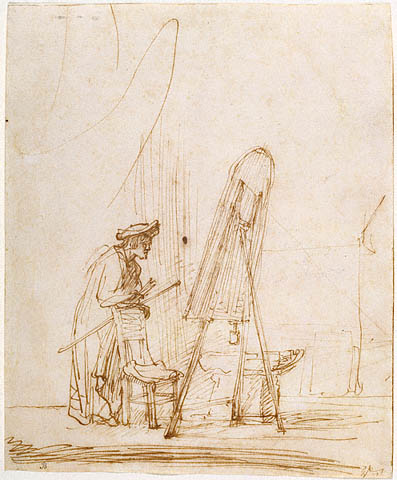
Rembrandt’s “Artist in His Studio” presents one of the most disarming themes in art: the maker alone with the act of making. Rather than a grand display of finished brilliance, we witness the humble yet charged moment in which imagination, labor, and uncertainty meet. A solitary figure bends forward, tools in hand, before a large easel that rises like an obelisk at the center of the sheet. The studio is spare and provisional. Everything is oriented toward the work, and yet the work itself remains unseen. This drawing turns the studio into an arena of thought, where the presence of the artist is both material and meditative, and where the architecture of production becomes the subject of art.
A Composition Built Around the Vertical Monarch
The easel dominates the composition like a vertical monarch. Its tall triangular legs press into the foreground, staking out a territory of purposeful geometry. The artist, by contrast, is a compact cluster of curves and slanted lines, a human knot at the left who leans toward the instrument of his vocation. Between these two figures—the animate and the inanimate—Rembrandt plants the central tension of the image. The easel’s height dwarfs the artist and seems to demand a response, while the artist’s forward tilt replies with concentrated attention. The sheet’s negative spaces are as important as its lines, amplifying the sense that the studio’s emptiness is not absence but possibility.
The Drama of Scale and the Psychology of Proportion
The easel’s exaggerated scale relative to the artist has often been read as a metaphor for the task ahead. It is not simply that the object is large; it is that the work to be done feels large. By allowing the easel to tower over the bent figure, Rembrandt compresses the artist’s body into a shape of readiness. The body is loaded like a spring. The smallness of the human form does not register as weakness but as a realistic appraisal of the magnitude of creation. In this sense, the drawing stages a psychological drama: the self confronting the scale of its own ambition.
Line as Thought and Hesitation
Rembrandt’s line is alive with hesitation, correction, and sudden decision. The studio walls are scarcely defined, as if the room were drawn with breath rather than ink. The easel receives clearer delineation, while the artist’s profile, cap, and shoulders are treated in supple, quick strokes that feel like notes taken from the body’s own tempo. These lines are not vectors aimed at a single outcome; they are thinking in motion. One can feel the nib slowing down for a curve, speeding up for a straight descent, and flicking away from the paper in moments of release. The drawing therefore functions like a visible transcript of mental pace.
Paper Space and the Weight of Air
The sheet’s blankness is not empty; it is an atmosphere. Rembrandt allows large fields of unmarked paper to surround the figures so the eye can experience quiet. Quiet, in turn, becomes weight, as though the air in the studio had mass. This weight of air bears down subtly on the artist’s back and accumulates around the easel’s peak, helping to register the pressure of expectation. Working with almost nothing—paper tone and a few calibrated strokes—Rembrandt makes the viewer feel the interior weather of the room.
The Theatre of Tools
Every visible object serves the theatre of making. The easel is the central prop; a stool and perhaps a low bench or table stand nearby; the artist holds a stick or brush in one hand and a longer mahlstick or support in the other. There is an economy of representation that suggests a studio stripped to essentials. The mahlstick’s diagonal echoes the easel’s legs, turning the artist’s body into an extension of the equipment. Tool and hand align, so that the figure seems almost wired into his devices, not dominated by them but in conversational rhythm with them.
Gesture as a Measure of Mind
The artist bends forward without strain. The knees are slightly flexed; the spine rounds; the arms extend in a poised angle that suggests a moment before contact. The gesture is one of approach rather than performance. It is as though he has come to the threshold of a mark and paused to test whether it is the right one. This is distinctive in Rembrandt’s depictions of work: he often locates drama in the moment before action when deliberation is thickest. Here, that pause carries the density of countless possible pictures.
The Studio as Interior Landscape
Though sparsely articulated, the studio reads like a landscape with a horizon and a dominant peak. The easel is the mountain. The flatness of the floor manifests as a wide plain of practice, a site that has been walked over and over by the same pair of shoes. The faint lines climbing the wall behind the easel act like atmospheric striations. This landscape metaphor subtly elevates the act of painting into exploration. The artist is not enclosed; he is out in a mental terrain mapped by the lines he is about to inscribe.
A Portrait Without a Face
The figure’s face is merely touched in, but personality radiates from stance and proportion. The hat, the cloak or apron, the slightly protruding chin, the way the tool is gripped—all of these serve as identifiers more than portrait likeness. Rembrandt turns away from a descriptive likeness to emphasize the condition of being an artist. The drawing is therefore a portrait of a role rather than of a single individual. It portrays the human posture of making: alert, inclined, carrying a bundle of knowledge in the hands.
The Courage of Leaving Things Unsaid
What makes the drawing powerful is not what is shown but what is left unsaid. The canvas on the easel doesn’t display an image; we are denied the subject of the work. The wall does not declare an exact room; furniture does not crowd the perimeter; no window is drawn to show where the light enters. These omissions create a field of indeterminacy that lets us project our own experience of beginning. The drawing is not a report from a finished world but an invitation into a beginning world, where every mark must prove itself in the next minute.
The Rhythm of Vertical and Diagonal
Rembrandt orchestrates a simple rhythm of vertical and diagonal elements. The easel’s central post establishes the main vertical, while its legs and the mahlstick produce diagonals that converge toward the artist’s hands. This rhythm drives attention to the place where decision concentrates: the tool poised before the surface. The eye cannot help but cycle repeatedly from the artist’s hands to the blank field and back again, simulating the very scanning motion an artist performs when evaluating a work in progress.
Working Knowledge Revealed Through Omission
Even without descriptive detail, the drawing betrays deep working knowledge of studio behavior. The stool is placed with practical alignment to the easel; the mahlstick is held at a leverage-friendly angle; the artist stands rather than sits at the critical moment of approach. These are habits of craft, recorded with such casual accuracy that they feel inevitable. Rembrandt’s authority arises not only from virtuoso mark-making but from the authenticity of habits he renders almost by reflex.
Humility as a Mode of Grandeur
The mood is humble, but humility here is not self-effacement; it is a disciplined clearing away of distraction. Grandeur derives from concentration, and concentration from purposeful restraint. The artist’s hat is modest, the robe or apron purely functional, the posture untheatrical. Yet the act of standing before the easel carries a quiet majesty. Rembrandt thus proposes an alternative to bombast: the grandeur of someone who has committed his body to a demanding craft and who meets the blank surface with respect.
Time Suspended in a Studio Without a Clock
Nothing in the drawing marks time explicitly, but the whole sheet is saturated with duration. The studio feels like a vessel that holds working time. We sense hours of practice compressed into a minute of poised looking. The absence of clocks, windows, and shadows makes the image strangely timeless, as though the studio were a place where the ordinary schedule dissolves and only the alternation between risk and judgment remains. This suspension enhances the contemplative core of the scene.
The Ethics of Proximity
Our viewpoint places us just to the right of the easel, at almost the same distance from the canvas as the artist himself. We occupy the working zone. This proximity is intimate but not intrusive; it grants us the privilege of standing beside the maker at the threshold of an act. The drawing therefore models a kind of ethical looking, in which the viewer is invited to share the responsibility of attention. We are not voyeurs; we are provisional collaborators, asked to participate in the seriousness of the moment.
The Artist as Everyworker
Although the subject is an artist, the drawing resonates beyond artistic labor. The bowed head, the primed tools, the quiet station, the negotiation with an unyielding task—these are recognizable to anyone who works with care. In this way, the drawing speaks to the dignity of attentive labor. It is an image of craftsmanship that honors both the mind’s plans and the body’s execution, refusing to divide thinking from doing.
Material Intelligence and the Economy of Means
The sheet demonstrates material intelligence through sparing means. A few tense strokes describe the easel’s engineering; quick, soft touches suggest fabric folds; barely-there lines mark the studio’s edges. The economy of means has a conceptual effect: by offering only what is necessary, Rembrandt puts pressure on each mark to carry meaning. Every line must justify itself. This insistence parallels the artist’s own internal criterion as he faces the blank support: only what is necessary should happen next.
The Invisible Image as the Drawing’s Secret Center
The most magnetic object is the one not drawn: the picture on the easel. Its invisibility pulls us forward. We search the rectangle for clues; we receive only paper tone. That blank plane functions as a second sheet inside the first, a meta-surface that mirrors the page we are looking at. This doubling creates a witty reflexivity. We look at a drawing about the moment before a drawing—a mise en abyme of making that turns absence into the secret center of the composition.
The Studio as Moral Space
Rembrandt frequently casts interiors as moral spaces, places where character is quietly measured. Here the studio embodies virtues that were especially important to him: patience, concentration, and resilience in the face of uncertainty. The drawing refuses bravado and settles into an ethics of preparation. To stand there with the tool in hand and the heart steadied is to practice a moral art, one that respects complexity and proceeds anyway.
The Human Scale of Genius
Rembrandt’s reputation can make it difficult to see the human scale of his practice. This drawing restores it. Genius appears here not as lightning strike but as ritual: enter the room, approach the easel, consider, test, commit, revise. The small figure under the big easel is a reminder that even the greatest talents meet their work at human size, one decision after another. The sight is encouraging. It shores up the courage of anyone confronting a blank beginning.
Silence as a Medium
What we hear in the image is silence. The quiet is not dead; it is the kind of silence that carries concentration, like the hush before an orchestra begins. Rembrandt uses silence as a medium alongside ink and paper. The absence of chatter, of spectators, of bustling props lets the focus thicken. In that thickened silence, the mind can calibrate itself to the task. The drawing trains the viewer to value such conditions, to see in silence an active and necessary instrument of making.
Looking, Measuring, and the Moment Before Touch
The artist’s hand has not yet touched the surface. He is looking, measuring, rehearsing a line in his mind before committing the real one. This pre-contact interval is the most difficult to depict because it is invisible in everyday life. Rembrandt nevertheless captures it through the angle of wrists and the alignment of shoulders toward the support. We feel the imminence of touch and the discipline required to delay it. The drawing credits the invisible labor of judgment that precedes a mark, the mental construction without which making devolves into accident.
The Tradition of Self-Reflexive Studio Images
Images of the studio have a long pedigree, from medieval illuminators at their desks to later depictions of ateliers as social theaters. Rembrandt’s version is stripped to essentials and inwardly turned. Rather than commemorate the studio as a place of pageantry or celebrity, he treats it as a cell for thought. This choice positions the work within a lineage of self-reflexive art that investigates its own conditions, but it does so without rhetoric. The question of how art comes into being is answered in a near whisper: by standing, by seeing, by trying again.
Endurance and the Poetics of Repetition
The drawing suggests not a single heroic moment but a practice repeated across a lifetime. The stool and easel stand like old companions; the posture feels learned over years. Even the floor’s sketched lines read as traces of prior sessions. The poetics of repetition—returning to the same place, the same equipment, the same problems—breathes through the sheet. Rembrandt converts routine into lyric by respecting its endurance.
Why This Image Still Matters
Contemporary viewers recognize the scene because the essential predicament of making has not changed. Whether the support is a canvas, a sheet, a tablet, or a screen, the poised hesitation before the first or next mark remains the crux. The drawing honors that shared predicament. It affirms that creation is not sorcery but attention coupled with courage, and it finds in the simplest studio geometry a monument to that truth. For all its modesty, “Artist in His Studio” is a devotional image for anyone who has ever begun.