Image source: wikiart.org
A First Encounter With Rembrandt’s Private Theater
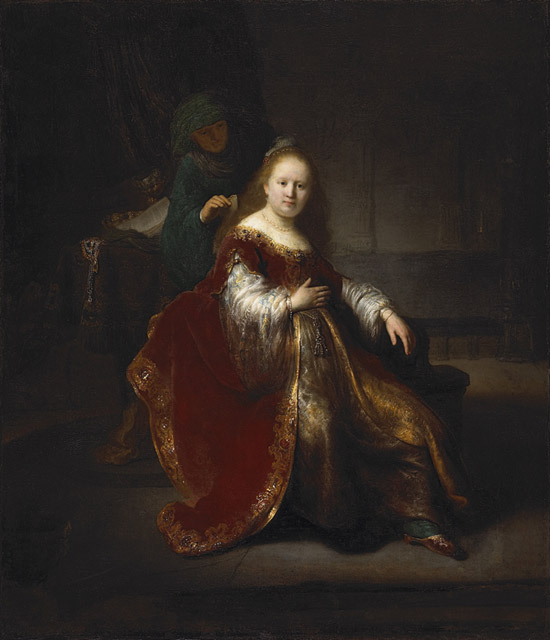
Rembrandt’s “A Young Woman at Her Toilet” stages a moment that feels both candid and composed, intimate yet ceremonially grand. A richly dressed young woman sits at a slight diagonal to us, turning her face and upper body into the light as if she has paused midway through a private ritual of dressing. Behind her, half veiled in darkness, an attendant leans forward with a motion that suggests fastening, arranging, or perhaps offering a final touch to hair or jewels. The painting’s dramatic chiaroscuro instantly establishes a theater of light where the heroine’s face, hands, and sumptuous clothing become protagonists, and where darkness doubles as a curtain that both conceals and reveals the scene. From the first glance, we sense that Rembrandt wants us to feel complicit in the moment, as though we have arrived at the threshold between ordinary preparation and public appearance.
The Genre Of Toilette And The Ambiguity Of Narrative
Scenes of a woman at her toilette were a familiar subject in the seventeenth century, spanning moralizing images of vanity, aristocratic self-fashioning, and biblical or mythological heroines preparing for decisive encounters. Rembrandt embraces this genre but refuses to pin it to a single, unambiguous story. The painting can be read as a secular interior in which a fashionable young woman prepares herself, yet it simultaneously hints at archetypal narratives: Esther readying herself before the king, Bathsheba attended by a maid, or a bride completing the ritual of adornment. Rembrandt keeps the narrative porous. The ambiguity invites multiple readings that focus our attention on the act of dressing as a threshold event—an in-between time that carries anticipation, vulnerability, and power.
Composition As A Controlled Asymmetry
The composition hinges on a controlled asymmetry that generates energy while maintaining balance. The young woman’s body angles forward and leftward, but her face and left hand gently pivot toward the viewer. The heavy sweep of her deep red cloak arcs outward, creating a semilunar form that anchors the lower left quadrant. Opposite this, a receding diagonal pulls us back into the dim interior where the attendant’s figure barely extracts itself from shadow. The key masses—a flare of crimson velvet, the pale oval of the face, and the lamped sheen of satin—are distributed like stepping stones across a dark pool. The asymmetry feels alive because it replicates the physical reality of dressing, where fabric shifts, weight shifts, and attention shifts from hand to clasp, from mirror to attendant, from interior to outward gaze.
Chiaroscuro And The Ethics Of Light
Rembrandt’s light is not merely descriptive; it is ethical. It assigns importance, establishes relations of seeing and being seen, and dramatizes the transition from private to public. The face is bathed in a calm, frontal glow that reveals the sitter’s alert intelligence without harshness. The hands—one resting near the bodice, the other extended with a subtle downward drift—receive slightly stronger incident light, which isolates their expressive agency. Shadows are not empty; they are saturated with browns, greens, and cool grays, forming a moral chiaroscuro in which the glamor of gold and velvet must negotiate with the quiet of obscurity. The attendant’s immersion in shadow turns service into a kind of votive anonymity, while the heroine’s emergence into light reads as selfhood coming to fruition.
Color As Social Temperature
The palette turns color into social temperature. The cloak’s wine-red velvet, edged with intricate gilded embroidery, radiates status and warmth; it functions as the painting’s hearth. The underdress in silvery satin and the pearls at the neckline offer a cooler register, tempering opulence with clarity. Greens and deep umbers suspend the background in a quiet, vegetal dusk. The interplay between the warm cloak and cool satin accomplishes more than contrast; it maps the sitter’s passage from the interior world of preparation to the cooler scrutiny of public space. Seen this way, red is the private warmth of dressing, and silver is the public sheen of appearance.
Textures You Can Hear
Rembrandt’s textures are so persuasive they seem audible. The velvet looks thick enough to muffle sound; the satin is taut and whispering; the lace at the neckline crackles with a fine, dry brilliance. He achieves this through a dialogue between impasto and glaze. The raised highlights on jewels and trim catch light like small bells, while thin, translucent layers in the shadows deepen color without sacrificing luminosity. The hem’s gilt ornament is not merely painted; it appears stitched into the picture plane through clusters of loaded, deliberate touches. The result is a tactile chorus in which each material speaks in its own timbre, yet all are orchestrated to the rhythm of the sitter’s poised pause.
Gesture, Poise, And The Grammar Of Hands
Few painters read hands as sensitively as Rembrandt. The nearer hand, aligned to the bodice, suggests that a clasp has just been fastened or will be in a heartbeat; it is the hinge of the moment. The further hand extends with a delicate, almost rhetorical droop, its fingers relaxed yet eloquent. These hands define the psychological tempo between inner awareness and outward address. The posture is neither defensive nor exhibitionist; it is an equilibrium of self-attention and composure before an imagined audience. In this grammar of hands, to touch the bodice is to recognize one’s own becoming, and to let the other hand descend is to concede the gaze without surrendering agency.
The Attendant As Negative Portrait
The attendant stands as a negative portrait, a silhouette of function more than individuality. Wrapped in darker fabrics and turning into the penumbra, the figure mediates between the heroine and the world of things—pins, combs, ribbon, and the tactile knowledge required to handle them. By blurring the attendant’s features and embedding her in darkness, Rembrandt converts service into a structural device: a shadow that articulates the light. This negative portrait underscores the painting’s theme of preparation by showing the social labor that props up elegance. Elegance here is collaborative and relational, not solitary.
The Stage Of The Room And The Invisible Mirror
The room functions like a shallow stage, hardly elaborated yet dense with implication. The spatial cues are minimal but sufficient: a bench or low platform, a dark hanging drapery, a smudged suggestion of architectural relief in the far background. The implied mirror, possibly outside the frame or dimly present, becomes the composition’s secret engine. The young woman’s turned gaze feels triangulated among self, attendant, and mirror, and we, as viewers, are drawn into that triangle. The painting therefore doubles the act of looking: she looks to see herself while we look to see her, and the two acts become simultaneous and mutually defining.
Early Rembrandt And The Rhetoric Of Splendor
Dated to the early 1630s, the painting belongs to a period when Rembrandt often reveled in the rhetoric of splendor—costume pieces, satins, parade armor, and theatrical dress. Yet he never lets splendor be empty display. The luminous fabrics are carriers of psychology and narrative, vehicles for light, and instruments for formal play. We witness the young Rembrandt testing how much drama a scene can hold without leaking into mere spectacle. His answer is to fold drama back into human presence: the flash of satin matters only insofar as it describes the sitter’s transition from preparation to presentation.
Paint Handling, Glaze Logic, And The Pulse Of Edges
Looking closely, one sees how Rembrandt modulates edges to control pulse and attention. He keeps the facial edges soft yet clear, avoiding the brittle contour that would make the sitter appear cut out against darkness. The boundary of the red cloak is more emphatic, a sculpted edge that carries the weight of the garment. In the shadows, he knits forms together with warm glazes so that objects seem to condense rather than sit separately. Highlights are often placed with loaded strokes that retain the memory of the brush’s pressure. In material terms, the painting rehearses the same story as the subject: a careful negotiation between exposure and withholding.
Costume, Class, And The Language Of Ornament
Costume here is a language of class and occasion. The embroidery that rims the cloak speaks in a high dialect of wealth, but Rembrandt avoids caricature by letting ornament serve structure. The gold edging is strategically placed to echo the curve of the body and to articulate the cloak’s weight. Jewelry is restrained, not heaped; pearls describe the threshold between flesh and fabric. Each ornament therefore functions as punctuation rather than florid decoration, helping the viewer read the figure’s volume and the scene’s tempo.
Intimacy Without Voyeurism
One reason the image feels dignified is that Rembrandt calibrates intimacy without tipping into voyeurism. The sitter’s gaze is direct but calm; it meets us on equal terms. There is no accidental disarray engineered to thrill the eye, no overexposure of skin or disheveled garment. The scene respects the ritual nature of dressing, which was as much about readiness and identity as about bodily display. We are invited not to stare but to attend, to witness a person gathering herself for her role in the world.
Moral Ambivalence And The Theme Of Vanity
The genre of the toilette carried a built-in moral tension. On one side lies the charge of vanity, the squandering of time and attention on outward beauty; on the other lies the ideal of appropriate self-presentation, a visible order that honors occasion and community. Rembrandt’s solution is not to adjudicate but to show preparation as a contemplative practice. The sitter’s expression is thoughtful, not coquettish; the attendant’s presence is practical, not frivolous. The painting does not scold or celebrate; it renders the ambivalence with grace, allowing viewers to supply their own moral accent.
Temporality And The Poetics Of The Pause
Everything in the picture suggests a pause of unusual thickness, the kind of interval in which decisions congeal. The cloak pools as if it has just fallen into place; the hand by the bodice indicates a fastening either completed or impending; the attendant’s arm is raised at a midpoint of action. Even the light feels momentary, like a door or curtain has opened wider for a breath and may soon narrow again. Rembrandt choreographs this temporal poise with such care that the painting reads less like a snapshot and more like a sustained inhalation.
The Viewer As Silent Participant
The composition subtly casts the viewer as a participant in the ritual. Our vantage meets the sitter’s eyes at almost equal height, implying proximity within the room. We are neither above judging nor below serving; we occupy a respectful nearness that honors her personhood. The invitation is not to intrude but to keep company. In this way the painting becomes a small social contract written in light: we will look attentively and she will allow herself to be seen attentively, and attention itself becomes the currency exchanged.
A Dialogue With Rembrandt’s Other Depictions Of Women
In the broader arc of Rembrandt’s work, this painting resonates with his evolving depictions of women as bearers of inward life. Whether he is portraying biblical heroines, allegorical figures, or contemporary sitters in imaginary dress, he often refuses to flatten them into types. The women look back. They register thought, hesitation, humor, resolve. “A Young Woman at Her Toilet” belongs to this lineage, translating the stereotype of the coquette into a subject with mind and situation. The toilette becomes not a trope but a narrative medium for conscience and anticipation.
Space, Depth, And The Tact Of Indeterminacy
Rembrandt’s handling of space is notable for its tact. He offers just enough architecture to suggest depth without imprisoning the figure in a rigid box. The blurred columns or wall reliefs in the distance are more atmospheric than structural; they keep the space breathable. This indeterminacy serves the painting’s theme by preventing the room from becoming a trap of specificity. The scene is any room, every room, the place where identity is assembled before it must withstand the world.
Light As Character And Theology
Light here is a character with intelligence and mercy. It does not rake or accuse; it consoles and clarifies. The sitter’s face is modeled with transitions so supple that shadow reads as thought rather than stain. Theological metaphors inevitably rise with Rembrandt: light as grace, darkness as humility. Even in a nonbiblical reading, the painting offers a secular sacrament in which illumination confers readiness. To be ready in this space is to be seen truly, and to be seen truly is to be affirmed.
The Pictorial Economy Of Silence
Silence is one of the painting’s materials. There is no chatter of objects, no busyness of background, no noisy narrative. The silence allows fabrics to speak, allows the small shift of a hand to register as an event, allows the attendant’s shadow-presence to be felt rather than described. Rembrandt practices an economy of means in which omission is eloquent. What is left unarticulated invites the viewer’s imagination to collaborate, completing the scene with personal experience of thresholds—weddings, audiences, crucial meetings, or any moment when dressing was also deciding.
The Psychology Of Expectation
The young woman’s gaze carries expectation rather than invitation. She is self-possessed, attuned to what the moment requires, neither anxious nor complacent. Expectation gathers at the corners of the mouth, in the stillness of the shoulders, and in the slight forward lean that foreshadows rising. The painting thereby becomes a study in readiness—a poised mind in a poised body, a person just before she steps across the invisible boundary from inner to outer life.
Why The Painting Still Feels Contemporary
Modern viewers often recognize themselves in the scene’s choreography of preparation. The ritual of getting ready persists, whether for ceremony, work, or performance. The painting understands the emotional weather of such moments: the quiet reckoning with self, the inventory of appearance, the acceptance that identity must sometimes be communicated through surface. Rembrandt refuses cynicism about this truth. Surface is not a lie; it is a medium for meaning, a negotiable interface between the self and the social world.
A Synthesis Of Material Splendor And Human Depth
Ultimately the painting achieves a synthesis rare in any era. Material splendor—the velvet, satin, gilding, and pearls—coexists with human depth rather than obscuring it. Light dignifies both the person and the things that serve her, but the person remains sovereign. The attendant’s shadowed devotion reminds us that beauty is made, not merely possessed; the sitter’s calm gaze returns us to the idea that beauty is also borne with responsibility. Dressing becomes a moral and social act, and Rembrandt’s artistry turns that act into a lasting image of poised humanity.
Closing Reflection On Rembrandt’s Art Of Thresholds
“A Young Woman at Her Toilet” is a meditation on thresholds: between dark and light, private and public, preparation and performance, ornament and essence. Rembrandt builds these thresholds into every level of the work—composition, color, texture, gesture, and space—so that the painting feels perpetually on the verge. The verge is where character shows. Standing there, the young woman neither begs to be admired nor fears being judged. She is ready, and readiness itself becomes beautiful. The canvas holds that readiness indefinitely, inviting each viewer to remember the charged hush before an important step, and to see in Rembrandt’s theater of light a mirror of their own becoming.