Image source: wikiart.org
Introduction
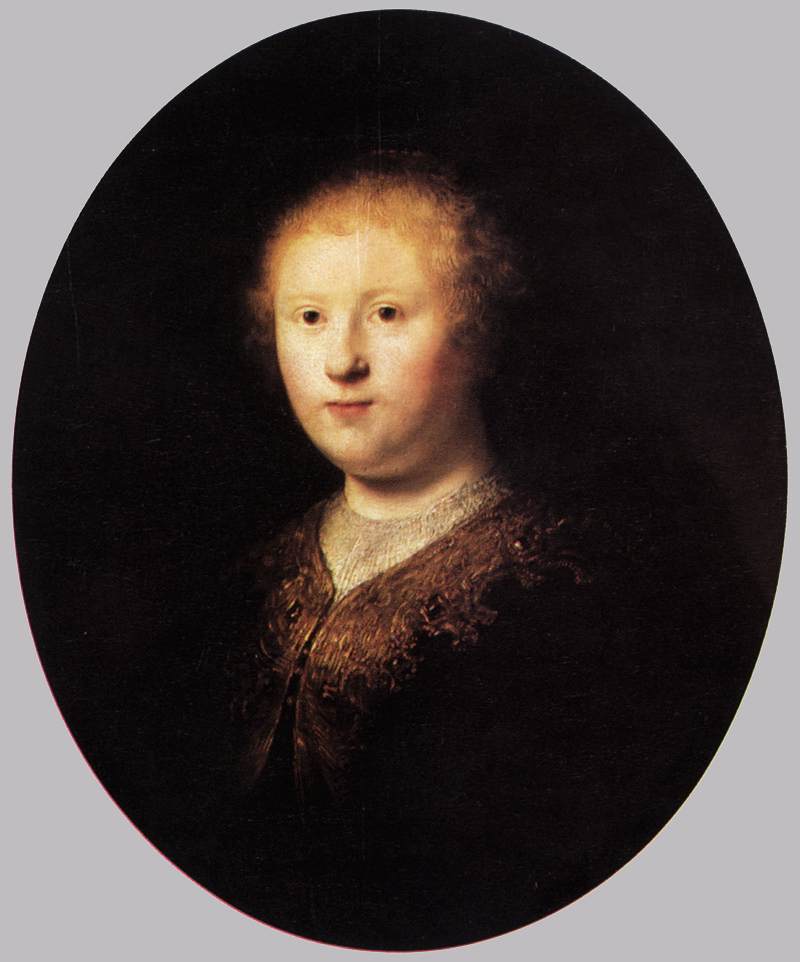
Rembrandt’s “Portrait of a Young Woman” from 1632 is a compact study in radiance and restraint. Set within an oval field, the sitter emerges from velvety darkness as if called forward by light alone. Her face, softly illuminated, floats above a collar and bodice delicately inflected with warm highlights. Nothing in the background distracts; the world seems to dissolve so that attention can gather on the features and the hush of the moment. Painted during the year Rembrandt cemented his reputation in Amsterdam, the work shows a young master translating civic taste—clarity, modesty, and finish—into an intimate presence that still feels alive today.
Historical Context
The year 1632 was pivotal for Rembrandt. Newly established in Amsterdam after formative years in Leiden, he was navigating a portrait market dominated by merchants, regents, and their families. Patrons sought likenesses that affirmed prosperity without ostentation: sober garments, pristine linen, and a neutral setting. Rembrandt accommodated those expectations while intensifying them. He softened the theatrical chiaroscuro of his Leiden pieces into a steadier studio light and polished surfaces to an urbane sheen, but he retained the psychological acuity that made sitters appear alert and present. “Portrait of a Young Woman” belongs to this moment of convergence. Everything about it—oval format, close cropping, delicate modeling—announces a painter attuned to Amsterdam decorum and determined to rescue individuality from formula.
The Oval Format and Its Effects
The oval is not a mere frame; it is a compositional principle. By trimming corners and compressing space, the format concentrates visual traffic toward the center, encouraging a circular scan that returns again and again to the face. It also harmonizes with the sitter’s forms: the head’s rounded silhouette, the collar’s soft arc, and the bodice’s gently curving neckline. Rembrandt uses this geometry to create a pocket of intimacy. The viewer feels invited into a private zone of attention where the figure can breathe yet remains protected by shadow. The oval’s dark perimeter functions like a velvet curtain, lending the portrait a quiet theatricality without props or architecture.
Composition and Proportional Balance
Rembrandt places the head slightly above the vertical midpoint and just off the horizontal center, giving the composition a minute asymmetry that keeps it alive. The face is turned three-quarter to the viewer’s left, with the faintest counter-tilt of the chin. The lighter collar sets a soft horizontal under the chin, while the embellished neckline creates a shallow V that leads the eye down and then back up to the cheeks. This triangle of attention—eyes, mouth, collar—establishes the rhythm of looking. The surrounding darkness offers rest, so the illuminated passages retain their freshness no matter how long we regard them.
Light as Presence
Light in this portrait behaves like a character. It arrives gently from the left, touching forehead, bridge of nose, cheek, and chin before dissolving into half-tones along the far contour. The effect is not theatrical spotlight but a studio glow calibrated to reveal how skin turns in space. Rembrandt avoids harsh edges; instead, he builds transitions with veils of thin paint, letting warmth gather toward the center of the face and coolness seep into the margins. The result is a sensation of breath and nearness. The sitter does not glare from darkness; she approaches it, as if about to speak.
Color and Tonal Design
The palette seems restricted—warm flesh against deep browns—but closer looking uncovers a harmonic field of hues. The face contains rosier notes around the cheeks and chin, pearly half-tones beneath the eyes, and a faint coolness along the temple that seats the head within the surrounding air. The collar and neckline carry gray-violets and amber touches that catch and release light. The bodice’s embroidery, though subdued, glints with coppered highlights. These quiet colors are subdued beneath a strong tonal architecture: deep shadow around the oval, mid-tone garment, high-value face. Color serves tone, and tone serves presence.
Surface, Brushwork, and the Tactile Illusion
Rembrandt’s handling in 1632 remains relatively smooth, yet the surface is subtly varied. The face is knit with small, fused strokes that avoid porcelain slickness; faint brush ridges catch light at the cheek and lower lip, giving flesh the look of living moisture. Hair at the brow is suggested with feathered touches that alternate between transparency and more opaque accents, letting the scalp’s glow filter through. The collar’s texture is registered with drier paint dragged lightly over darker underlayers, creating a grain that reads as woven fabric. Even in passages that appear flat, the paint carries a memory of touch—proof that restraint can be sensuous.
Youth and the Psychology of Gaze
The portrait’s subject is young, and Rembrandt suggests youth without sentimentality. The cheeks have a gentle fullness; the lips are soft yet firm; the eyes are level and open, their highlights small and sober. There is no theatrical smile. Instead, the expression hovers in a state of readiness, a mixture of curiosity and self-possession. The gaze meets ours straight on before drifting, as gazes do, into thought. This elasticity—the sense that the face could change—animates the painting. Rembrandt understands that youth is not a costume; it is a tempo of attention, quick to respond and slow to harden.
Costume, Modesty, and Social Codes
Unlike grand portraits heavy with lace and jewels, the wardrobe here is understated: a plain collar, an embroidered neckline, a dark bodice absorbing the light. In Amsterdam’s moral economy, such restraint signaled probity. Yet Rembrandt finds richness within simplicity. The threadwork at the bodice’s edge opens like a low, warm flare against the surrounding black, providing a counterpoint to the cool light of the face. The collar’s muted sheen frames the head without vying for attention. These details say little by themselves; together they speak a social sentence about decorum and means, placing the sitter within a comfortable, respectable household.
Background as Breath
The background is almost pure shadow, modulated enough to keep from becoming a dead field. Near the head it warms and lightens, creating a low, atmospheric halo that pushes the figure forward. This halo is not sentimental; it is structural. It protects the contour from being swallowed by darkness and makes the oval feel like air rather than a void. Silence, in this portrait, is not emptiness but space for the sitter’s presence to resonate.
The Oval Head and the Geometry of Human Recognition
Rembrandt leans into the essential geometry of the human head—spherical mass, planar turns, gentle asymmetry—to secure likeness with minimal detail. The nose sits slightly off axis, the lips tilt minimally, and the eyes are not mirrors of each other. These imbalances are not mistakes; they are identity. By refusing absolute symmetry, the painter avoids a doll-like perfection and anchors the face to a particular life. The viewer recognizes the person not through attributes but through geometry made luminous.
Technique and Underlayers
Technical reconstructions of Rembrandt’s practice in this period suggest a warm ground laid over the panel, followed by a monochrome sketch and successive layers that move from general to specific. The shadows likely began as transparent glazes over the ground, while the lights became increasingly opaque. In the face, thin scumbles unify transitions and hide seams. The dark perimeter, perhaps established early, operates like a theater’s black drape—absorbing scattered light so the face can emerge cleanly. Even without lab reports, the visual evidence points to a careful choreography of opacities and transparencies aimed at maximizing depth.
The Ethics of Restraint and the Poetics of Nearness
What gives the portrait its power is restraint turned into poetry. No jewelry clamors; no background motif shouts; no grand gesture interrupts. Instead, the painting invites close looking as an ethical act: to see a person clearly with as little noise as possible. Nearness becomes the poem. A single plane of cheek picks up light and gives it back; a small highlight at the lower lip confirms moisture; the faintest shadow under the chin declares the head’s weight. Such modest means achieve a surprising intimacy, as if the sitter had only just lifted her face from the dimness of the room.
Youth, Time, and the Quiet of Expectation
A portrait of youth in the Dutch Republic was often a prelude—to marriage, to household responsibilities, to public life. This image carries that sense of expectancy without turning the sitter into a symbol. She is present to this moment, yet the oval darkness around her hints at a future not yet written. The painting catches the interval between formation and fruition, the years when character clarifies and choices gather. Light here is less a spotlight than a dawn.
Comparisons with Contemporary Works
Placed alongside Rembrandt’s pendant portraits and youthful studies of the same year, the picture shows family resemblance in treatment of light and finish but stands out for its minimalism. Many 1632 portraits include elaborate ruffs or detailed cuffs; this canvas pares accessories to essentials. The approach brings it closer to his early self-portraits, where identity is negotiated almost entirely through light on flesh. It also anticipates later small portraits and tronies in which the head floats from darkness like a thought emerging from mind.
The Viewer’s Role and the Shared Space of Looking
The portrait assumes a viewer at conversational distance. Its scale and oval format encourage proximity, and its tonal design rewards sustained attention. The sitter’s steady gaze creates reciprocity: we look; she looks back. In that exchange, the painting stops being an object and becomes a meeting. Rembrandt’s genius is to make this meeting feel undramatic, ordinary, and, therefore, deeply human.
Conservation, Condition, and the Life of the Surface
Paintings that rely on soft transitions and deep shadows can suffer if overcleaned or overvarnished. When in good condition and properly lit, the face retains its pearly half-tones and the surrounding darkness remains deep without chalking out. Fine craquelure in light passages can even enhance the sense of skin. The oval edge, often vulnerable to abrasion, should keep its soft vignette; if too sharp, the portrait loses air. The best presentations respect its low-key palette and allow the light to feel like slow arrival rather than glare.
Meaning Beyond Biography
Whatever the sitter’s name, the painting speaks to broader themes: how a community pictures virtue in youth, how light and modesty collaborate to make presence, and how a minimum of means can reach a maximum of intimacy. Its endurance lies in the truth that a human face, calmly lit and attentively observed, does not date. Viewers across centuries recognize the moment of gathering oneself to be seen.
Conclusion
“Portrait of a Young Woman” is Rembrandt’s early Amsterdam portraiture at its most distilled. The oval field concentrates attention; the dark surround hushes noise; the face, modeled with reticent mastery, meets the viewer with clarity and warmth. The work satisfies social codes of modest prosperity while delivering something rarer: a sense of nearness that feels like breath. In 1632, as commissions multiplied and reputation grew, Rembrandt could still make a painting this quiet and exact, where the most eloquent element is light itself.