Image source: wikiart.org
Introduction
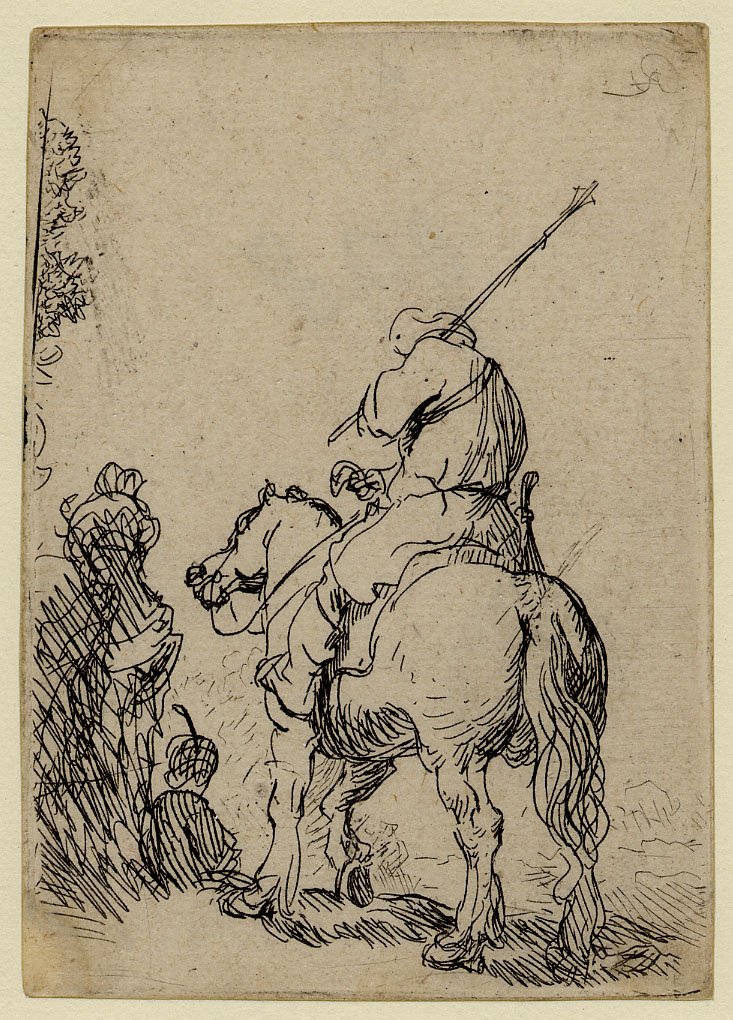
Rembrandt’s “Turbaned Soldier on Horseback” from 1632 is a remarkably economical etching that turns a handful of decisive lines into a living scene. The rider, seen from behind, occupies most of the plate on a compact, muscular horse. A long lance angles over his shoulder like a compass needle, and a small figure with a cap crouches in the left foreground near a leafy thicket. The sheet is modest in size and nearly monochrome, yet the sense of movement, weight, and watchfulness is immediate. This is not a display of elaborate costume or anatomy for its own sake; it is a study of bearing and alertness, of how a body, a mount, and a weapon align in space when vigilance is required.
Historical Context
The year 1632 marks Rembrandt’s first Amsterdam period, when the artist expanded rapidly from Leiden-trained prodigy to metropolitan master. Alongside portraits and grand commissions, he explored printmaking with daring spontaneity. Etching suited his temperament because it allowed drawing directly onto a waxed copper plate with a needle, preserving the energy of the line. The Dutch Republic of the 1630s was deeply engaged with global trade and frequently encountered foreign soldiers and travelers; “oriental” headgear appears throughout Dutch art as a prop for timelessness and exoticism. The “turbaned soldier” belongs to this visual vocabulary. Rather than offering a literal depiction of a specific regiment, Rembrandt presents a type—part study from life, part studio role-play—that let him examine posture, equine mass, and the graphic language of motion.
Composition and Point of View
The decision to show horse and rider from the rear is crucial. Most equestrian images privilege profile or frontal heroics; Rembrandt chooses the tact of observation. We seem to follow the soldier along a path, catching him in a moment of pause as he turns slightly left, toward the small figure by the bushes. This viewpoint emphasizes the curve of the horse’s hindquarters, the flexed hocks, and the swing of the tail, all rendered with supple, directional strokes. The rider’s torso tilts forward, gathering the lines of cloak and weapon into a single vector. The diagonal of the lance sets the page’s rhythm and establishes a subtle tension between forward motion and watchful restraint. Spatial depth is suggested with very few devices: the dark nest of lines at left becomes foliage and shade; the pale openness at right becomes air and distance. The empty upper half of the plate allows the eye to rest and imagine the space into which the soldier looks.
The Soldier’s Identity and the Meaning of the Turban
The “turban” functions less as strict ethnography than as a studio sign for otherness, rank, or timeless antiquity. Rembrandt borrowed such headgear for biblical scenes, tronies, and character studies, using it to remove figures from contemporary Dutch specificity. Here it makes the soldier feel both immediate and emblematic—someone from elsewhere, or from a story beyond the present day. The clothing itself is broadly suggested: a cloak gathers in folds on the rider’s back, sleeves bunch at the elbow, and the lower garments are left largely to the viewer’s imagination. This looseness focuses attention on structure rather than decoration. The figure reads as a man prepared for duty, not a parade mannequin.
The Horse as Engine of Form
The horse is one of the work’s triumphs. Its compact frame is drawn with a calligraphic assurance that captures the torsion of the spine and the coiled power of the hind legs. Short, curved strokes articulate muscles across the croup and gaskin; longer, sweeping lines define the barrel and ribcage. The left foreleg bends at the knee as if shifting weight, while the right foreleg plants firmly, producing a sensation of poised readiness. The tail, a rope of looping lines, echoes the curves of the foliage and the drapery, unifying the sheet’s rhythms. The bridle and bit are indicated with a few sharp touches, enough to register control without fussy detail. Rembrandt’s horse is neither idealized nor anecdotal. It looks learned from observation, condensed to essentials that communicate balance and strength.
Drawing, Etching, and the Language of Line
Rembrandt treats the copper plate as a sketchbook page, letting line vary in speed, pressure, and interval. The etching needle dances between tight hatching and open contours. On the horse’s hindquarters, firm contours do most of the work; in the thicket, a dense, restless web of hatch creates shadow and tactile confusion appropriate to shrubs and leaves. The rider’s cloak is a marvel of edited suggestion: a few parallel sweeps establish volume, while darker accents at folds confirm gravity. The small figure at left is barely more than a cluster of curves, yet the tilt of his head and the upthrust of a small stick evoke attention and conversation. Such economy is a hallmark of Rembrandt’s prints of the early 1630s. He trusts viewers to supply what the line implies.
Light, Tone, and Atmosphere
With etching, light arises from paper left untouched. Rembrandt keeps large areas of the plate open, allowing a high-key atmosphere that feels like daylight. The darkest field is the foliage at left, which frames the encounter and pushes the rider forward. Mid-tones flow across cloak, horse, and ground with sparse hatching that breathes, so the scene never clots into blackness. The distribution of light also functions narratively: brightness gathers around the horse’s flank and the rider’s back, while the shadowed thicket cloaks the crouching figure and whatever message he carries. The atmosphere suggests the outdoors without cataloging clouds or terrain. We are somewhere on a path at the edge of scrubland, under a pale sky that leaves every outline crisp.
Gesture and the Psychology of Encounter
Although there are no faces in full view, the scene is psychologically charged. The soldier’s slight twist toward the left indicates a response to the smaller figure, who rises from the bushes as if to report or warn. The diagonals of lance and reins imply readiness to move or strike. The horse’s head turns back just enough to catch the suggestion of its rider’s attention, completing a loop of awareness from crouched messenger to man to mount. The viewer, positioned behind, becomes the final participant in this relay of looks. The print thereby stages a quiet drama of vigilance and communication, a theme pertinent to soldiers and citizens alike in a century of sieges and patrols.
Costume, Rank, and the Politics of Appearance
Even reduced to outline, the soldier’s silhouette conveys rank through accoutrements. The lance is long and straight, not a shepherd’s staff but a military implement. The turbaned head reads as noble or foreign, distancing the figure from everyday Dutch militia. The heavy cloak, slung asymmetrically, expands the rider’s mass and dignifies his outline. Yet nothing is ostentatious. The dignity is in carriage, not ornament. Rembrandt consistently explored how clothing shapes perception, and here he distills that inquiry to a few graphic decisions that transform a back view into a statement of authority.
The Small Figure and Narrative Possibilities
The crouching figure at left is a catalyst. Is he a scout, a peasant, a child? The little hat with its bobbing stem suggests youth. His emergence from bramble patches and his upward gesture hint at urgency. Because the lines are so economical, the print can support multiple readings: a soldier receiving directions to a village, a guard hailed by a messenger, a rider pausing to hear a warning about danger ahead. This open narrative is not a weakness but a strength. It invites the viewer to finish the story while returning to enjoy the beauty of the lines that made it plausible.
Space, Ground, and the Use of Emptiness
One of the etching’s quiet pleasures is its use of emptiness. The upper right expanse is almost blank, a pale field that sets off the dark lattice of the thicket and the bold silhouette of horse and rider. This negative space does not feel unfinished; it reads as air and distance, a compositional counterweight that gives the lines room to vibrate. The ground beneath the horse is marked by short strokes that suggest ruts or trodden earth, enough to anchor the hooves without imprisoning them. Rembrandt knew when not to draw, and the restraint heightens the authority of every mark that remains.
Relation to Rembrandt’s Other Equestrian and “Oriental” Studies
Rembrandt returned repeatedly to exotic headgear and equestrian themes, often in quick studies that investigate weight, stance, and light. Compared with later, more elaborate prints or paintings, this 1632 sheet is spare, almost calligraphic. It shares DNA with his tronies and with his habit of dressing models in the studio’s closet of costumes to test attitudes under different silhouettes. Where other artists might indulge in decorative trappings, Rembrandt trims away everything but the functional essentials of motion and alertness. The result is modern in its directness, as if we were looking at a notebook page that happened to achieve the poise of a finished work.
Technique, States, and Printing Variations
While detailed state histories belong to catalogues raisonnés, the print betrays an immediacy consistent with a single, confident campaign of biting. Variations among impressions would have depended mostly on inking and wiping. A plate tone left on the sky would create a duskier atmosphere; a cleaner wipe would sharpen the contrast between foliage and air. Because etching preserves the tempo of the hand, one senses the speed of certain passages—the horse’s tail drawn in swift loops, the thicket hatched with energetic diagonals—set against slower, deliberate contours around the croup and cloak. The sheet therefore records both a rider on patrol and an artist at work.
The Appeal for Collectors and the Work’s Intimacy
Small prints like this moved easily through the hands of Amsterdam collectors who valued them for their portability, informality, and capacity to offer fresh experiences at each viewing. The image’s intimacy invites close inspection: the faint start of a line on the upper margin, the slight burr on a stroke, the places where the needle lifted and set down again. Such tactile evidence of making collapses the distance between seventeenth-century studio and present-day eye. One does not simply see a soldier; one witnesses drawing as a form of thinking.
Meaning and Afterlife
What, finally, does “Turbaned Soldier on Horseback” mean? It is at once a record of observation, a study in motion, and a scene of alert contact on a path. Thematically, it compresses a world of borderlands and patrols, of scouts and riders, into a few grams of ink. Culturally, it reflects the Dutch fascination with exotic dress and the realities of life lived under the necessity of watchfulness. Artistically, it declares that a line can carry weight, a contour can suggest time, and a blank can become sky. Its afterlife rests on this confidence. Viewers return to it not for spectacle but for the sensation that truth can be quick and exact.
Conclusion
Rembrandt’s 1632 etching is a masterclass in how little a picture needs to do to be complete. A horse’s hindquarters, a cloak’s curve, a lance’s diagonal, a messenger’s tilt—these elements, balanced in an airy field, assemble into presence and narrative. The soldier’s turban locates him in a cultural imaginary that fascinated the seventeenth century, but the drawing’s real subject is attention itself: the rider’s, the messenger’s, the artist’s, and ours. Looking after this mounted figure as he pauses at the edge of the thicket, we inhabit a quiet, tensile moment in which potential action hums. It is the sound of a line finding its way across copper and of a story about to continue down the road.