Image source: wikiart.org
Introduction
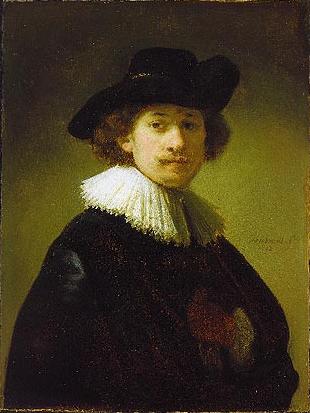
Rembrandt’s “Self-portrait with Hat” from 1632 presents the artist at a decisive moment in his life and career: newly established in Amsterdam, confident in his skill, and acutely aware of the city’s appetite for finely rendered portraiture. The painting shows a young man in a broad-brimmed black hat and gleaming white ruff turning into a corridor of light. His features—gentle mustache, lively eyes, and softly modeled cheeks—emerge from the surrounding dusk with calculated clarity. The image is both advertisement and inquiry: a public demonstration of professional polish and a private experiment in how light and attitude can construct a self.
Historical Context
The year 1632 saw Rembrandt’s move from Leiden to Amsterdam, the mercantile capital of the Dutch Republic. Amsterdam’s booming economy fed a thriving market for portraits, and the artist’s early commissions from surgeons, merchants, and civic guards demanded a style that balanced naturalism with decorum. In Leiden, Rembrandt had already cultivated a dramatic, Caravaggio-inflected chiaroscuro; in Amsterdam he refined that drama with smoother surfaces, more restrained palettes, and an emphasis on fashionable dress. The self-portrait belongs to this transitional phase. It projects urban elegance through black attire and crisp linen, but the spotlighted face and enveloping shadow retain the theatrical charge of his Leiden years. The painting can be read as a calling card to Amsterdam’s patrons: here is a painter who understands your taste, yet offers an intensity of presence that sets his work apart.
Composition and Pose
The composition is strikingly simple. The body occupies a three-quarter view, sweeping across the canvas in a dark wedge of cloak, while the head turns toward the viewer with a slight, almost conversational tilt. The brim of the hat forms a strong horizontal shadow that lowers the center of attention to the eyes. Rembrandt engineers a gentle spiral that begins at the collar’s luminous ruffles, passes along the chin and mouth, climbs to the gaze, then returns to the hat’s brim. Nothing distracts from this circuit. The background is an atmospheric brown-green that offers no narrative setting, only an undefined space thick enough to hold light. The economy of means is deliberate: by stripping away architectural or symbolic props, the painter invites the viewer to attend to the act of looking itself—how a person is conjured by light, how identity flickers as the eye moves across planes and textures.
The Role of the Hat
The hat is not incidental. In early seventeenth-century portraiture, the broad-brimmed black hat signaled both fashionability and a certain intellectual or artistic persona. It shades the forehead, creating a theatrical proscenium that concentrates brightness on the cheeks and nose. Its silhouette also amplifies the triangular geometry of the composition: brim, ruff, and cloak form stacked, interlocking shapes that stabilize the figure within the otherwise open field. The hat’s velvet absorbency swallows light, which makes the modest highlights—along the brim’s edge and crown—read as tactile cues to material. As an emblem, the hat frames Rembrandt as a gentleman-painter, one who moves comfortably in civic spaces while maintaining the cultivated air of an artist.
Costume and Social Signals
The white ruff, meticulously painted with serrated pleats, asserts cleanliness, prosperity, and social standing. In Protestant Amsterdam, the color black carried a double value: moral seriousness and fashionable restraint. Rembrandt’s black is never flat. Subtle shifts—the slight blue-black on the cloak’s shoulder, the brownish undertone along the torso—suggest varied fabrics and the way garments turn in space. The costume’s elegance is functional as well as symbolic. It concentrates the painting’s tonal range, so that the leap from deep blacks to the collar’s white stages a controlled drama. This contrast, common in Dutch portraiture, becomes in Rembrandt’s hands a metaphor for emergence: a person stepping from anonymity into legibility, from background into recognition.
Light and Chiaroscuro
Light structures the image. It falls from the left, striking the ruff, cheek, and the front plane of the nose before sliding off into half-tone across the opposite cheek and upper lip. The transitions are suave yet purposeful. Rembrandt avoids hard edges except where he wants emphasis—at the eyelid crease, the rim of the nostril, and the sharply raked fold of the collar. The background gradient is as carefully staged as the face; it brightens near the head and darkens toward the lower right, creating a visual pressure that pushes the sitter forward. This manipulated atmosphere owes a debt to Caravaggio’s tenebrism filtered through Dutch taste. However, Rembrandt resists spectacle. His light is interior, a studio light that clarifies form and invites close looking, rather than an outdoor sun or a dramatic spotlight that declares external events.
Color and Tonal Design
Although the painting initially reads as a play of black and white, the chromatic orchestration is subtle and warm. Olive and tobacco tones in the background counterbalance the cooler graphite blacks of the clothing. The skin tones carry peach and rose notes tinged with gray, a mixture that humanizes the flesh and situates it in the low-key palette. The ruff’s white is never pure; it is built from cool grays and faint yellows that allow highlights to sparkle without detaching from the scene. The few color accents—the faint redness near the lips, the suggestion of auburn in the hair emerging from beneath the hat—sustain a lifelike rhythm. Nothing jars or calls attention to itself. The color is a servant of tone, and tone is a servant of presence.
Brushwork and Surface
At this early date Rembrandt’s handling remains comparatively smooth, in keeping with Amsterdam taste. Yet even here one can sense the beginnings of the impasto techniques that would later become his signature. The ruff’s ridges are delineated with tiny, confident strokes that catch the light. The highlight on the cheek seems slightly raised, gathering the illumination with physical thickness. By contrast, the cloak and hat absorb the brush into velvety fields where the stroke disappears. This alternation between worked detail and painterly economy produces a tactile hierarchy: eye and ruff demand attention, clothing recedes. The surface, then, is not merely a record of labor; it is a map of where the artist wants the viewer’s gaze to dwell.
The Psychology of the Gaze
Rembrandt’s self-portraits are renowned for their psychological directness, and this early example offers a subdued but potent version. The look is steady but not confrontational, the lips closed in a neutral line that could turn into a smile or a more sober expression. The head’s slight tilt and the forward angle of the shoulder suggest movement, as if the artist has just turned from his work to address us. That suspended instant carries a delicate tension: we are included in the studio’s space, yet we are also held at a respectful distance by the sitter’s polished attire and composed demeanor. The portrait thus stages a double identity—the working artist and the gentleman entrepreneur—a duality central to Rembrandt’s self-fashioning in the 1630s.
Comparisons with Other Early Self-Portraits
Rembrandt painted himself repeatedly across his career, often probing the limits of costume and expression. Compared to the lively, sometimes humorous “tronies” of his Leiden period, where he tried on exotic caps and grimacing faces, the 1632 self-portrait is restrained. It aligns with the decorum demanded by paying clients while preserving the investigative spirit of self-study. In later self-portraits from the 1640s and 1650s, he would introduce heavier impasto, richer browns, and a franker, weathered visage. Those later works often present the artist as a master of the craft who has experienced fortune’s reversals. Here, by contrast, he is fresh, eager, and poised—an image balanced between aspiration and control. The continuity across decades lies in the intensity of looking: Rembrandt never paints a mask. Instead he builds a living presence out of layered tones and minute calibrations of light.
Technique and Underpainting
Technical study of works from this period reveals a method that begins with a warm ground, often reddish or brown, over which the composition is sketched broadly in a darker tone. The forms are then modeled with opaque lights and translucent shadows, alternating between thin glazes and thicker highlights. In the “Self-portrait with Hat,” the background’s mellow glow may be the ground shining through thin layers, lending depth without fussy detail. The face likely received multiple sittings, with time between for layers to settle. The control of edges—from the soft cheek merging into space to the crisp pleats of the collar—suggests a painter intimately aware of how different paint consistencies behave under the brush. The economy of means is striking: very little is described, yet all is present.
The Self-Portrait as Professional Strategy
Self-portraits in the Dutch Republic often served as professional statements. In this work Rembrandt presents himself as someone clients could trust with their likeness and their reputation. The elegant costume signals social fluency, while the psychological acuity promises more than mere record. To commission a portrait from such a painter was to align oneself with a new, modern sensibility: individuality rendered with empathy, status conveyed without ostentation. That the subject is the artist himself adds another layer. He sells not only a style but a brand—Rembrandt the discerning observer. The picture thus functions both as a specimen of skill and as a piece of marketing in a competitive market.
Materiality and the Illusion of Flesh
Rembrandt’s fascination with how paint can imitate flesh is already evident. The cheek’s modeling proceeds from shadow to half-tone to highlight in carefully graduated steps, yet the final effect is not porcelain smoothness but a living surface animated by tiny variations. The mustache is indicated with near-calligraphic touches that refuse to overstate. The eye whites are not white at all, but gray-beige, so the small light at the pupil appears vivid. Such restraint is crucial. If everything sparkled, nothing would. By limiting sharp accents to crucial points—the glint in the eye, the wet line of the lower lip—Rembrandt concentrates vitality where the viewer instinctively looks for it in a human face.
Space, Distance, and Viewer Relationship
The undefined background raises the question of space. Where is the sitter? The answer is: precisely where we need him to be, neither far nor close, but at a conversational distance. The soft halo around the head suggests air, a shallow depth that envelops rather than isolates. This calibrated distance is part of the painting’s charm. It avoids the intrusive intimacy of extreme closeness while refusing the aloofness of a far-set figure. The viewer feels invited into a reciprocal act of recognition: we look, he looks back, and the exchange completes the picture.
Time, Youth, and Ambition
Youth saturates the image. The skin is taut, the expression unburdened, the costume pristine. Yet the painting also hints at time’s passage through the very means of its making. The meticulous ruff, already slightly old-fashioned by the early 1630s, may signal respect for tradition even as the handling of light looks forward. The self-portrait freezes a career’s hinge point: behind lies the experimental Leiden phase; ahead, the monumental Amsterdam successes and the later introspective depth. To look at this work now is to feel the energy of ambition contained within a small, balanced rectangle of light and dark.
Audience Expectations and Artistic Independence
Amsterdam’s patrons valued accuracy, status, and propriety. Rembrandt conforms to these expectations but keeps an independent edge. He refuses gratuitous accessories, declines to flatter with sugary color, and insists that character emerges from structure rather than ornament. This independence would later harden into a reputation for stubbornness, but in 1632 it reads as elegance. The painter offers an image that fits comfortably into burgher interiors while carrying an intensity that rewards extended looking. The portrait therefore performs a delicate negotiation between market and vision.
Conservation and Condition Considerations
Paintings from this period often reveal craquelure in darker passages and slight abrasion in thinly glazed areas. The “Self-portrait with Hat,” given its subdued palette and large fields of dark paint, depends heavily on the integrity of those depths. When well preserved, the blacks retain their modulated richness, allowing the face to float convincingly. The background’s olive tones should read as warm air rather than flat paint; any overzealous cleaning that whitens or cools them would disturb the tonal equilibrium. Rembrandt’s early surfaces, being smoother than his later impastos, can still show tiny ridges in highlights that catch museum light and lend the picture a living shimmer.
Meaning and Interpretation
What, finally, does the painting mean? On one level it is a demonstration of mastery: a subtle performance of how to turn limited means into powerful presence. On another, it is a meditation on identity in a mercantile society where images circulate as social currency. The artist presents himself as both product and producer, a person fashioned by light and cloth who in turn fashions others. The hat and ruff tell us how he wishes to be seen; the quiet intensity of the gaze tells us who he is beneath the costume. The junction of style and self is the work’s true subject. It invites the viewer to consider how outward signs—dress, bearing, the play of light—construct inner life in the eyes of others.
Place within Rembrandt’s Oeuvre
Across more than forty self-portraits, Rembrandt charts a biography in paint. This early entry contributes the chapter of arrival: the confident young master entering Amsterdam’s stage. It complements contemporary works in which he portrays himself in elaborate costumes, using historical roles to test expressions and lighting effects. Over time, the theatricality will cede to gravity. The later self-portraits confront aging, loss, and resilience with startling frankness. Seen against that arc, the 1632 painting shines with the freshness of beginnings. It is not naive, but it is bright with possibility, a testament to a painter who already understood that the most enduring drama is the drama of seeing.
Why the Image Persists
Viewers return to this self-portrait for its balance of poise and warmth. The face is neither remote nor ingratiating; it offers the simple honor of attention. The painting also exemplifies a distinctly Dutch humanism that values the individual without pomp. It is easy to imagine this image hanging in a merchant’s home, participating in daily life while quietly elevating it. The work’s persistence owes to its clarity: one person, lit by one light, painted by one hand determined to understand what a face can say.
Conclusion
“Self-portrait with Hat” stands as a compact manifesto for the young Rembrandt’s art. With sparse means—dark fabric, bright linen, a soft atmosphere, and a carefully tuned play of light—he composes a presence that feels immediate across centuries. The painting satisfies the social codes of its time while reaching toward a more enduring truth: identity is not a fixed mask but an event that happens in light. As we look at the image, the event repeats. The eyes meet ours; the ruff catches the gleam; the hat frames a forehead busy with thought. The rest falls away. In that quiet exchange, the portrait accomplishes what it set out to do in 1632 and still achieves today: it makes us believe that paint, properly handled, can think.
