Image source: wikiart.org
Introduction
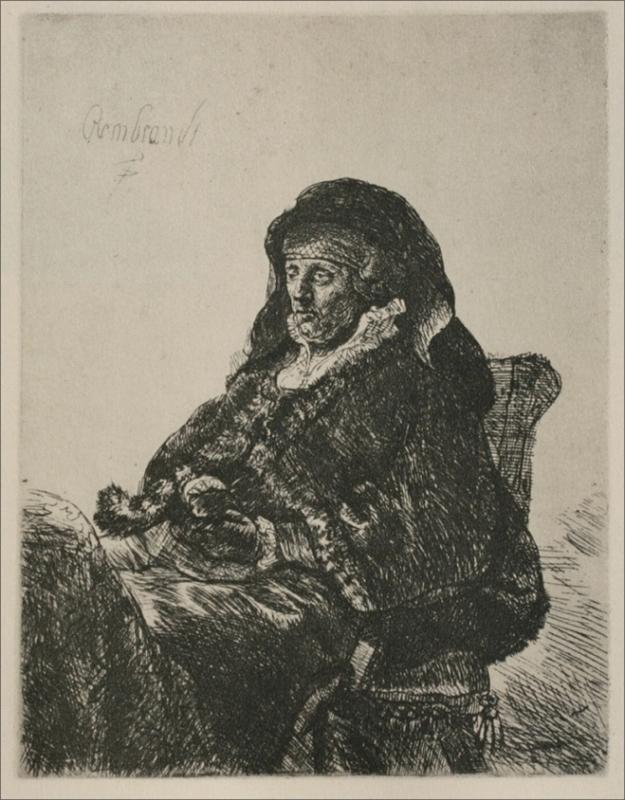
Rembrandt’s “Rembrandt’s Mother in a Widow’s Dress” (1632) is a small but resonant work that threads filial tenderness through the rigorous language of Dutch portraiture. The figure sits slightly turned, bundled in layered garments whose dense blacks and grays gather like weather around her face. A modest cap and enveloping hood identify mourning attire, yet Rembrandt avoids emblematic melodrama. Instead, his attention settles where life lingers most: the furrowed planes of the cheeks, the tender orbit of the eyes, the mouth resting in a line learned from years of speaking little and listening much. Made in the same year as several of his breakthrough Amsterdam portraits, this image presses the public grammar of dignity into the intimate register of family, and the result is one of those rare likenesses that feels both private and exemplary.
Context, Motif, And The Language Of Mourning
In the Dutch Republic of the early 1630s, the black wardrobe of grief functioned as a visible code for piety, modesty, and continuity. Widows were frequently portrayed in dark cloaks with fur linings, hoods drawn low, and linen caps that framed the forehead like a pale crescent. Rembrandt took to this motif often, using his mother as a model for studies of aged women, prophets, and scriptural figures. This particular work strips away narrative and keeps only the fact of widowhood, translating costume into character. The sober attire is less an emblem than a habitat—soft, heavy, and protective—within which the sitter’s spirit continues to breathe. By declining theatrical accessories and keeping the background austere, Rembrandt lets mourning speak as a condition of attention rather than an episode of drama.
Composition That Centers Quiet
The composition seats the figure at a three-quarter angle, with head inclined slightly downward and gaze set just off to the side. A low diagonal of the forearms steers the eye into the lap, then back up to the head through the dark funnel of the cloak. This triangular circulation keeps the picture calm and steady, as if the viewer had walked into the room and found the woman already keeping company with her thoughts. The chair back on the right, lightly etched, confirms domestic placement without choreographing a distracting interior. Empty space to the left completes the balance, giving the portrait breathing room and allowing shadows to register as presence rather than void.
Chiaroscuro As Consolation
Light in this image is measured and merciful. It slips across the forehead and cheekbones, rests on the bridge of the nose, and then dissolves gently into the mouth and chin. Shadow collects under the hood and along the fur collar, softening the figure’s silhouette while isolating the face as the painting’s moral center. The result is not theatrical contrast but a lullaby of tone—an atmosphere that dignifies age by refusing to glare at it. This kind of chiaroscuro avoids spectacle and instead models consolation: grief is not erased by light; it is made legible, and therefore bearable.
The Face And The Practice Of Looking
Rembrandt’s portraits of elders are lessons in the ethics of attention. Here the eyes are slightly narrowed, their highlights minute but exact; the skin around them is thin, mapped with fine cross-hatching that creates both texture and temperature. A touch of warmth sits high in the cheek, and the mouth resolves into a narrow shape that neither pleads nor preaches. The artist avoids sentimentality; he records patience. What we discover in the face is not a story told to us, but the presence of a person willing to be seen as she is. This is the painter’s true subject, and it is the quality that makes the image feel inexhaustible.
Garment, Fur, And The Weight Of Time
The widow’s dress is not a flat field of black but a living surface full of decisions. Rembrandt differentiates soft wool from slick fur and the denser nap of the hood by changing pressure, speed, and direction of his strokes. The fur collar is feathered with infinitesimal flicks; the cloak’s body is woven from tighter networks of hatch; the cap carries lighter, more regular strokes that read as crisp linen beneath the hood. These distinctions are not decorative; they are moral. Clothing here is the body’s climate—kept, mended, and worn—and it tells us how the sitter lives: with frugality, with care, with an intimacy to materials that labor and necessity teach.
Hands, Lap, And The Grammar Of Gesture
Hands are partially sheltered by the cloak, emerging just enough to register as forms of rest rather than display. Their recession is eloquent. In Rembrandt’s other portraits, hands frequently deliver speeches—crossing the chest in oath, touching a book, gesturing with authority. Here their withdrawal matches the psychology of bereavement: activity diminishes, and the work of the day returns to the work of enduring. Yet notice how the edge of a cuff catches light, and how a subtle ridge along the wrist insists on the body’s continuing vitality. The painting keeps grief from becoming abstraction; it locates it in muscles that still warm the air.
Background As Gentle Silence
The background is a pale ground that darkens imperceptibly where the figure’s mass stirs the light. No objects intrude. The resulting silence is not empty; it is the space in which loss can be acknowledged. This spareness is why the picture does not feel like a report but like a visit. The viewer is granted a respectful distance; the sitter is given the dignity of not being staged. Such reticence is the opposite of poverty; it is the richness of attention refusing to clutter its subject.
The Palette’s Subtle Heat
Even within an ostensibly monochrome world, color hums. The face carries thin warmths—ochres, whispers of pink—that lean against cooler grays around the eyes and mouth. The fur gathers browns and bottle greens that surface when light grazes the nap. The cap’s inner band receives a faint, cool tone that separates it from the hood’s deeper black. These calibrated temperatures prevent the portrait from sinking into uniform dusk and, more importantly, keep the skin alive. The old Dutch formula—warm flesh, cool shadow, sober cloth—becomes here a hymn to continued life inside restraint.
Line, Hatching, And The Music Of Touch
If the work is an etching, it is also a score. Lines speed up across light-catching planes and slow into dense chords where shadow deepens. The direction of hatching follows form: around the cheek its arc echoes bone; across the cloak it rides with the fall of cloth. Cross-hatching thickens the darker passages, then breaks open just enough to let air flow between strokes. In passage after passage one senses a hand that thinks through touch, adjusting pressure until matter answers. This musicality of mark is why the portrait reads as breathing rather than merely described.
Filial Nearness Without Sentimentality
Because the model is the artist’s mother, the image carries an unavoidable personal charge. Yet the work never turns indulgent. There is no softening of features to flatter age, no symbolic theatrics to ennoble sorrow. Instead we meet a woman whose life is allowed to speak plainly—a gift that only close, loving scrutiny can give. The painting’s tenderness lies in its exactness: the small collapse of skin above the nostril, the quickened hatch where the cheek meets the hood, the decided little triangle of light at the edge of the collar. These are the kinds of truths that a son who paints as a witness, not as a courtier, would preserve.
Mourning As Continuance Rather Than Ending
The widow’s dress could have frozen the sitter into emblem, but Rembrandt stages grief as a practice of continuance. The posture is upright; the head, though lowered, is not bowed in defeat; the gaze, though sidelong, is not absent. Clothes keep the person warm; the chair keeps the body supported; the light keeps the face legible. The world, in other words, continues to make room. The portrait’s power is this reassurance: after the ritual of loss comes the daily work of living, done with diminished noise and increased gentleness.
Relation To Rembrandt’s Broader 1632 Corpus
In 1632 Rembrandt produced some of his most luminous civic portraits—men with brilliant ruffs and women adorned with lace and gold—as well as inward scenes of scholars and prophets. This study of his mother shares DNA with both strands. From the civic portraits it borrows disciplined lighting and sober clothing; from the studies of elders and biblical figures it borrows psychological depth and tactile attention to wear. Unlike the public likenesses, however, it refuses any need to persuade. The painting is content to be, and that contentment reads as confidence.
A Guide For Slow Looking
Begin with the jewel of light at the inner corner of the near eye; it is small, but it anchors the gaze. Let your attention travel along the upper lid to the brow, then drift to the thin light on the bridge of the nose before settling into the shadow that cups the nostril. Move to the far cheek, where hatching loosens and lifts, a breath taken. Follow the edge of the fur collar as it curves toward the chin; notice how the strokes turn and splay, delivering the softness of pelt without counting hairs. Down in the lap, watch the hatching slow and thicken into a murmur, then rise again across the chair back in lighter, more elastic lines. Return to the face and, for a moment, simply keep company with it. The picture answers most generously when it is not interrogated but accompanied.
Material Memory And The Poetics Of Age
Age in this portrait is not a theme laid atop the sitter; it is embedded in the way materials behave. Cloth slumps with a heaviness that younger clothes do not yet know; fur hugs close like inherited warmth; skin holds the afterglow of years spent near hearth and window. The picture becomes a catalog of continuities: garments passed down, habits of sitting, the particular angle at which a head turns when hearing without being surprised. In preserving such textures, the artist writes a poem about time’s ability to soften without erasing.
Why The Image Still Speaks
Modern viewers are surrounded by images of grief that alternate between spectacle and concealment. This portrait offers a third way: witness. It shows a person visible in her mourning but not reduced to it. The piece asks nothing of our pity and everything of our attention. It is this ethical stance—uncluttered, unsentimental, faithful to small facts—that keeps the work contemporary. The widow’s dress becomes not a relic of a confessional culture but a universal sign of the human capacity to continue.
Conclusion
“Rembrandt’s Mother in a Widow’s Dress” is an act of loving precision. It transforms the language of Dutch sobriety into a chamber where a single face can rest and be recognized. The light is companionable, the costume protective, the marks responsive to the weight of materials and the weather of feeling. At a historical moment when Rembrandt was mastering the public portrait, this image remains deliberately private—an icon of patience rendered so truthfully that it transcends its occasion. What abides after looking is not the fact of death implied by the clothing, but the fact of life reinforced by the gaze.
