Image source: wikiart.org
Introduction
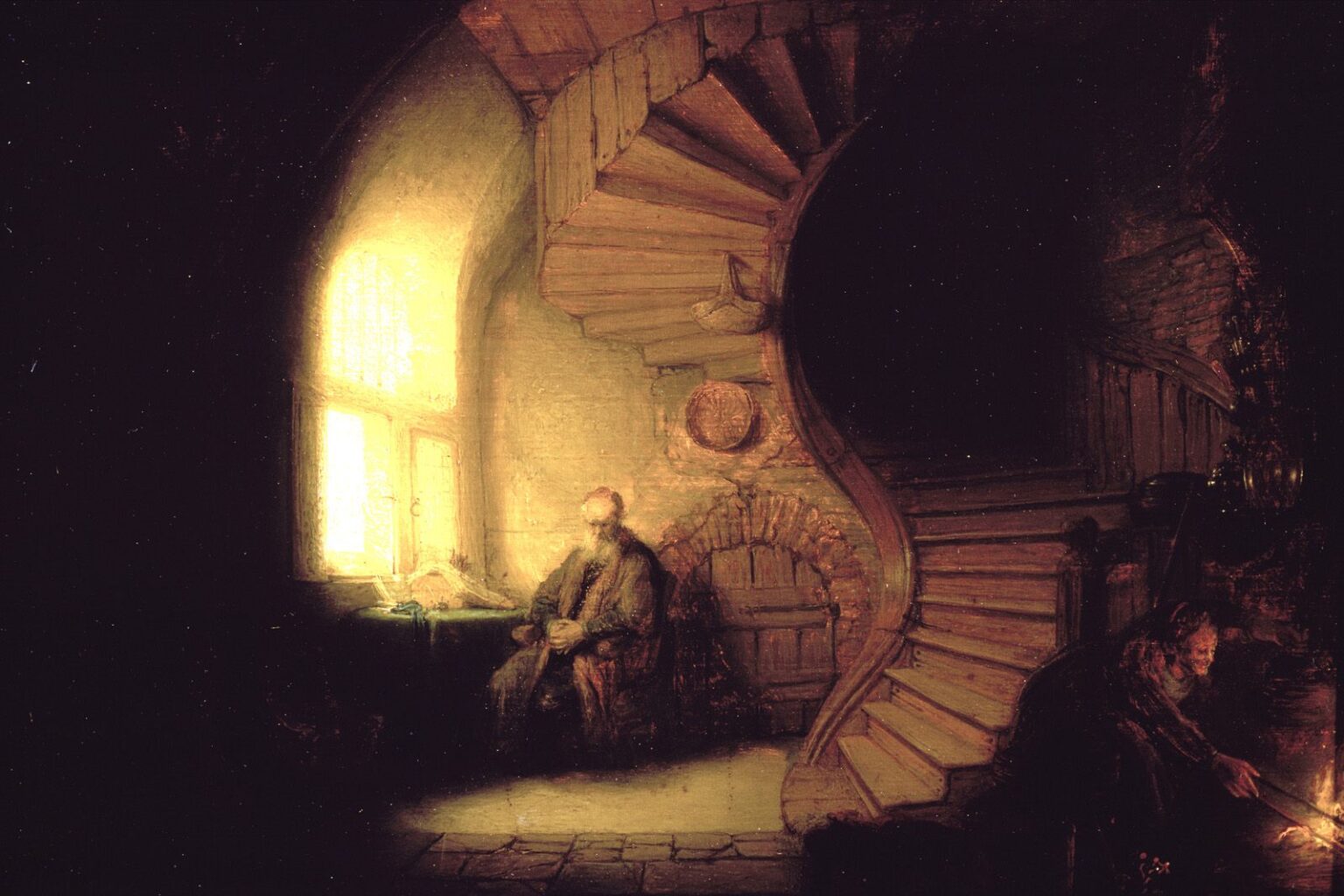
Rembrandt’s “Philosopher in Meditation” (1632) is one of the most haunting interiors of the Dutch Golden Age—a small canvas that makes vast space out of light, silence, and the curved logic of a wooden stair. At left a window breathes daylight into a stone-walled room; beneath it a scholar sits beside a table where books and a globe-like form rest. To the right, a spiral staircase climbs into darkness, while at the base of the steps a second figure tends a low fire. The composition is at once architectural and psychological: a diagram of ascent and pause, of the mind illuminated while the world recedes. Painted during Rembrandt’s first year in Amsterdam, the picture declares how convincingly he could convert humble elements—wood, brick, cloth, and air—into a theater of thought.
Amsterdam, 1632: Learning, Labor, And The Interior
The early 1630s in Amsterdam married commerce to intellect. The city had become a magnet for merchants, printers, exiles, and scholars who valued private study as much as public action. Dutch painters responded by making interiors that celebrated reading, calculation, and domestic labor. “Philosopher in Meditation” participates in this culture while standing apart from its tidy genre scenes. The space is not a neat study with an inventory of instruments; it is an archaic chamber whose architecture seems grown rather than built. Rembrandt’s goal is not description for its own sake, but the creation of an environment where thinking can be felt in the bones of the room.
Composition As A Machine For Meaning
The composition hinges on two arcs: the round of light at the window and the spiral of the stair. These arcs are joined by a vertical seam of wall that carries illumination downward like a conduit. The scholar sits at the intersection of those forces, the point where light meets stillness. The staircase curves behind him, then swells into a full helix that almost fills the right half of the canvas, a giant wooden thought winding toward mystery. Meanwhile, the lower right registers a different activity: a crouched figure, half lost in shadow, pokes at embers, a domestic counterpoint to the scholar’s inward flame. This tripartite arrangement—light at left, spiral at center-right, fire at bottom-right—leads the eye through a narrative of ascent, posture, and humble heat.
Chiaroscuro That Thinks Like A Philosopher
Rembrandt’s light is not decorative; it argues. Sunlight presses through the leaded panes and dilates into a pool that licks the wall and drops onto the scholar’s lap, making his head and beard glow like a candle’s plume. The remainder of the room becomes a deep, living twilight in which forms persist by touch rather than sight: the arch of a bricked doorway, the ribs of stair treads, the lifted lid of a hearth vessel. Darkness accumulates not as absence but as a reservoir of possibility. The fire at the right throws a contrary, low light that warms the servant’s face and paints the near steps with a copper hush. Two lights—one celestial, one earthly—balance the painting’s metaphysics.
The Spiral Staircase As Metaphor
The stair is the work’s emblem and engine. Structurally, it binds the left and right halves of the composition, its sinuous stringer separating illuminated wall from engulfing shadow. Psychologically, it stands for the mind’s ascent—laborious, circling, always returning near the point of departure but a level higher. The broken rhythm of its treads, painted with flicks of light and dark, reads like a sequence of thoughts. The handrail rises like a question mark then disappears into blackness, reminding us that knowledge is always partial. Rembrandt resists the temptation to describe the upper landing; the stair climbs to where painting cannot follow, which is precisely the allure.
The Scholar: A Body At Rest, A Mind In Motion
The seated philosopher is minimized in scale yet vast in implication. Wrapped in a heavy robe, he holds his hands together in a posture that might be prayer, reflection, or simple warmth. His head tilts toward the window; light flares on the beard, while the face remains partly veiled by shadow. The ambiguity preserves quiet: we read the figure not as an identifiable portrait but as a type—someone who has learned to sit at the threshold between world and thought. Books lie closed on the table; in Rembrandt’s universe, understanding often follows the moment when the page is set aside and the gaze turns to light.
The Servant And The Ethics Of Work
At the foot of the stairs, the kneeling figure stokes a fire. Cloaked in darkness and busy with practical heat, this person embodies the body’s economy—the necessary maintenance that keeps the household alive. The philosopher’s illumination would be a cold sermon without it. Rembrandt stamps equal dignity on both figures by giving the servant her own light and by painting her gesture with the same seriousness as the scholar’s stillness. The painting refuses a hierarchy that would privilege contemplation over labor; instead it shows how the two complete one another.
Architecture As Psychology
The room itself seems carved from the earth: bricks set into arches, a low door sealed like a memory, battered wood that has swallowed the touch of generations. Nothing is pristine, nothing ornamental. The stair’s bulging stringer reads like a spine; the bricked arch suggests a ribcage; the window is an eye. The chamber becomes a body within which two humors circulate—light and heat—while the spirit (the philosopher’s attention) settles at a point of calm. Rembrandt’s interiors are never abstract containers; they are organisms where mood lives in the joinery.
The Palette: Honey, Coal, And Weathered Timber
Color is restrained and purposeful. The window’s blast is pale lemon veering to cream at its edges; the lit wall carries a warm, chalky ochre; the staircase is a gradient of timber browns that cool toward charcoal as it rises into shadow. The philosopher’s robe is woven from near-black with pockets of amber where light catches cloth nap. Over everything hovers a granular glaze—fine particulates that make the air visible, as if motes were suspended in sun. The fire’s orange is muted; it lights the scene without rupturing the painting’s tonal gravity. These choices produce a harmony of earth and sun that feels inevitable.
Edges And The Breath Of Space
Rembrandt’s edges tell the truth of perception. Where sunlight scalds the wall near the window, contours dissolve and mortar lines blur, mimicking how glare erases detail. The philosopher’s outline is a play of lost and found: the crown of the head disappears into backlight, while a rim of brightness finds the shoulder. The stair’s ribs sharpen where they catch cross-light and soften as they turn away, creating a tactile sense of tread and rise. The servant’s hands, close to the coals, pulse with warmer edges that merge into the fire’s glow. Everywhere, boundaries breathe, and the room opens like a lung.
Brushwork And The Texture Of Time
The surface bears Rembrandt’s touch in registers calibrated to each material. The window and wall are built with scumbled strokes that leave granular ridges—plaster catching light. The stair’s long curves are drawn with confident, loaded sweeps, then broken by nervous, short marks to articulate wear. The philosopher’s garment is laid with thicker, softer paint, allowing highlights to sit like nap on velvet. The fire’s core is a few decisive flicks, surrounded by thin transparent glaze that suggests warm air. This orchestration of mark-making is not virtuosity for show; it inscribes the room with time, as if each stroke were a remembered moment of use.
The Silence Of Objects
On and beside the table lie objects whose identities remain just out of reach: a folio, perhaps a globe, perhaps a folded cloth. Their ambiguity is deliberate. Rembrandt withholds sharp labeling because the painting’s subject is not the equipment of learning but the condition of it. The indistinct things are like unspoken words—the world of instruments rendered humble before the act of thought. Even the little arched door behind the philosopher resists narrative; it is a closed memory, important because it is closed.
The Theological Weather Of Light
Although the picture has no overt biblical narrative, its light reads with theological undertones. The sun through leaded glass becomes a figure for grace: it arrives unearned, it clarifies, and it asks nothing in return. The philosopher does not grasp at it; he sits and receives. The servant’s fire, meanwhile, is sacramental—an earthly sign that warmth depends on tending. Together they describe a human life balanced between gift and effort. Rembrandt, who often painted the play between divine and domestic illumination, casts this interior as a sanctuary of ordinary revelation.
Scale, Intimacy, And The Gaze Of The Viewer
The canvas is small, inviting a viewing distance that mimics the scholar’s solitude. At close range one sees the grained strokes that weave the plaster and wood; at a step back, the whole scene coheres into a quiet world that the eye can cross in a breath. The viewer becomes a third inhabitant—standing in darkness, watching the river of light pass over wall and cloth. The effect is not voyeuristic but companionable; the painting grants us silence without asking us to be silent about it.
The Rhythm Of Ascent And Return
The stair pulls the eye upward into darkness, then returns it along the same curve to the kneeling figure, back to the philosopher, and finally to the window where the cycle begins again. This visual rhythm mirrors mental life: we rise toward abstraction, descend to tasks, and come back to the light that makes both meaningful. The painting never forces this reading; it lets the architecture teach us by example. To stand in front of it is to feel the continuity between steps and thoughts, between treads and breaths.
The Myth Of Identity And The Truth Of Type
Over centuries the painting acquired narratives—guesses about the philosopher’s identity, whether a biblical sage or a named thinker. Rembrandt resists such specificity in the image itself. The face is not carefully individualized; it is dignified and general, a human instrument tuned to receive light. This refusal to pin down biography is a strength. The work functions as an emblem for thought itself, accessible to every viewer who has ever paused with a book shut and a window bright.
A Guide For Slow Looking
Begin at the window’s leftmost pane where daylight is thickest; watch it thin as it passes across the mullions and breaks into soft rectangles on the wall. Let that light carry you down to the philosopher’s forehead and beard, then sideways to the stacked pages on the table whose edges vanish into glow. Drift across the bricked arch to the staircase’s belly; trace the grain along the stringer and the scalloped rhythm of treads. Descend visually to the servant at the coals and hold the little triangle of orange until your eyes remember heat. Move back to the shadow’s center, where the stair mounts to black, and feel the room grow quiet; then return to the window, and begin again. The painting is a pendulum—each cycle a breath.
Technique And The Alchemy Of Limited Means
Everything on the canvas—architecture, figures, philosophy—arises from a limited toolkit: a narrow value scale, a handful of warm and cool browns, disciplined highlights, and edges tuned to perception. Rembrandt’s genius is the alchemy by which those means generate atmosphere and meaning. The light is not only seen but felt on the skin; the wood is not only described but remembered; the space is not only arranged but inhabited. The painting is proof that richness does not require noise.
Why The Image Still Feels Contemporary
Modern viewers recognize the room. Replace the quills and folios with a laptop and a kettle, and its essence persists: a workspace, a household, a spiral of stairs leading to elsewhere, and the competing lights of day and hearth. The painting honors concentration at a time when attention is thinly stretched. It remembers that thinking is not an abstract activity but a physical one, dependent on seats, surfaces, light, and heat. In an age of speed, the picture proposes slowness as an instrument of clarity.
Conclusion
“Philosopher in Meditation” compresses an entire philosophy of living into a modest interior: seek the light that arrives unasked, tend the fire that requires hands, sit where both can reach you, and accept the spiral—the mind’s way of climbing by circles. With sunlight, wood, brick, and two figures, Rembrandt builds a sanctuary for attention. The picture does not tell us what the philosopher thinks; it shows us how thinking happens, how space and light collaborate to permit understanding. Nearly four centuries later, we step into that room and recognize its weather as our own.
