Image source: wikiart.org
Introduction
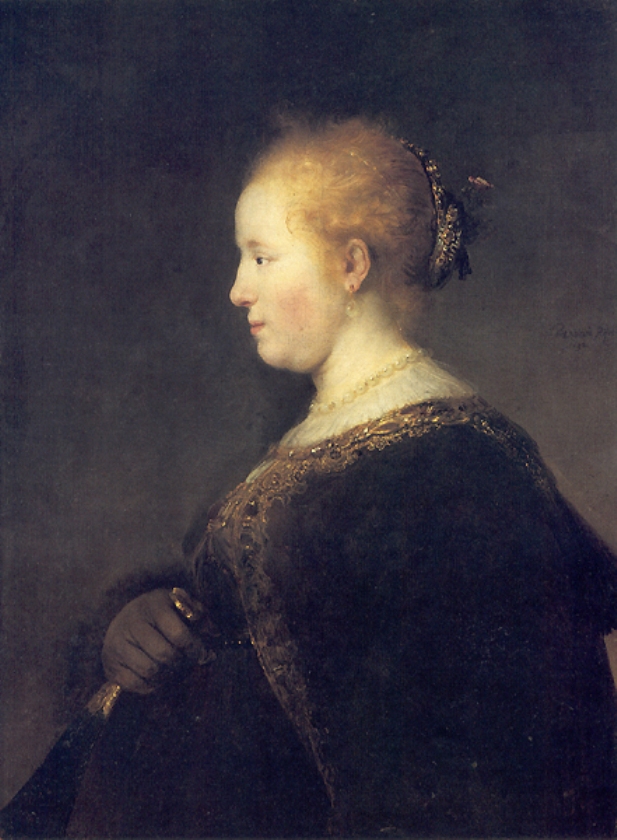
Rembrandt’s “A Young Woman in Profile with a Fan” (1632) is a lesson in how a single silhouette, delicately lit and carefully costumed, can carry an entire world of character. The sitter turns left in pure profile, her features etched against a deep, still atmosphere. A halo of warm light gathers around the forehead and hair, then softens along the cheek before dissolving into the sober darkness of her dress. Pearls ring the neck like quiet punctuation; a small fan rests in her gloved hand, completing a poised arc across the lower half of the canvas. Painted in the year Rembrandt consolidated his move from Leiden to Amsterdam, the portrait shows a young master testing metropolitan taste while keeping his intimate, human scale intact.
A Year Of Arrival And Experiment
The date 1632 marks one of Rembrandt’s most exploratory moments. He was adapting to Amsterdam’s clientele, who favored portraits that signaled prosperity with discretion. This picture belongs to the group in which he calibrates elegance and restraint: rich fabrics, subdued ornament, and the most telling luxury of all, a tender light that dignifies without flattery. Choosing a full profile is itself a calculated experiment. In an age dominated by three-quarter views, profile renders personality through outline and illumination rather than frontal expression, demanding a different kind of attention from painter and viewer alike.
The Authority Of Profile
Profile condenses likeness into contour. Here the line that runs from hairline to brow, nose, lip, and chin reads like a single, continuous thought. Rembrandt strengthens that thought by keeping the background plain and tonally even, so nothing interrupts the silhouette. The young woman’s head sits slightly forward of the shoulder, suggesting alertness rather than stiffness. The neck rises with swanlike clarity from the collar, allowing the oval of pearls to nestle naturally into the turn. Because the eye cannot search for expression in both eyes at once, it lingers on the gentle projection of the mouth and the pragmatic tilt of the nose, discovering character in the intervals and transitions rather than in overt display.
Light That Shapes and Listens
Light enters from the upper left and takes its time across the face. It blooms at the forehead, brushes the bridge of the nose, and settles into a soft glow at the cheek. The ear, taken for granted in most portraits, becomes a small theater of half-tones, its helix and lobe described with a handful of patient, warm notes. The same illumination grazes the pearls, leaving minute points of brightness that keep them from reading as chalk. On the dress, light thins quickly, exposing the absorbing depth of near-black fabric and thereby placing the face into calm relief. This is not spotlight; it is a listening light that discovers rather than declares.
Composition As Measured Arc
Rembrandt builds the painting around two arcs. The first is the profile itself, a clean curve that leads the eye from forehead to chin. The second is the long diagonal that runs from the illuminated temple down through the neckline to the fan and gloved hand. That diagonal is crucial. It counterbalances the head’s prominence, keeps the lower half of the canvas engaged, and offers a narrative hint without overpowering the stillness. The fan is not opened to flaunt pattern; it is closed, its gilded tip catching a discreet glint. The gloved hand, round and secure, turns the fan into an anchor that holds the figure in place.
Costume, Ornament, and Social Code
The dress is dark and heavy, likely velvet or a similarly absorptive textile, trimmed with a ribbon of gold embroidery around the bodice. Rembrandt does not fetishize detail; he lets threads of gold flicker where light grants permission, then withdraws them into shadow. The hair is gathered and bound with a jeweled fillet that repeats the small, bright language of the embroidery and the pearls. Together these elements signal prosperity but refrain from ostentation. The necklace’s modest scale and the fan’s restrained presence belong to a civic culture that prized order, cleanliness, and probity. In the economy of Amsterdam taste, restraint was itself a luxury.
The Psychology Carried By Stillness
Although profile removes frontal expression, the painting is not emotionally mute. The gentle forward set of the head, the relaxed lower lip, and the ease in the gloved hand all suggest composure rather than posing. This is the stillness of a person who knows how to be looked at without yielding her inwardness. Rembrandt’s compassion lies in the softness of transitions: cheek into jaw, jaw into neck, neck into collar. The sitter’s youth reads not from idealized smoothness but from the buoyant, living quality of those changes in plane.
Color And Temperature As Harmonic Climate
The palette is deliberately limited: warm flesh notes modulated by cooler half-tones; a deep, slightly plum black for the dress; muted golds for embroidery and hair ornament; and the creamy neutrality of pearls. Within this narrow set Rembrandt plays temperature like a musician. A cool shadow under the chin steadies the warmth of the cheek. Slightly cooler grays in the background keep the profile legible without outlining it. Warm glints in the hair and fillet stitch the head to the garment’s trim, unifying upper and lower registers across the diagonal described by the fan.
Brushwork From Porcelain To Velvet
Handling shifts with material. On the face, strokes melt into one another, suppressing the brush while preserving flesh’s vitality. In the hair, Rembrandt allows strands to escape in thin, nimble touches that catch light like down. The embroidery is built with tiny, lifted impastos that sparkle in raking light, while the dress accepts broader, quieter passages and glazes that drink illumination. The glove is a hybrid zone: its rounded form is modeled with supple strokes that make leather convincing without enumerating seams, and a few precise highlights deliver the sense of a gently polished surface.
Space, Depth, and the Ethics of Background
The background is not a void. It is a quiet field that deepens imperceptibly as it approaches the sitter’s back and dress, allowing the head to float forward without detaching. Faint, warm-brown atmospherics around the profile create a breathable halo that keeps contour from becoming a cutout. This refinement is crucial to the painting’s ethical tone. Nothing shouts; nothing competes. The background listens, so the figure can speak softly.
The Fan As Emblem Of Poise
In seventeenth-century portraiture, fans could signal grace, modesty, or fashion awareness. Rembrandt chooses a closed fan, placing it where it will complete the composition’s diagonal rather than where it would demand attention. The small gold ferrule and tassel glimmer just enough to announce refinement. Because the fan is not theatrically displayed, it reads as a natural extension of the sitter’s presence rather than as a prop. Its quiet curve echoes the curve of the profile, a visual rhyme that binds top to bottom.
Profile Portraits And The Classical Echo
Profile has an ancient pedigree, from Roman coins to early Renaissance panels. In 1632 Amsterdam it also carried a whiff of the classical and the courtly. Rembrandt embraces that echo while domesticating it. Unlike hard-profile court images that can feel minted rather than painted, this profile breathes. The soft transitions and luminous modeling bring human weather to a form associated with medals and cameos. The result is a portrait that honors tradition without becoming its servant.
Parallels Within Rembrandt’s Early Portraits
Compared with Rembrandt’s three-quarter likenesses from the same year—where millstone ruffs and glimmering chains dominate—the present painting is more intimate and more experimental. It shares with “A Portrait of a Young Woman” the ethic of restraint, but it pushes that ethic further by removing the direct exchange of gazes that usually secures a portrait’s psychology. Here, the viewer’s engagement depends on tenderness toward outline and light. The artist trusts that a truthful silhouette can be as revealing as a meeting of eyes.
The Signature, Date, and Professional Confidence
Rembrandt signs and dates the painting with the assurance of a young master in demand. The inscription’s presence within an essentially unadorned field quietly underscores authorship without intruding on the sitter. It belongs to the picture’s grammar of modest display: reputation acknowledged, spectacle avoided. In 1632 that balance was not merely aesthetic; it was a professional stance, a way to satisfy patrons who wanted their likenesses both fashionable and morally calibrated.
A Guide For Slow Looking
Begin at the forehead where the light is largest and softest. Let your gaze travel down the line of the nose and pause at the small shelf of the upper lip, noticing the cool, gray half-tone that keeps the mouth alive. Drift back to the eye’s shadowed socket and watch how a tiny touch of brightness keeps the lid from closing. Move to the ear and trace its interior with the faintest warm accents. Slide along the pearl necklace and count—not with numbers but with the rhythm of light—how each bead alternates between glow and shadow. Reach the fan, and see how its small highlight pulls the hand’s roundness into focus. Step back and allow the long diagonal from temple to fan to reassert itself, knitting the composition into calm.
What The Painting Teaches About Presence
This portrait argues that presence does not require a frontal encounter. It can be made from the side, with a posture that admits the viewer while preserving inward life. It also argues that luxury is not a sum of details but a quality of air. The warm halo, the soft sheen of pearls, the disciplined restraint of embroidery and glove—these create a climate of well-being more persuasive than any pageantry. Above all, it teaches that character can be carried by the simplest means: a clean outline and a listening light.
Legacy And Contemporary Resonance
Modern viewers, trained by photography to read silhouettes and by design to love negative space, find in this painting an unexpectedly contemporary pleasure. Its emphasis on shape over spectacle, on tact over insistence, resonates with current ideals of portraiture across media. The profile’s calm authority can be felt in everything from fashion editorials to modernist sculpture, yet Rembrandt’s version remains distinctive because it is warmed by empathy. The sitter is not a cipher stamped onto a field; she is a person whose outline has been earned by careful looking.
Conclusion
“A Young Woman in Profile with a Fan” distills Rembrandt’s early Amsterdam ambition into a single, serene curve. The profile is clear, the light humane, the costume tasteful without noise. Pearls, fillet, glove, and fan serve the face rather than upstaging it. Within this poised simplicity, the painter finds a wealth of meaning: youth without sentimentality, prosperity without ostentation, and stillness that feels alive. The canvas shows how, in the hands of a master, the slightest turn of head and the softest fall of light can be as eloquent as any staged drama.