Image source: wikiart.org
Introduction
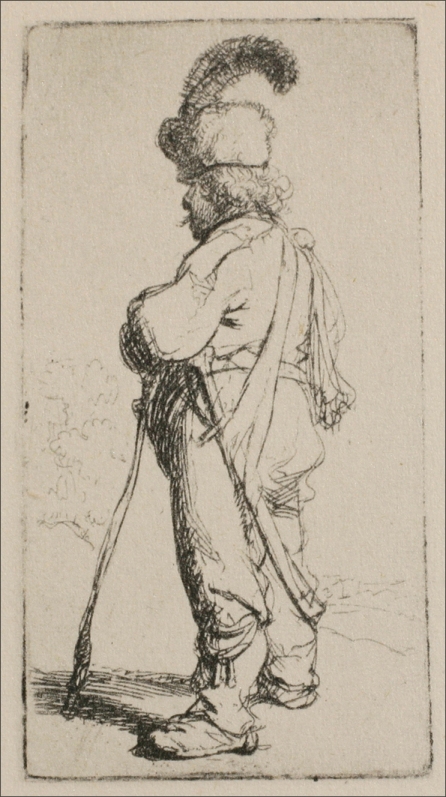
“A Polander Turned to the Left” (1632) is a small etching in which Rembrandt turns a passerby into a monument of posture and line. The figure stands almost in profile, weight settled into one hip, gloved hands resting on a long staff or pike. A fur hat crowned with a curling plume, a sash that drops behind the back, baggy trousers tucked into sturdy shoes—the ensemble reads immediately as foreign to Dutch eyes of the 1630s. Rembrandt does not name the man; he simply calls him a “Polander,” the contemporary Dutch term for travelers, mercenaries, and traders from the Polish–Lithuanian Commonwealth whose exotic dress fascinated the Republic. What might have been a quick street sketch becomes a study in balance, negative space, and the quiet charisma of a body at rest.
A Moment In Rembrandt’s Early Amsterdam Practice
The date situates the print at the beginning of Rembrandt’s Amsterdam period. Having moved from Leiden in 1631, he was securing portrait and history commissions while relentlessly experimenting in etching. Alongside beggars, fiddlers, and militia men, he etched several “Polanders,” turning them into compact essays in costume and stance. These prints were not souvenirs; they were laboratories. They allowed him to test how a single figure can command a page through the choreography of silhouette and the honesty of line. The Polander series also charted the city’s cosmopolitan reality: Amsterdam’s streets swarmed with sailors, merchants, refugees, and hired soldiers. Rembrandt’s plate is therefore both art and ethnography—faithful to what he saw and attentive to how line persuades.
Composition And The Authority Of Profile
The figure is set within a narrow, vertical plate. Rembrandt positions him slightly forward of center, leaving a band of air behind the plume and above the hat. That air is not empty; it frames the feather’s arc so the eye can read its spring without confusion. The man’s body constructs a subtle S-curve: plume bending right, hat and beard thrusting left, back arcing gently in the opposite direction, legs spreading to ground the weight. The staff completes the geometry by anchoring the foreground with a firm diagonal. Nothing crosses the figure; there is no background architecture to muddy the silhouette. We meet the body as an independent fact, a shape that contains its own equilibrium.
The Language Of Etched Line
Etching preserves gesture. Every stroke records the speed and pressure of the needle as it moves through the wax ground on copper. In this small plate Rembrandt demonstrates a full vocabulary. The contour of the overcoat is drawn with elastic lines that thicken and thin, describing weight without pedantry. Short, ragged strokes along the hem and sleeve give the sense of pile and wear in the wool. The plume is a string of rapid flicks that gradually open up, like a breath dispersing into air. Across trousers and sash he switches to broader, looped marks that suggest softened fabric. Notice the staff: it is one firm, almost unbroken descent, slightly thickened near the hand where grip and gravity meet. The cumulative effect is a figure whose surfaces feel touched rather than diagrammed.
Costume As Theater And Observation
Seventeenth-century Dutch viewers would have recognized the dress as “Polish” or Eastern European: tall fur cap with plume, loose trousers, sash and belt, and a short coat or dolman. Painters prized such garments because they offered texture and silhouette beyond local Calvinist sobriety. Yet Rembrandt resists exotic cliché. He avoids ornamental overload, presenting the outfit as working clothing rather than pageant wear. The fur hat reads warm and heavy; the shoes are practical rather than dainty; the sash hangs like a tool strap. This moderation makes the figure a person first, a type second. Costume becomes an instrument of description, not a disguise that erases character.
Negative Space And The Ethics Of Restraint
One of the print’s most striking features is how much paper remains untouched. The large pale field behind the figure is a breathing space that keeps the silhouette legible and the posture calm. Rembrandt could have filled the background with scrubby trees or distant roofs; instead he allows a faint, barely stated cluster of foliage at left, just enough to keep the ground from feeling abstract. The rest is air. This restraint directs all attention to the body’s balance and to the long plume’s arabesque, which would be lost in visual noise. In Rembrandt, empty paper is never laziness; it is the painterly equivalent of silent listening.
Posture, Gravity, And Character
The image’s psychology resides in stance. The Polander bears weight on his rear leg; the forward foot extends slightly, heel light, toe persuasive. The pelvis turns away, the chest turns back, and the head tilts toward the distance, making a gentle corkscrew that opens the torso. Hands rest on the staff not as an invalid’s crutch but as a prop that keeps the body in casual readiness. This is not a caricature of swagger. It is the stance of a watchman between tasks, a soldier at ease, or a traveler in a pause. Rembrandt’s empathy is in the small kinks: the way the elbow sticks out of the coat’s line, the hint of bunched fabric at the knee, the feather’s jaunty, asymmetric droop.
The Plate’s Scale And Intimacy
The print is small enough to be cradled in the hand. That intimacy changes the viewer’s relation to the subject. We do not stand at a respectful distance as before a life-size oil portrait; we lean in. The plume’s tiny flicks, the barely legible shading along the staff, the few freckles of tone behind the cap—these are pleasures meant for close looking. At the same time, the figure fills the frame robustly, so the small scale never diminishes his presence. He becomes a pocket monument, an emblem of posture scaled to the human palm.
The Role Of Plate Tone And Printing
Impressions of the etching vary. When the plate is wiped clean, the surrounding paper glows and the figure’s contour reads with crisp authority. When the printer retains a film of ink—plate tone—the space behind the figure darkens slightly, wrapping him in a soft haze that suggests outdoor light or the dust of a road. Such variability is not incidental. Rembrandt printed many plates himself and treated the press as a second stage of authorship. The Polander’s mood subtly shifts with the wiping: from analytic clarity to atmospheric encounter. The lines are the same; the weather changes.
“Polanders” In Dutch Visual Culture
Polish and Eastern European figures appear throughout Dutch prints and paintings of the period, often in militia scenes, genre pictures, and street views. They reflected the Republic’s trade links and the movement of mercenary soldiers during the Eighty Years’ War. Sometimes these figures were cast as picturesque exotics; sometimes as threats; sometimes, as here, as individual presences. Rembrandt’s repeated return to the type suggests fascination with how costume alters silhouette and how unfamiliar dress can refresh a draughtsman’s eye. But his difference from many contemporaries lies in his respect. He does not turn the Polander into a comic foil or a cipher for martial bravado; he simply records how a particular body carries particular clothes in a particular instant.
Comparison With Beggars And Soldiers Of 1632
Placed alongside Rembrandt’s etched “A Beggar Standing and Leaning on a Stick” or “A Cavalry Fight,” this plate reveals the artist’s range within a single year. The beggar image studies fatigue balancing on a staff; the cavalry plate explodes into diagonal speed; the Polander stabilizes between those poles. He is not exhausted; he is not in motion; he is alert and grounded. By shifting only a few lines—straightening the staff, opening the chest, lifting the plume—Rembrandt composes a completely different psychology. The lesson is simple and profound: character lives in weight and angle as much as in facial expression.
Material Truth Over Decorative Detail
Even in a costume that invites ornament, Rembrandt trims excess. The plume contains no individual barbs; the fur brim bears no counted hairs; the sash is a single ribbon of tone whose frayed end is suggested with two or three stray strokes. This economy preserves the drawing’s speed. The viewer senses that the artist did not freeze his subject into illustrative stiffness; he watched, understood, and translated. Material truth emerges from the logic of marks rather than from enumeration. That logic keeps the image modern: it would be hard to improve with more detail because its persuasion lies in syntax.
A Guide For Slow Looking
Enter at the feather’s tip and follow its curve downward until it sinks into the dense fur of the cap. Notice how the contour of the hat is double—two closely spaced lines that vibrate slightly—giving the sense of plush thickness. Slide along the ridge of cheek and beard to the shoulder where the coat’s outer line swells gently, like a sail filled with a mild breeze. Travel down the staff: a decisive stroke that thins as it reaches the ground, a sign of pressure. Pause at the rearward heel, pressed more firmly than the forward foot; you can feel the weight there. Rise through the sash that loops behind, a ribbon of ink that keeps the back from reading as a single slab. Step away and watch the whole silhouette reassemble, the feather’s arc echoing the staff’s diagonal in a quiet duet.
The Viewer’s Place And The Picture’s Civility
Rembrandt positions us just off the man’s left shoulder, slightly behind him. We are not inspected; we are allowed to look without confrontation. That civility is part of the print’s allure. It belongs to a city where strangers passed one another at close quarters every day and where the habits of looking had to balance curiosity with restraint. The etching trains that urban gaze: attentive, non-invasive, alert to posture and path.
The Modernity Of A Small Etching
To modern eyes accustomed to photography and design, the print’s virtues feel surprisingly contemporary. The reliance on silhouette, the generous negative space, the trust in a few decisive marks, the refusal of anecdote—these are principles shared by modern illustration and street photography. What keeps the image fresh is its combination of clarity and warmth. It reads immediately as a person in a moment, yet it also rewards sustained attention with micro-pleasures of line.
Influence And Afterlife
Rembrandt’s single-figure etchings influenced generations of printmakers who sought to dignify ordinary bodies with economical means. The Polander plates, in particular, offered a template for portraying “types” without dehumanizing them: let costume carry difference, let posture carry character, and let space do the courtesy of silence. In later centuries, when artists looked back for lessons on how to make a small sheet hold large presence, they often found it in these early Amsterdam prints.
Conclusion
“A Polander Turned to the Left” is a pocket-sized essay on the power of posture. With a handful of lines, Rembrandt captures foreignness without spectacle, dignity without pomp, and stillness that vibrates with readiness. The etched figure is less a character in a story than an encounter in public space—a man paused in his own thoughts while the city moves around him. By trusting to silhouette, restraining detail, and using the plate’s air as a partner, Rembrandt creates an image that feels as immediate now as it did on the 1630s street. The Polander stands, the plume bends, the staff touches ground, and the viewer breathes the same air of attention.