Image source: wikiart.org
Introduction
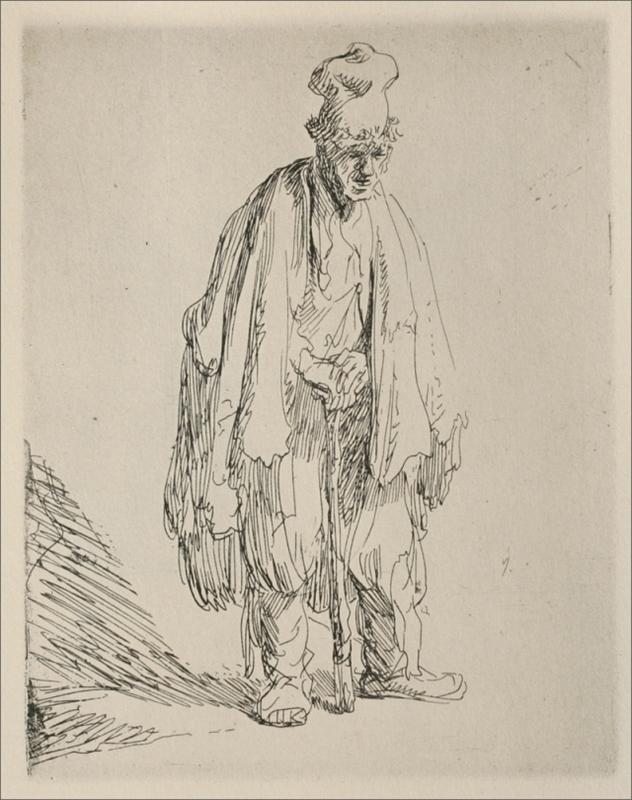
Rembrandt’s “A Beggar Standing and Leaning on a Stick” (1632) is an etching that compresses empathy, observation, and technical daring into a handful of lines. The figure occupies the sheet alone, a full-length silhouette of threadbare layers and bowed resolve. He leans into his staff with the subtle torque of someone who has walked far and long, his cap slouched, his cloak in tatters, his shoes softened by the road. There is no architectural backdrop, no anecdotal prop, no moralizing inscription. The space around him is nearly blank, save for a wedge of hatched shadow and the faint tremor of plate tone—emptiness that reads as public air. This spareness is the key to the image’s force: it insists that a person, looked at carefully and honestly, is enough.
A Turning Point In Rembrandt’s Early Amsterdam Years
The date 1632 catches Rembrandt at the beginning of his Amsterdam ascent. Commissions for portraits and histories were multiplying, yet the artist continued to etch small scenes of ordinary life—beggars, street vendors, travelers, and solitary elders. These prints were never side projects; they were laboratories where he refined a language of line capable of holding light, posture, and character without the help of color or large scale. In this print he asks a radical question for its time: can the dignity of a human being who owns nothing be conveyed without piety, scorn, or theatrical pathos? The answer arrives through posture, negative space, and the moral clarity of the etched mark.
Composition As A Study Of Gravity
The figure stands slightly left of center, giving the sheet more air than mass. That decision allows the staff to become a compositional hinge: it falls in a clean vertical, measuring the body’s pitch and dividing the draped shapes of cloak and tunic. The man’s head droops forward, not dramatically but with the habitual curve of someone whose eyes consult the ground before the horizon. One foot extends hesitantly; the other plants and bears weight. The tiny wedge of hatched shadow at lower left does the heavy work of anchoring the stance, its diagonal thrust opposing the body’s downward pull. With the most economical means, Rembrandt sets up a dialogue between verticals that hold and diagonals that yield—geometry that reads viscerally as weariness supported.
The Language Of Line
Etching is a recorder of touch. Each line on copper remembers the needle’s speed and pressure; acid then bites that memory deeper, fixing it into printable fact. Rembrandt uses a varied vocabulary here. Long, sloping strokes pour down the cloak like rain, their spacing widening toward the hem to suggest light thinning as cloth swings forward. Short, haggard nicks describe rents and edges; rounder, looping marks in the cap and sleeves register soft, worn fabric. The staff is a single, firm descent with a slight thickening near the hand where grasp and gravity meet. Most of all, the face is a cluster of small, hesitant hatchings that hold shadow without sealing it, leaving the expression readable but not forced. The line’s honesty is the figure’s dignity.
Light, Paper, And The Ethics Of Negative Space
Because an etching prints dark lines on pale paper, light is an absence the artist must learn to protect. Rembrandt leaves large fields of untouched paper around the man. That reserve is more than a background; it is the scene’s moral atmosphere. The blankness reads as city air, open yet indifferent. Against it, the beggar’s silhouette has the poignancy of a voice in a quiet square. The wedge of ground shadow does not dramatize a light source; it simply proves that the man has weight and that time of day happens to him as to everyone else. In this economy, there is no visual sermon—only the claim of presence.
Clothes As History Written In Fabric
The garment’s layered ruin tells a biography without narrative. Thinning seams, bunched sleeves, scalloped tears along the cloak’s edge, and the softened bulge of shoes speak of weather and use more persuasively than any inscription could. Rembrandt does not catalogue dirt; he draws structural fatigue. The clothes still do their job—cover, warmth, pockets—but they reveal the countless negotiations between need and resourcefulness. Those negotiations are the social fabric of the Dutch Republic’s streets: charity, odd jobs, alms, relief houses, and the sheer mathematics of subsistence. In the etched folds one reads the slow handwriting of a life.
Posture As Psychology
The man leans, but he is not collapsed. His head is inclined, yet his shoulder girdle remains engaged, with the elbow slightly out and the wrist firm around the staff. The hands are remarkably eloquent: one cups the stick as if it were both tool and reassurance; the other hangs but remains anatomically alert, fingers asking the ground a question the eyes already know. This poised fatigue refuses caricature. Rembrandt has drawn someone who has been hurt by the day yet continues to occupy it with measured care.
A Street Study Without Sentimentality
Seventeenth-century images of the poor often served as moral fables: laziness punished, charity rewarded, vice anatomized. Rembrandt avoids that didactic habit. There is no theatrical grief, no children clutching the hem, no melodramatic pleading. The figure is presented with the same attention the artist gave to scholars and captains; he is not an emblem of sin or sanctity but a neighbor temporarily stalled in air. The print therefore returns the viewer’s gaze to the present tense. The question it asks is not moral arithmetic, but attention: can you see this person as fully as the lines do?
The Wedge Of Shadow And The Geometry Of Silence
That triangular patch at the left lower corner matters more than its size suggests. It duct-tapes the figure to the ground, of course, but it also occupies the role that in a larger composition might be played by architecture or a passing wall. It is the picture’s counterweight, its partner in a duet. With it, Rembrandt sets a tempo of silence; without it, the figure would hover, and the sheet would be air without weather. The shadow’s hatched diagonals angle away from the man, like the wake of a boat drifting to a stop.
Technical Subtleties: Plate Tone, Wiping, And Impressions
Impressions of this etching can vary widely depending on how Rembrandt or later printers inked and wiped the plate. A cleanly wiped impression emphasizes the crisp, calligraphic elegance of the contour and the articulate hatching in the cloak. An impression with retained plate tone—a film of ink left on areas that were not bitten—wraps the figure in a faint haze that draws him deeper into space and mellows the paper’s brightness. These small atmospheric shifts change the print’s emotional temperature from analytic clarity to chilly morning air without the artist adding a single line. In this way the printing process becomes a second stage of authorship.
Kinship With The Beggar Series And The Artist’s Broader Project
This plate belongs to a constellation of small figure etchings Rembrandt made in the early 1630s: beggars with staves or crutches, a leper ringing a clapper, street musicians, the blind fiddler, and travelers called “Polanders.” Each is a micro-essay in posture and social reality. Together they map a microcosm of the city that portrait commissions and biblical dramas rarely show. The artist’s approach is consistent: isolate the figure, simplify the scene, and let line tell the truth of mass and balance. Within that program, this particular print is notable for its refusal of anecdote and its almost abstract pleasure in drapery and weight.
The Dutch Republic’s Poor And The Visual Politics Of Seeing
Seventeenth-century Amsterdam maintained an elaborate system of poor relief run by civic and church institutions, yet poverty remained visible in markets, alleys, and ferries. Artists navigated a visual politics: to depict the poor could be an act of social realism, satire, moral instruction, or agency-less spectacle. Rembrandt chooses the first. He paints the elite and etches the vulnerable with the same attentive ethic. By stripping away emblem and setting, he removes the mediation of story and lets the viewer’s responsibility be only to look. That equality of attention is a quiet social statement embedded in style.
Comparing Etched Line To Painted Light
It is instructive to compare this print’s economy of means with Rembrandt’s painted scenes from the same years—grand works where light descends theatrically in oil. Here, light is implied by absence, and modeling is achieved by the density of lines rather than by pigment. Yet the feel is recognizably Rembrandtian: a living envelope of air, surfaces with character, and a face that asks you to spend a second more than you thought necessary. The print is a monochrome cousin to the paintings’ gold: light and empathy share a grammar across mediums.
A Guide For Slow Looking
The most rewarding way to read the print is to travel slowly. Begin at the cap’s lopsided crest and see how a few spare curves establish wool made soft by rain. Slide down the forehead into the eye sockets, noticing how minimal the marks are—just enough to turn the plane and register attentiveness. Cross to the hooked nose, then to the softened, unsmiling mouth. Drop to the left shoulder and follow the cloak’s downward rivers of line, widening toward the hem like water shallowing to a shore. Pause at the staff hand; feel its grip harden the line. Step to the wedge of shadow and sense how it cools the paper. Then return to the shoes and their blunt tips; they are the print’s honest punctuation.
The Role Of Scale And Intimacy
The plate is small enough to hold close in the hand. That scale creates intimacy without sentimentality; you are near enough to trace individual hatchings but far enough to see the whole silhouette breathe. The modest size also echoes the subject’s social scale: a person who occupies little space in the city’s attention but fills the artist’s field of view. In a culture of large, celebratory militia portraits, this palm-sized sheet is a whisper with the resonance of a bell.
Why The Image Still Feels Modern
Contemporary viewers, trained by photography to read posture and negative space, recognize the print’s modernity immediately. Its design could hang beside twentieth-century documentary portraits without losing relevance. The refusal of anecdote, the generosity of blank background, and the insistence on a single, legible gesture align with our era’s taste for clarity and restraint. Most of all, the print’s ethic—attention without exploitation—feels urgently contemporary.
Influence And Afterlife
Rembrandt’s beggar etchings influenced generations of printmakers who sought to dignify ordinary subjects with a precise economy of means. In the nineteenth century, when social realism became an explicit artistic program, these plates served as precedents for looking without condescension. Even within Rembrandt’s own oeuvre, motifs recur: the bowed head, the hand on a stick, the cloak’s slow waterfall of lines. They migrate into biblical elders and scholars, reminding us that the boundary between the poor and the wise is often a matter of circumstance, not essence.
Process, Experiment, And The Pleasure Of Making
There is a palpable pleasure in the way the lines flow, stop, and recommence. You can sense the artist testing pressure, letting a line wander and then correcting it with a second pass that sharpens contour while leaving the first as a ghost. Small pentimenti are not mistakes; they are the record of a drawing thinking. That liveliness contributes to the figure’s vitality; his edges are a conversation between decision and reconsideration, just as a real body adjusts its weight while standing.
The Image As Invitation Rather Than Judgment
By avoiding literal markers of destitution—no begging bowl, no written plea—Rembrandt relinquishes control over the viewer’s moral response. The print becomes an invitation: to recognize, to imagine a before and an after, to consider what attention itself might be worth. In this sense, the sheet performs the work of civic seeing. It asks for the same courtesy in the square that the artist extends in the studio.
Conclusion
“A Beggar Standing and Leaning on a Stick” is a small work with a large conscience. Within a few square inches, Rembrandt engineers a study of weight, weather, and human persistence. The space is bare, the lines are few, and yet the presence is complete. The figure’s quiet lean transforms into a statement about how to look at one another—without spectacle, with patience, and with the knowledge that dignity can survive poverty when attention is paid with care. Nearly four centuries later, the etched air around this stranger still feels like our own.
