Image source: wikiart.org
Introduction
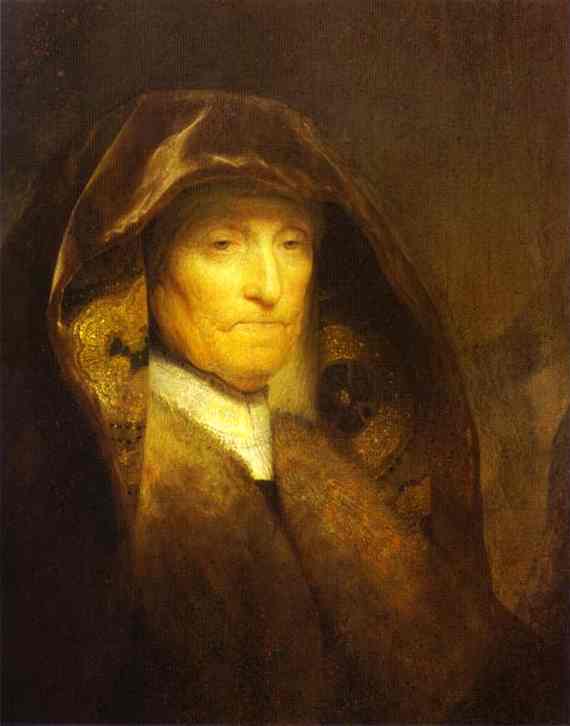
Rembrandt’s “Portrait of the Artist’s Mother” (1631) is a concentrated study of light, time, and tenderness. In a shallow, glowing space, an elderly woman appears in three-quarter view, her head wrapped in a dark hood whose edges catch glints of gold. The fur-trimmed coat and the white linen at her throat form a quiet frame for a face modeled with exquisite patience. The painting is small, but it feels monumental because Rembrandt lets illumination do the heavy lifting, allowing light to define character more persuasively than any emblem or anecdote. The image is both a filial homage and a manifesto of the young painter’s powers at the very moment he moved from Leiden to Amsterdam.
A Pivotal Year And A Family Presence
The year 1631 marks Rembrandt’s transition from provincial promise to metropolitan acclaim. He had already earned a reputation for expressive heads and inventive etchings; Amsterdam offered a larger market, especially for portraits. In that hinge year he repeatedly turned to his mother, Neeltgen Willemsdr., as model. Whether this panel was intended as an intimate likeness or as a character study (a tronie) that could stand for pious widowhood, its specificity is undeniable. The soft pouches under the eyes, the slight slackening at the mouth, the quietly set chin: all speak of a living person recognized by her son. The painting becomes a meeting point between private affection and public display of skill.
Composition As A Chamber For Light
Rembrandt stages the figure in a compact, oval-like frame of darkness that brightens toward the center. The head occupies the upper-right quadrant, angled gently toward the viewer, while the body’s mass settles into the lower-left with the weight of real cloth. The hood makes a second frame inside the first, deepening shadow around the face so that light can emerge from within. There is almost no background detail—no window, no furniture, no still-life punctuation—because all narrative will be carried by light’s behavior on skin, fur, and thread.
The Face: A Map Of Time Without Cruelty
The sitter’s face is one of Rembrandt’s early miracles of candor. He refuses the porcelain smoothing favored by competing studios, yet he resists caricature. The eyelids sink slightly but are still keen; the cheekbones retain structure; the mouth rests in a neutral line, softened by age but not collapsed. The nose reddens a degree near the tip, the flesh cools along the jaw, and a whisper of blue shadows the eye sockets. These temperature shifts, subtly woven through creamy transitions, give the impression of blood and breath under skin. The result is a face that has lived but is not defined solely by age—a person rather than a moral lesson.
Headgear, Fur, And The Rhetoric Of Texture
Costume is not an afterthought. The hood’s dark velvet receives light as if it had a nap; soft, broken strokes on its edge suggest pile catching illumination in tiny sparks. Within the hood, circular ornaments or embroidered patches glimmer like constellations, their gold leafed effect conjured through warm ochres punched with small, higher notes. The fur collar is built from short, lifted touches that break at the surface, so the eye senses individual hairs without counting any. These registers of texture—velvet, fur, metallic embroidery—are not mere decoration. They situate the sitter in a respectable domestic economy and, more importantly, they provide differing theaters for light, proving the painter’s ability to make material truth serve psychological truth.
Chiaroscuro As Ethical Language
The picture’s moral temperature is set by chiaroscuro. Light falls from the left, passes softly over brow and cheek, and subsides into the hood’s shelter. There is no violent contrast; instead, a slow gradient keeps the features humane. The most brilliant spot is the band of light at the upper cheek and forehead, yet it never bleaches into chalk. It is tempered, as if filtered through air warmed by breath. Darkness behaves like privacy rather than threat; it guards the face rather than attacking it. In this pictorial ethic, light is mercy—clarifying without exposure—and shadow is dignity—holding what should remain intimate.
The White Linen And The Architecture Of Modesty
At the throat a crisp, white linen insert interrupts the broader harmony of browns and golds. Its geometry is deliberate: two acute angles and a vertical seam that lead the eye upward to the face while proclaiming order and cleanliness. This small architectural element anchors the composition and signals the sitter’s modesty without any emblematic sermon. The linen’s coolness also calibrates the color balance, preventing the warm palette from swamping the face.
A Palette Of Hearth And Honey
The painting’s restricted palette—umbras and siennas, yellowed lights, and the intermittent sparkle of gold—is not stinginess; it is strategy. Rembrandt uses neighboring hues to create depth within darkness. The hood’s brown is cooler near its outer rim and warmer where it cradles the cheek. The fur collar oscillates between walnut and amber, allowing shadows to feel inhabited. The face merges with this climate of warmth, as if living in the same air as the garment. This chromatic unity fosters emotional unity: the sitter appears at home in her own light.
Brushwork: From Fused Skin To Dancing Edge
Rembrandt varies touch with purpose. On the face, brushstrokes fuse into an almost enamel smoothness, so transitions read as flesh rather than paint. Along the hood’s edge he allows the brush to drag and skip, producing a fringe of glittering irregularities that suggest worn velvet. In the circular ornaments the paint thickens into tiny impastos that catch incident light, while in shadowed areas thin glazes preserve respiratory depth. These shifts in handling are not showmanship; they are devices to place the viewer at the correct distance—near for intimacy, far enough for unity.
Expression And Psychological Register
There is a temptation to read melancholy into the downturned mouth, but the eyes do not agree. They are neither damp nor clouded; they are steady. The face gives the impression of an inward composure, a person who has learned to hold emotion in balance. Perhaps there is a trace of fatigue, but it is the fatigue of life lived attentively, not defeat. The son’s gaze is empathetic but unsentimental, which invites the viewer to occupy the same stance.
Between Portrait And Tronie
Rembrandt’s many images of elderly sitters from the early 1630s oscillate between commissioned portraits and tronies—character studies that explore expression, costume, or light. This panel leans toward portraiture because of its specificity and gravity, yet it shares with tronies the freedom to stage light for its own sake. That dual identity allows the painting to function both as a family likeness and as a public demonstration of Rembrandt’s capability to dignify age without formula.
Space As Quiet
The background is a soft field of warm air, with only hints of vertical structure that never resolve into furniture or a wall. This quiet is narrative: the sitter exists in a zone of contemplation. The lack of scenic information instructs the viewer to read the face, not the room. In later portraits of scholars and elders, Rembrandt will add books and ledgers; here he chooses silence so that the slightest inflection of light on the cheek becomes an event.
The Ethics Of Looking At Age
Seventeenth-century images of old women could veer toward satire or moral allegory. Rembrandt avoids both by refusing to impose a lesson on the sitter. There is no hourglass, no skull, no wagging finger; there is only a person treated with exacting attention. The warm palette and gradual modeling restrain the viewer’s appetite for scrutiny, providing a respectful distance. The painting teaches by example that attentive looking, free of spectacle, confers dignity.
Kinship With Neighboring Works
Set alongside the related “Prophetess Anna” from the same year, this painting shares the cone-of-light composition and the tender modeling of aged skin, but it cools the overt narrative. Instead of presenting an open book and the trope of scriptural study, it shows readiness for contemplation without props. Compared with Rembrandt’s shimmering portraits of male sitters in gorgets and chains from 1631, this panel replaces public assertiveness with domestic gravity, proving the range of the young artist’s psychological register.
The Role Of Scale And Viewer Distance
The portrait is intimate in scale. At close viewing distance, the granularity of the hood’s edge and the tiny flashes of gold read as physical. Step back, and those incidents dissolve into an overall halo that shelters the face. This fluctuation between detail and unity mirrors the way we actually look at loved ones: we alternate between the quiver of a single eyelid and the whole presence. The painting’s size enforces that human rhythm.
A Son’s Craft And A Mother’s Presence
While filial piety may have motivated the choice of model, the painting never collapses into private sentiment. Discipline rules. The carefully placed highlights, the balanced palette, the economy of setting, and the exact weight of the garments reveal a young painter using affection as a spur to rigor. What we feel as tenderness is inseparable from craft: the paint’s control is the tenderness.
How To Look Slowly
Begin at the linen triangle at the throat. Notice how its cool whiteness measures the warmth around it. Follow that vertical seam up into the shadowed underside of the chin, then allow your eye to rise to the soft band of light across the cheekbone. Drift into the eye socket and observe the minute shift from warm highlight to cooler half-tone beneath the brow. Travel outward to the hood’s edge and watch how tiny, irregular touches catch light like glints on worn velvet. Slide down to the fur collar where short, lifted strokes set up a low rustle. Then return to the mouth and note its neutrality—not frown, not smile—only a settled, humane pause. The circuit is slow because the painting is slow; it rewards patience with presence.
Influence And Afterlife
This portrait helped set the template for Rembrandt’s lifelong engagement with age. Later in Amsterdam he would paint regents, scholars, and Jewish elders with the same respect for irregular surfaces and unguarded expression shown here. The method—light as psychological agent, texture as testimony—became a grammar others borrowed. The painting also occupies a special place in the long history of artists turning to family as models, proving that domestic familiarity can yield universal resonance when treated with discipline.
Conclusion
“Portrait of the Artist’s Mother” is more than a likeness; it is a compact meditation on how light reveals a life. The hood, fur, and gold create a warm theater, but the drama belongs to the measured illumination of a face that refuses both flattery and despair. In this early Amsterdam moment, Rembrandt shows that the most powerful subject may be the one closest at hand—looked at carefully, described truthfully, and allowed to glow from within.
