Image source: wikiart.org
Introduction
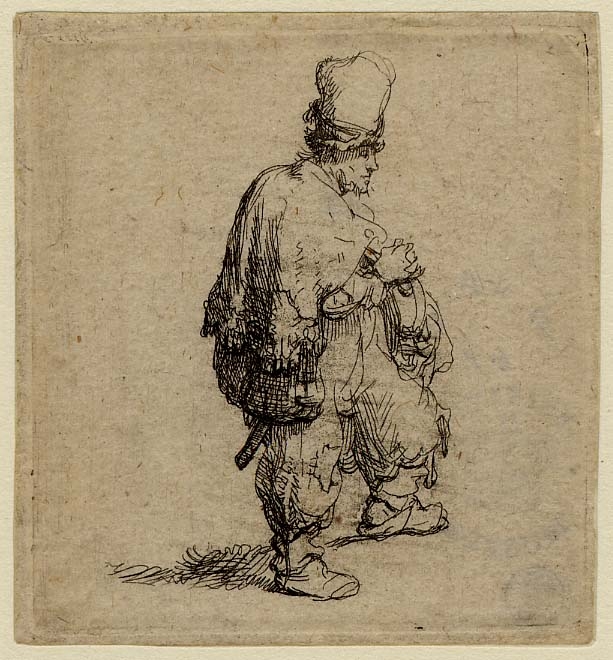
Rembrandt’s “The Barrel Organ Player (Polander Standing with Arms Folded)” (1631) is a small but remarkably vivid etching that captures a single itinerant figure with the force of a full narrative. The subject—often identified as a “Polander,” a Polish or Eastern-European street performer—is shown in profile, his arms folded across the chest and his weight rolling onto a bent front leg. A tall, soft cap crowns the head; a coarse cloak and baggy trousers wrap the body; stout shoes plant him to the ground. In just a handful of quivering lines, Rembrandt conveys status, movement, climate, and mood. More than a picturesque vignette, this print is an early declaration of the artist’s lifelong commitment to dignifying everyday lives through exacting attention.
The Work In Rembrandt’s 1631 Breakthrough
The year 1631 marks Rembrandt’s leap from Leiden to Amsterdam, where a broader clientele and thriving print trade awaited. He was twenty-five, and his studio bustled with experiments in light, texture, and character. Etching, in particular, became the laboratory where he tested how to make line behave like breath and weight. “The Barrel Organ Player (Polander Standing with Arms Folded)” belongs to a series of small plates focused on beggars, peasants, and street musicians (“The Blind Fiddler,” “The Leper,” “Peasant with His Hands Behind His Back,” among others). These images are neither caricatures nor sermonizing tableaux. They are exercises in looking: how to let posture, clothing, and a few well-chosen marks carry the full freight of human presence.
A Composition Built From Posture
Rembrandt composes the sheet around the simple geometry of a walking turn. The performer’s torso rotates slightly back while the front leg steps forward and the rear foot drags—an economical choreography that suggests both pause and readiness to move on. The body forms a gentle S-curve: cap and head tipped forward; shoulders sloping down under the cloak; hips swelling; knees rounding toward the ground. This curve keeps the small figure lively and prevents the compact rectangle from hardening into a static silhouette. A tuft of hat and a tassel of bag or strap act like punctuation, quickening the outline and giving the eye footholds as it circles the form.
The Etched Line As a Record of Touch
Etching preserves the tempo of the hand, and Rembrandt uses the medium’s responsiveness with precision. Short, parallel flicks define the nap of the cloak; looser, longer hatchings give the trousers their sack-like sag; a few taut, darker strokes weight the shoes. The face receives the most reticent treatment—just enough contour and shadow to propose cheekbone, nose, and beard—so that expression remains understated, a by-product of posture rather than theatrical acting. The tiny spray of lines beneath the feet becomes a rough ground and a cast shadow, anchoring the figure without pedantry. Everywhere, the pressure variations in the needle—harder where mass gathers, lighter where air circulates—translate directly into sensation.
Who Is the “Polander”?
Seventeenth-century Dutch art frequently labeled certain costumed street figures “Polanders,” a catch-all term for migrants and mercenaries from the Polish–Lithuanian Commonwealth and other Eastern regions who were visible in port cities like Amsterdam. The tall, soft cap and layered, bulky clothing signal this exoticized type. Rembrandt’s interest, however, is not ethnographic costume per se; it is the opportunity the outfit affords for describing texture, weight, and rhythm. The heavy wrap and slouching trousers allow him to build a powerful dark mass with a few crosshatches while keeping the head and hands—seats of thought and intention—light and legible. The result trades stereotype for specificity: a traveler momentarily paused, not a cartoon.
Barrel Organ Player—Where’s the Organ?
Titles for old master prints often accrue later. Scholars have linked this figure to the street-musician theme because adjacent plates from 1631 show fiddlers and other performers, and because a short strap-like form near the left hip may be part of a small portable instrument or bag. Whether or not we see the mechanism, the body reads like that of a player between phrases: arms folded as if warming hands or waiting for coins to drop, shoulders hunched against wind, mind focused on the next stop. Rembrandt trusts the viewer to infer livelihood from bearing rather than from literal props—a mark of his narrative economy.
Light Without Spectacle
The print relies less on dramatic chiaroscuro than on the white of the paper and the density of the lines to stage light. The figure’s back dissolves into a mid-tone mesh; the front edge catches small reserves of paper that act as highlights along sleeve, knee, and shoe. Because no part of the figure explodes into pure white or sinks into impenetrable black, the mood is observational, like an overcast noon. This is the weather of work, not theater. It suits a traveler who lives outdoors and an artist who refuses to inflate a modest subject with melodrama.
Gesture As Psychology
Arms folded across the chest can signal defensiveness, cold, or simple rest. Rembrandt does not force a reading. The slight tilt of the head and the modest projection of the chin imply wakefulness without challenge, the look of someone scanning peripherally while remaining closed against the wind. The clenched hands—drawn with only a few loops and angles—convey purpose more than plea. The overall attitude is one of inwardness: a man traveling inside his own weather, conserving heat and attention for the next bit of work. Psychology, for Rembrandt, lives first in weight and balance—how the body stands in the world.
Texture Tells the Story
One of the print’s quiet triumphs is the distinct vocabulary of marks for each material. The cloak’s hatching, tight and irregular, reads as worn wool; the cap’s top, sketched with a feathery scrubbing motion, has a puffed softness; the trousers, built from longer verticals that bunch around the knees, yield a sense of sagging cloth; the shoes, finished with solid, darker accents, feel leather-stiff and roadworthy. Even the short hatch that shadows the ground carries texture, suggesting grit or grass. Texture here is not decoration—it is narrative. It tells us about climate, class, and labor without a single emblem.
Negative Space As Breath
Rembrandt leaves the right two-thirds of the paper virtually untouched. That negative space acts like air and quiet. It gives the small figure room to exist and implies a future into which he will step. The emptiness is also social: street musicians and itinerant workers often inhabited the margins of public space, tolerated but kept at a distance. By allowing blankness to surround the “Polander,” Rembrandt registers that buffer without moralizing about it. The viewer’s eye respects the space even as it is drawn to the warm, vibrating mass of the man.
Scale, Cropping, and Viewer Distance
The plate is intimate—palm-size—yet the figure feels monumental because it absorbs so much of the rectangle. Rembrandt crops nothing essential, letting the hat float near the top margin and the feet settle close to the bottom. This gives the sense of a whole person, not a fragment, encountered at arm’s length. The viewer stands at a respectful, conversational distance, neither voyeuristically close nor coldly remote. That carefully judged space is one way the print achieves its particular humanity.
Kinship With Rembrandt’s Beggar Studies
Across 1630–1631, Rembrandt developed a suite of beggar and traveler plates that taught him how to communicate character with the fewest means. Compare this “Polander” with “The Leper (Lazarus Clep),” where a stark profile and a clapper condense a social system; or with “The Blind Fiddler,” where diagonal energy binds man and dog. In each, posture and mass do more work than faces packed with emotion. The “Polander” stands out for its quiet interiority—a figure not defined by a tool or emblem, but by the felt weight of clothing, the folded arms, and a gait that you can almost hear shuffling.
Printing, Plate Tone, and Subtle Variations
As with many Rembrandt etchings, impression-to-impression differences in wiping create distinct atmospheres. A cleaner wipe leaves the paper cool and crisp, emphasizing the graphic precision of the line; a retained plate tone warms the field and enfolds the figure in a slight haze, like breath in cold air. Neither mood is definitive; both reveal how the plate can “perform” differently without any change in drawing. Collectors prized these micro-climates as evidence that printmaking was a living art in Rembrandt’s hands, not a mechanical copy.
The Social Optics of Street Performance
Amsterdam’s mercantile culture depended on a public sphere crowded with sellers, sailors, porters, musicians, and migrants. Images of such figures were popular not only because they were common sights, but because they allowed viewers to rehearse attitudes—charity, curiosity, suspicion—at a safe remove. Rembrandt’s approach resists the easy moral lessons or mockery that some contemporaries offered. He gives the performer neither halo nor sneer. Instead, he offers accuracy and a kind of quiet equality: a person made of weight and cloth and habit, held together by a few sympathetic lines.
A Guide for Close Looking
Start at the cap. Notice the quickened scribble at the crest; the tiny tilt invests the whole figure with motion. Move to the face: there is no eyelash detail, only a deft wedge of shadow for the eye socket and a hooked contour for the nose—just enough to grant sentience. Travel down the sweeping line of the shoulder into the cloak’s hanging hem; feel how the crosshatching densifies where cloth overlaps. Pause at the folded arms: a couple of ovals and knots suggest glove and wrist, while a single darker loop locks the fingers. Then follow the trouser folds as they bunch at the knee and relax onto the shoe. End with the scratch of ground—five or six lines that summon a patch of earth. The whole figure is a lesson in sufficiency.
Why This Etching Still Feels Modern
Strip away period costume and this might be a contemporary street photograph: a passerby caught mid-step, insulated by clothing and thought, framed against blank architecture. The print’s modernity lies in its trust in negative space, its economy of means, and its ethical neutrality. It neither pleads for pity nor delights in superiority. It looks, records, and leaves room for the viewer’s own knowledge of fatigue, weather, and the self-sufficient stance of someone accustomed to moving through the world without asking for much.
Legacy and Influence
Rembrandt’s small plates of single figures influenced generations of printmakers who learned from his economy and his respect for ordinary subjects. The “Polander” prototype—compact field, mobile silhouette, varied hatch—can be traced through eighteenth- and nineteenth-century etchings of workers and travelers, and it anticipates modern reportage drawing. Within Rembrandt’s own trajectory, these studies of posture and mass underwrite the deep psychological truth of his later portraits: he understood how a person’s center of gravity tells the truth as surely as any facial expression.
Conclusion
“The Barrel Organ Player (Polander Standing with Arms Folded)” turns a simple encounter into a durable image of human presence. With a few flicks of the needle, Rembrandt records weight, temperature, and thought. The folded arms conserve warmth; the hat and cloak resist the wind; the shoes grind the road; the blank field opens into the next street. Nothing is extraneous, and nothing is sensational. This is the artist’s early genius at full strength: to make a life feel substantial through line alone, and to grant dignity by means of accuracy and restraint.
