Image source: wikiart.org
Introduction
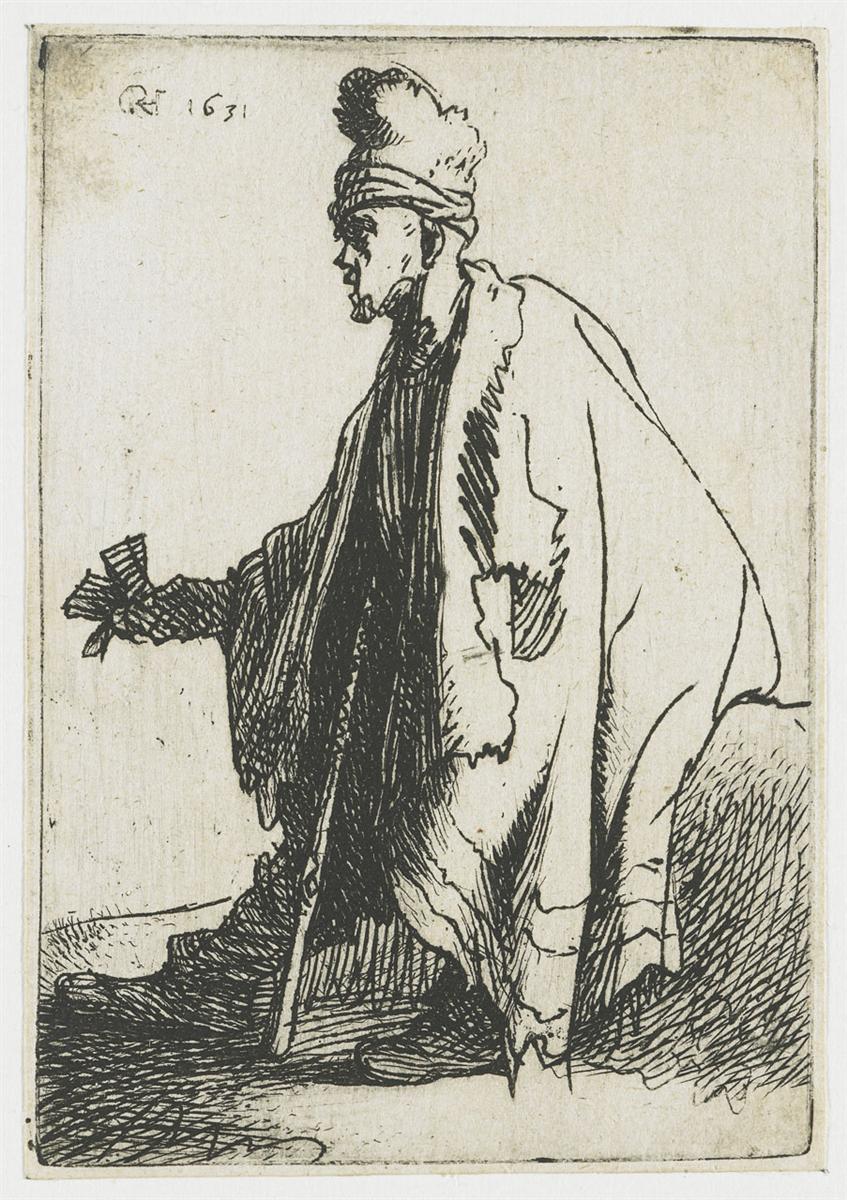
“The Leper (Lazarus Clep)” (1631) is a terse, unforgettable etching in which Rembrandt distills an entire life of hardship into the silhouette of a single figure. A man wrapped in a patched mantle moves from left to right with the aid of a staff. His profile is severe, his clothing torn, and the glove on his outstretched hand holds a small clapper, the emblem that publicly declares his condition. The lines are few and emphatic, the background almost empty, and yet the image vibrates with human presence. Rembrandt’s early print transforms a fragment of street life into a dignified monument to endurance.
A Work At The Threshold Of Amsterdam
The date anchors the print at a crucial moment when Rembrandt was leaving Leiden for Amsterdam. In these years he experimented vigorously with etching, using the medium to test how little information could bear the weight of character, narrative, and light. Scenes of beggars, itinerants, and marginalized figures recur throughout his early plates. They are not curiosities; they are laboratories in which he perfected a language of line capable of swift description and deep empathy. “The Leper (Lazarus Clep)” belongs to this sequence and shows the artist’s ability to compress observation into a hieroglyph of human truth.
Lazarus And The Cultural Significance Of The Clapper
The word “clep” refers to the clapper traditionally carried by those suffering from leprosy and other contagious diseases, signaling their approach so passersby could keep distance. Rembrandt’s leper holds the device at arm’s length, its slats clearly notched by a few decisive strokes. The gesture is both practical and symbolic. It marks the man as segregated by law and custom, yet it also gives him a voice in a world that might otherwise ignore him. In Rembrandt’s hands the clapper is not a badge of shame; it is a tool that structures social space and a prop that, paradoxically, brings the subject into our attention.
Composition As Ethics
The figure dominates the small plate. Set in strict profile, he advances across a field of untouched paper that reads as air and silence. The staff, angled to the ground, creates a strong diagonal that stabilizes the body’s forward tilt. A loose rhythm of large shapes organizes the sheet: the tall hat’s tuft, the bulky mantle, the outstretched forearm with clapper, and the stout shoes that grip the earth. Nothing distracts us from the person. The austerity of the composition functions ethically, refusing everything that would turn the leper into anecdote or entertainment and insisting instead on presence.
Etched Line And The Weight Of Cloth
Rembrandt’s line is unusually bold here. He lays down thick contours along the mantle’s edge, allowing the acid to bite deep and print dark. Within that contour he modulates density with crosshatching that falls like heavy rain, conveying the coarse, ill-fitting weight of the garment. Torn areas at the hem are described with jagged, irregular edges that read instantly as fray. The hat’s furry top is a chorus of short, energetic strokes that bristle upward, while the striped under-tunic receives a leaner, more vertical hatch. These vocabularies of mark speak the languages of wool, fur, and rough cloth without a single explanatory word.
Light Without Chiaroscuro
The image is almost schematic in its lighting. Instead of dramatic shadow and highlight, Rembrandt relies on the pale ground to supply a cool, even illumination. The deep black inside the mantle’s fold provides local contrast and keeps the figure from flattening, but the print avoids theatrical modeling. This restraint keeps the mood sober and observational. The leper is presented not as an actor on a stage but as a person encountered in daylight, moving along the world’s edges.
Profile As a Vessel For Character
Profile is a classical mode that lends clarity and dignity. It avoids the intrusive gaze of a face-to-face encounter while revealing the structure of nose, brow, and chin with sculptural economy. In this plate, the profile does additional work: it implies a direction of travel. The man is moving forward, and our eye moves with him. The clenched mouth and the slight angle of the neck communicate resolve rather than complaint. The profile’s authority helps the print avoid voyeurism; we witness, we do not pry.
Gesture And The Architecture Of Movement
Everything in the figure’s bearing is functional. The staff plants slightly ahead of the forward foot, taking weight and pacing the stride. The other arm extends to the side, clapper held firmly yet not aggressively, creating a counterbalance to the mantle’s mass. The long diagonal of the staff and the horizontal thrust of the arm lock the body into a dynamic triangle that feels stable without stiffness. This is not a tableau of suffering; it is a record of practiced movement, the choreography of getting from one place to another under difficult conditions.
Negative Space As Compassion
The emptiness surrounding the leper is not a lack of description; it is an artistic choice that communicates social reality. The laws that required clappers also created a buffer of space around those who carried them. Rembrandt visualizes that buffer with blank paper. The untouched ground feels like silence into which the instrument will click. It also becomes a zone of respect. By refusing to fill it with scenery, the artist leaves room for the viewer’s response and acknowledges the distance—literal and cultural—that separates communities.
Clothing As Narrative Of Poverty
The mantle’s tears, the patched lining, the bunched trouser at the ankle, and the thick soles of the shoes are narrative elements as powerful as any emblem. They are not miserly details; they are the record of a life in weather. The frayed edge near the ground, caught by a few jagged strokes, tells a story of years of contact with dirt and stone. The heavy textures that build the mantle signal warmth and protection, but also weight and encumbrance. Without melodrama, the clothes narrate the compromises of survival.
A Quiet Iconography Of Sanctity
The print’s title invites association with Lazarus, the beggar from the Gospel parable who suffers in this life and is comforted in the next. Rembrandt, however, does not supply overt religious attributes. There is no halo, no attendant angels, no didactic inscription. If sanctity appears, it does so through the gravity of posture and the discipline of line. The humble staff, the measured step, and the refusal of spectacle allow the leper to occupy an icon-like stillness within motion. Devotion is found in the way the artist looks, not in the addition of sacred props.
Relation To Rembrandt’s Studies Of Beggars And Wanderers
Rembrandt’s early prints often feature solitary figures on the road or at the threshold of houses. “The Leper (Lazarus Clep)” is among the starkest of these. Others include lively crosshatching or clusters of onlookers; here almost everything extraneous is burned away. That reduction emphasizes the silhouette and the rhythm of walking, making the plate a touchstone for his later ability to convey character through posture alone. It also shares with his best studies of peasants a powerful neutrality: no satire, no sermonizing, only disciplined attention.
Printing Variants And The Plate’s Voice
As with many etchings, impressions of this plate can differ depending on how they were inked and wiped. A cleaner wipe throws the figure into crystalline relief against a cool field, sharpening the graphic impact. A retained plate tone softens contours and warms the space, making the mantle’s interior shadows feel deeper and the scene slightly duskier. These differences change the emotional weather without altering the underlying drawing, reminding us that Rembrandt treated printing not as mere reproduction but as a second stage of expression.
The Viewer’s Role And The Ethics Of Attention
The man’s blindness is not specified; the clapper’s presence suggests disease and separation more than visual impairment. Regardless, the print positions the viewer as someone standing to the side, allowing passage. We are close enough to read texture and gesture, yet far enough to respect the bubble of space the clapper creates. The artist’s ethics becomes our own: to look carefully, to withhold judgment, and to acknowledge the dignity of someone whose life we cannot fully know.
Close Looking And Small Miracles
Several passages reward slow attention. The tufted hat is composed of quick, buoyant lines, each curved just enough to create a feathery rise. The profile’s jawline is thickened by a short, dark stroke that gives the head weight above the collar. The inner edge of the mantle near the staff is a powerful vertical that functions almost like a backbone, organizing the whole mass. The clapper is described with a handful of angular strokes, but its dangling cords receive a more delicate touch that keeps the device from hardening into a rigid emblem. Even the shoe treads are hinted at with energetic hatching that makes the step believable.
Why This Image Still Feels Contemporary
Modern viewers often find this little sheet startlingly current. Its refusal of sentiment, its reliance on silhouette and gesture, and its trust in negative space align with contemporary graphic languages. It carries social content without spectacle. It is a portrait of marginalization that neither aestheticizes suffering nor turns away from it. Instead, it offers respect through accuracy, the most durable kind of empathy art can offer.
Legacy And Influence
“The Leper (Lazarus Clep)” helped establish a Rembrandtian approach to the human figure in print: large, simplified masses; decisive contours; and a mood built from air as much as from ink. Later printmakers learned from its economy and from the way it lets a single object—the clapper—stand for a wider social system without preaching. Within Rembrandt’s own development, it is a milestone in his lifelong project of dignifying ordinary lives by means of extraordinary attention.
Conclusion
In a small rectangle of paper Rembrandt stages a meeting between artist, subject, and viewer that is both intimate and restrained. The leper advances with staff and clapper, wrapped against the weather, moving through a pale field that is at once physical space and social distance. The etched line carries the weight of cloth and the fact of hardship; the profile confers clarity and dignity; the emptiness around the figure grants breath. “The Leper (Lazarus Clep)” is not a spectacle of suffering but a study of perseverance. It asks us to witness without intrusion and to measure the power of simple marks to hold a human life.
