Image source: wikiart.org
Introduction
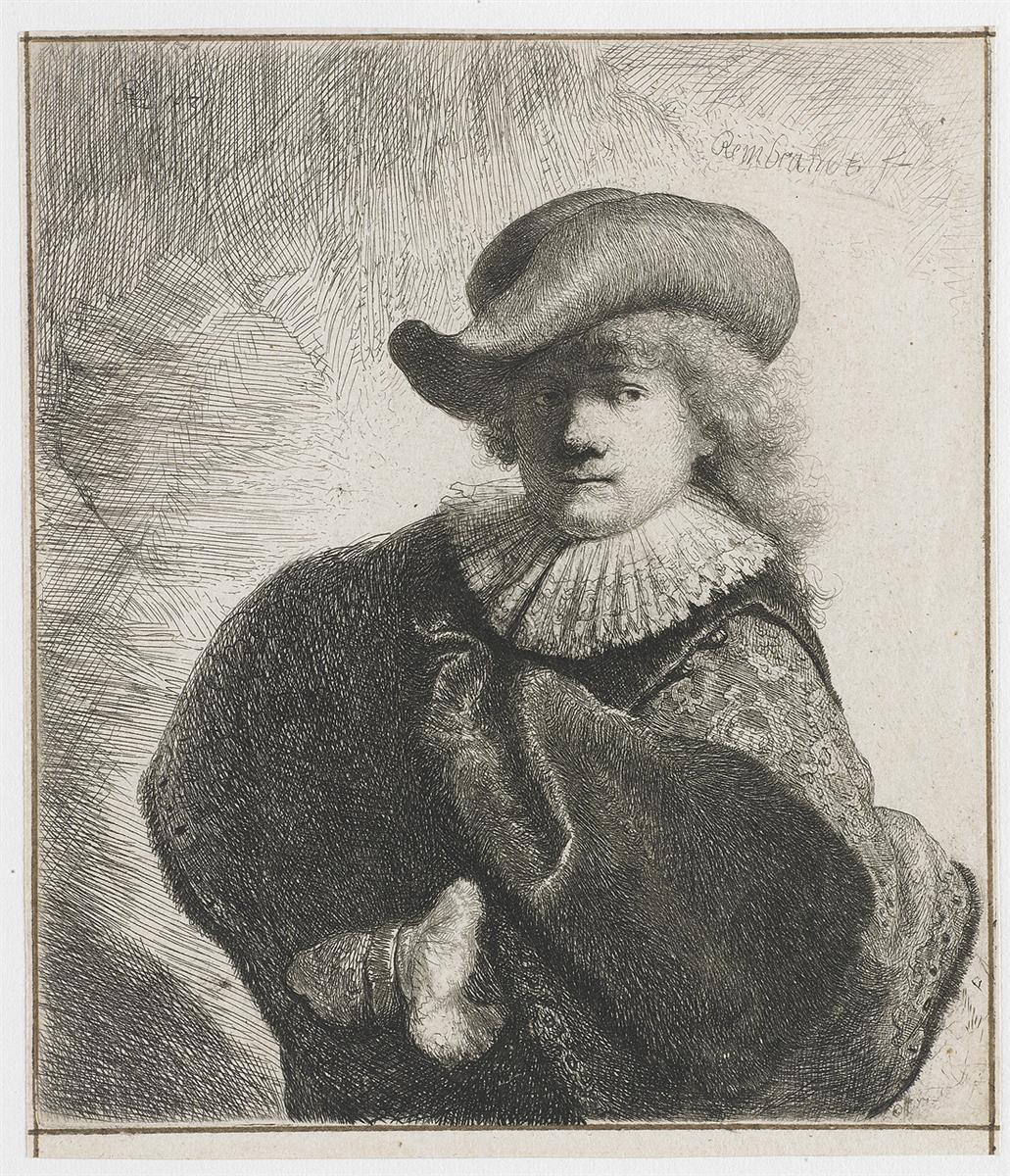
“Self-portrait in a Soft Hat and Embroidered Cloak” (1631) captures Rembrandt at the precise moment he was turning youthful bravura into a public persona. The image shows him half-length, turned three-quarters to the viewer, the brim of a supple cap casting a gentle visor over the eyes while a lavish, patterned cloak swells across the foreground. A crisp ruff rings the neck like a small stage of light. Everything is orchestrated by etched line and the disciplined play of light and shadow. Rather than a simple likeness, the print is a study in how costume, pose, and mark-making can construct identity.
A Hinge Year Between Leiden And Amsterdam
The date 1631 sits at a hinge in Rembrandt’s career. He was moving from Leiden’s workshop networks to Amsterdam’s larger market, eager to court patrons and collectors who prized virtuosity and novelty. Self-images from this period—across paint and print—functioned as laboratories for lighting, expression, and texture, and as calling cards that circulated through the print trade. This sheet belongs to that cluster. It reveals an artist refining the vocabulary he would use to win Amsterdam’s attention: theatrical costume tempered by psychological candor, and an atmosphere built not from backdrop but from light itself.
Etching As A Responsive Instrument
Etching was the perfect medium for this experiment. A copper plate coated with wax ground allowed Rembrandt to draw with a needle at the speed of thought. The acid then bit the exposed lines, preserving every pressure change and hesitation. In this self-portrait he uses the medium’s agility to differentiate materials with exquisite economy. Long, supple hatchings shape the plume-like swell of the hat. Dense crosshatching compacts the cloak into velvet darkness. Short, crisp strokes describe the ruff’s ridges without resorting to mechanical repetition. The result is a small symphony of lines that remain alive even after multiple impressions.
Composition And The Oval Of Presence
The figure fills the plate without crowding it. Rembrandt positions the head near the upper right, leaving a pale field to the left that reads as air and directs the eye back toward the face. The cloak’s large, dark mass sweeps across the lower half like a stage curtain, anchoring the composition and thrusting the head forward. Behind the figure, a faint halo of radiating hatch marks creates an oval of presence. This aura is not an emblem but a practical device: it separates the silhouette from the background and gives the portrait an atmospheric depth that plain paper cannot.
The Soft Hat As Character
The soft hat is more than a fashionable accessory; it is stagecraft. Its flexible brim dips in a shallow curve that shades the eyes just enough to intensify the gaze. Its surface is modeled with gentle, parallel strokes that follow the fabric’s slump, communicating weight without heaviness. The hat’s shape softens the head’s outline and confers a relaxed authority. Paired with the ruff and the cloak, it locates Rembrandt in the theater of “costume tronies,” those character studies in which artists tested roles and moods in the studio.
The Embroidered Cloak And The Rhetoric Of Texture
Across the foreground the cloak surges like a velvet wave. Rembrandt renders it with layered crosshatching that deepens where folds meet and relaxes on broader planes. Along the outer edge, a delicate brocade emerges, described by a few witty inflections rather than literal patterning. The cloaked arm forms a sturdy diagonal up to the shoulder, while the knuckles peeking from the cuff provide a small counterpoint of light within the dark mass. Texture here is argument: the cloak declares material richness, but the drawing’s restraint keeps opulence subordinate to character.
The Ruff As Engine Of Light
The ruff rings the neck with serrated brilliance. Rembrandt builds it from short, alternating strokes that articulate ridge and hollow without freezing them into formula. Its cool brightness becomes a luminous stage on which the face can play. Notice how the light ricochets from the ruff to the underside of the chin, then up to the cheek and the bridge of the nose, before falling off into the hat’s soft shadow. The ruff is not merely a period accessory; it is an optical engine that powers the portrait.
Light, Shadow, And Psychological Temperature
Light arrives from the left, catching the cheek and nose, sliding across the ruff, and grazing the glove. Shadows gather under the hat and along the far jaw, but they never swallow expression. The value range is deliberately moderate; Rembrandt avoids harsh black against blinding white. This calibrated palette of greys creates a humane temperature, a mood of alert calm rather than theatrical melodrama. The expression—lips closed, eyes steady—reads as thoughtful readiness, a young artist measuring the viewer as he invites the viewer to measure him.
Background Mark-Making And The Sense Of Air
The background’s crosshatching is not filler. Its radiating pattern creates an atmospheric dome around the head and shoulders, keeping the figure buoyant while preventing the paper from feeling empty. The direction and density of these lines vary subtly, thickening near the hat and thinning toward the plate edges. This breathing field of marks allows the head’s silhouette to vibrate slightly against its surroundings, increasing the sensation of living presence.
Gesture, Glove, And The Theater Of Hands
The right hand emerges from the cloak in a soft glove, turning slightly toward us. Its placement is compositional and psychological. It breaks the dark expanse with a pale, tactile form that leads the eye up the arm to the face. It also signals controlled self-presentation: the glove announces civility and readiness, an accessory halfway between restraint and flourish. Rembrandt resists over-describing the fingers; a few decisive planes and reserves suffice to make the glove feel supple and inhabited.
Cropping, Scale, And Viewer Distance
The plate brings the viewer close—close enough to read the weave of marks but not so close that the figure crowds the paper’s edges. This carefully judged distance matters. It places us in a zone of conversational intimacy rather than confrontation. The slight turn of the shoulders away from us keeps decorum, while the directness of the head’s angle invites exchange. The portrait becomes a meeting rather than a display.
Comparison With Neighboring Self-Images
Around 1631 Rembrandt made several self-portraits that test costumes and expressions: beret and gold chain in oil, long bushy hair in etching, oriental attire with a dog in paint. The present print sits between the quiet poise of the beret painting and the bravura of the “bushy hair” etching. Like the painting, it favors tonal unity and measured light; like the etching, it revels in the virtuosity of line. It is less theatrical than the oriental masquerade and more formally elegant than the laughing or grimacing studies. It proposes a persona of polished seriousness, suited to courting Amsterdam patrons who valued both refinement and veracity.
Printing, Plate Tone, And Variations In Mood
Because etchings exist in multiple impressions, the sheet’s mood can shift subtly with inking and wiping. A retained plate tone in the background adds a warm veil that deepens the aura around the head; a cleaner wipe sharpens the contrast between figure and ground. Rembrandt exploited these variables to “reperform” the same image with slightly different atmospheres. Collectors prized such variations because they made the print feel alive, capable of breathing different air without losing identity.
The Ethics Of Costume And Candor
Costume self-portraits risk vanity. Rembrandt dodges the trap by letting light and drawing carry the drama rather than finery alone. The embroidered cloak and soft hat are vehicles for texture and value; they never eclipse the mind in the face. The sitter’s gaze is direct but not imperious, and the mouth resists the easy theatrics of a smirk or a scowl. The result is an ethic of self-presentation built on attention rather than display, already a hallmark of the artist’s mature work.
What To Look For Up Close
Close looking reveals a choreography of tiny decisions. A narrow reserve along the bridge of the nose keeps the form crisp under the hat’s shadow. The eyelids are not rimmed; they are turned by minute value shifts, which prevents the gaze from hardening. The ruff’s scallops vary in size and spacing, avoiding mechanical repetition and preserving a sense of hand. Along the cloak’s edge, a few almost calligraphic squiggles conjure brocade without clutter. In the glove, two short strokes indicate creases that make the fabric feel lived-in. These micro-choices accumulate into a believable person rather than a catalog of parts.
The Portrait As Market Savvy
Amsterdam’s clientele collected small prints as eagerly as paintings. A sheet like this could be purchased, gifted, and handled, allowing the artist’s face—and skill—to circulate widely. Its mix of elegance and candor would have appealed to merchants and regents who prized both refinement and honest dealing. By mastering the language of dress while keeping the gaze frank, Rembrandt presented himself as a painter who could honor status without sacrificing truth.
Legacy And Influence
This self-portrait helped codify a Rembrandtian approach to etched portraiture: a controlled halo of background marks, a restrained yet expressive costume, a face modeled by nuanced light, and hands or accessories that anchor the composition without stealing the scene. Later printmakers learned from its economy and its trust in the viewer’s eye to complete forms from suggestion. Within Rembrandt’s own career, the sheet foreshadows the lifelong dialogue between role and reality that would culminate in the searching self-portraits of his final decades.
Conclusion
“Self-portrait in a Soft Hat and Embroidered Cloak” is a compact demonstration of early mastery. With nothing more than copper, ground, acid, and ink, Rembrandt conjures a world of texture and air, a personality poised between theater and candor, and a light that seems to think. At a glance, it is a handsome image of a young artist dressed to be seen. On sustained viewing, it becomes a lesson in how presence is constructed—how a brim can deepen a gaze, how a ruff can power illumination, how a cloak can carry the weight of a picture while the face carries its soul.
