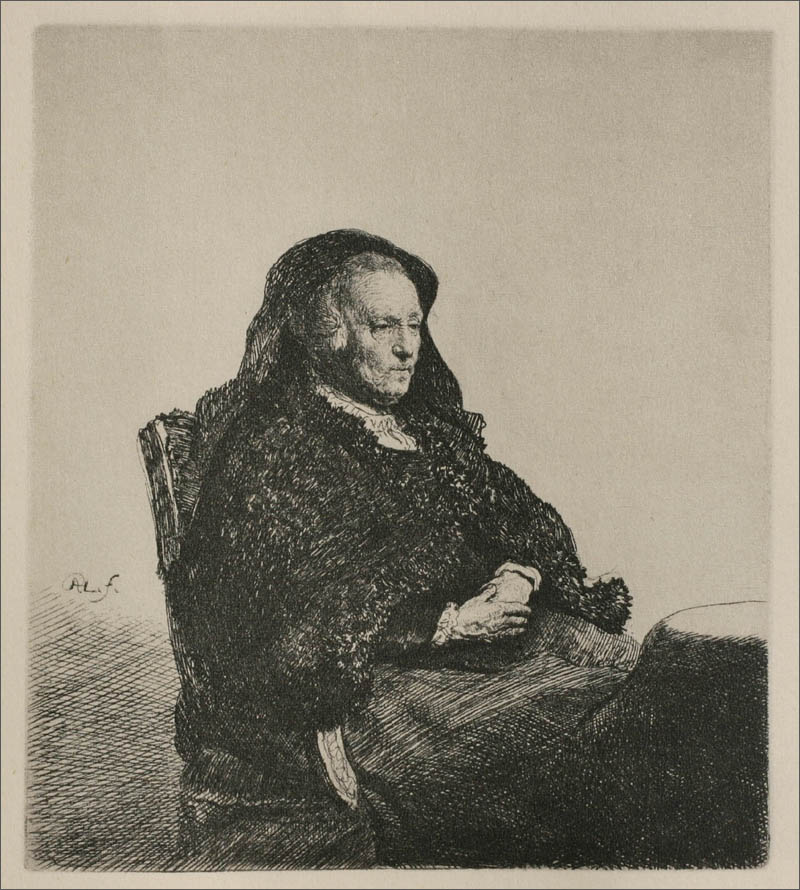
Image source: wikiart.org
Introduction
“Rembrandt’s Mother, Seated, Looking to the Right” (1631) is a small etching that radiates a monumental calm. The sitter occupies a chair in profile, hands loosely clasped, gaze turned toward light falling in from the unseen right. A cowl-like veil and heavy cloak envelop her, and the broad emptiness of the background isolates the quiet architecture of her posture. Within a few inches of copper, Rembrandt organizes a world of attention: the felt weight of layered garments, the notch of light on a cheekbone, the minute tensions in folded fingers, and the hush that surrounds a thinking person. The print is intimate without being sentimental, observant without being clinical, and austere yet warm—qualities that define Rembrandt’s early mastery of character.
The Moment In Rembrandt’s Early Career
The year 1631 stands at a hinge between Leiden and Amsterdam for the twenty-five-year-old Rembrandt. He had already earned a reputation for powerful “heads” and history scenes, and he was rapidly expanding his vocabulary in printmaking. Etchings from this moment show him testing how far line alone can carry tone and mood, and how light can be made to emerge from paper rather than be painted upon it. Portraits of an elderly woman—traditionally identified as Rembrandt’s mother—appear in several guises in these years. Whether or not the identification is exact, the subject allowed him to refine a grammar of dignity that would inform his later portrayals of old age, saints, and scholars.
Composition And The Authority Of Profile
The composition is deceptively simple: a profile set against a generous field of untouched space. The profile provides anatomical clarity, letting Rembrandt articulate the brow ridge, nose, lips, and chin with sculptural crispness, yet the clarity never stiffens. The body is diagonally set, from the high dark of the cowl down through the forearm and into the lap, which is summarized by a powerful wedge of crosshatching. This diagonal energy is checked by the horizontal of the unseen table’s edge at right, whose rounded corner cuts into the picture like a balancing counterweight. Together these forces stabilize the image while making it feel alive, as though the sitter had just settled into a long breath.
Light As The Argument Of The Image
Light enters from the right and touches the forehead, the bridge of the nose, the upper lip, and the clasped hands. Rembrandt allows the paper’s whiteness to supply the most radiant values, preserving a small reserve along the cheek and on the knuckles that keeps the image breathing. The rest of the sheet is built from layered hatchings and crosshatchings that thicken into velvet in the cloak and dissolve into a whisper across the background. Because the brightest lights are small and precisely placed, they assume narrative importance: they are the points where attention lands, and they link sight (the eye) with character (the hands).
Etched Line, Pressure, And The Tactile World
Etching preserves the liveliness of a hand moving with a needle. In this print the pressure varies with material and mood. The cowl’s edge bristles with short, prickly strokes that suggest both woolly texture and a thin halo of air between fabric and skin. The cloak’s interior darkness is woven from dense, rhythmic crosshatching that absorbs light like fleece. The lap and skirt are handled with longer, more directional strokes that follow the body’s planes; the chair back receives a few wiry accents to register wood grain; and the background’s soft net of marks keeps the emptiness from feeling blank. Texture here is not decoration but meaning—each set of marks embodies the sitter’s world.
Gesture And The Grammar Of Hands
Hands are the portrait’s quiet theater. They interlace loosely in the lap, neither wringing nor rigid. The thumb of the right hand hooks around the other with a practiced ease that suggests patience. Rembrandt builds the forms with minimal means: the swell of a knuckle articulated by a single contour, the plane of a finger turned by two or three parallel strokes. Because the hands sit at the hinge of the body’s diagonal, they stabilize the pose and serve as a visual rhyme with the illuminated cheek—a pair of pale ovals that speak of mindfulness and restraint.
The Veil, The Ruff, And Clothing As Ethics
Costume here functions like a moral argument. The veil frames the face with a somber dignity; the small ruff at the collar introduces a modest ring of brightness; and the cloak’s mass asserts warmth and privacy rather than display. Rembrandt refuses ornamental complication. By simplifying costume into large tonal masses punctuated by small highlights, he shifts the portrait’s emphasis from social status to human presence. The clothing protects the sitter and, pictorially, protects the image’s silence.
Negative Space And The Breath Of Stillness
The most radical choice in the sheet may be the open, nearly unmarked expanse to the right of the figure. This negative space is not an oversight; it is the condition that makes the rest of the image resonate. The blankness becomes air and quiet, pushing the sitter forward while giving her room to think. It also dramatizes the direction of the gaze: the eyes lead into that pale field, suggesting a future beyond the plate edge and transforming a private moment into a space of expectation. Few artists trust emptiness as Rembrandt does; here it is a protagonist equal to light and line.
Psychology Without Display
The sitter’s psychology is rendered with a rare economy. The mouth is closed but not compressed; the eyelids settle into a line of attention rather than fatigue; and the slight lift of the chin communicates alertness under restraint. We are not given a narrative about what she sees or thinks. Instead, we are offered the conditions of thought: a steady posture, a cleared space, a concentration of light. This refusal to prescribe emotion is what makes the print inexhaustible. Viewers project different interior monologues into the same poised silhouette without feeling manipulated.
The Chair, The Table, And Spatial Credibility
The simple chair back and the table’s rounded corner play outsized roles in the sheet’s spatial logic. The chair back yields a small wedge of perspective that grounds the figure in a room rather than in an abstract field. The table’s form, intruding at the far right, sets a tangible distance between sitter and viewer. It is a buffer that preserves decorum and prevents the profile from becoming a clinical specimen. These minimal props create a credible interior without clutter, keeping the image’s quiet mood intact.
Variations In Impressions And The Role Of Plate Tone
As with many Rembrandt etchings, impressions can vary depending on how the plate was inked and wiped. In some, a retained plate tone floats over the background like a thin atmospheric veil; in others, the wipe is cleaner, and the field becomes more crystalline. The differences subtly shift the image’s temperature—toward warmer dusk in one, toward cooler clarity in another—while the underlying drawing remains constant. This variability is not incidental; it is integral to the print’s voice, allowing each impression to perform the same score with slightly different timbre.
Relation To Other Depictions Of Rembrandt’s Mother
Rembrandt produced multiple prints and drawings of an elderly woman associated with his mother, sometimes in frontal view, sometimes three-quarters, sometimes in different headdresses or reading. Compared to more frontal versions, this profile emphasizes silhouette and discipline. The later images would explore richer plate tone and denser environments; this one prefers clarity and air. Taken together, these portrayals demonstrate a lifelong interest in aged faces as vessels of time and as theaters for light. This sheet, among the most restrained, distills that interest to essentials.
Time, Age, And The Dignity Of Inwardness
Age in Rembrandt’s art is never a curiosity; it is a repository of narrative. In this portrait, years register not only in the softened jawline and lined brow but in the habits of posture and gaze. The sitter’s body has learned the economy of stillness. Hands fold rather than clench; back leans rather than locks. The grace on offer is not youthful grace but the grace of acceptance, patterned by routine and reflection. The print’s dignity arises from that acceptance and from the artist’s refusal to sensationalize it.
Close Looking: Small Decisions With Big Effects
A slow inspection yields a sequence of tiny decisions that sustain the illusion of presence. A narrow reserve along the bridge of the nose keeps it lucid under the cowl’s shadow. A feathery highlight on the upper lip prevents the mouth from sinking into the facial plane. The veil’s edge is not a hard contour but a vibrating fringe of short lines, which reads as both fabric and atmosphere. The lap’s crosshatching subtly changes angle near the knee, turning the plane without heavy modeling. The chair’s vertical striations are just enough to call up wood and nothing more. This economy is the print’s quiet bravura.
Architecture Of Respect Between Viewer And Sitter
The profile, the intervening table, and the surrounding emptiness establish an ethic of viewing. We are invited to look, but not to pry. The sitter’s turned head denies us full frontal access; the table’s edge keeps us at a conversational distance; the blank field refuses narrative distractions that might tempt curiosity into impertinence. The result is a model for how images can create respectful relationships between people who have never met.
Influence And Afterlife
The portrait helped codify a Rembrandtian approach to intimate printmaking: large, simplified tonal masses; disciplined highlights; and an atmosphere built from negative space rather than from elaborate backdrops. Later printmakers learned from this strategy how to conjure mood with restraint and how to let the paper itself carry light. Within Rembrandt’s own development, the sheet points toward the sustaining role that emptiness and silence would play in his mature works, where shadow is not a hiding place but a medium for thought.
Conclusion
“Rembrandt’s Mother, Seated, Looking to the Right” is a masterwork of quiet persuasion. With a handful of etched lines and carefully husbanded light, Rembrandt gives us a human presence that feels both specific and archetypal. The profile’s authority, the gentle tyranny of negative space, the eloquence of the hands, and the sobriety of clothing gather into an image that respects the sitter as much as it captivates the viewer. It is a portrait of attention itself, showing how art can honor the private dignity of another person while inviting us into a shared stillness.
