Image source: wikiart.org
Introduction
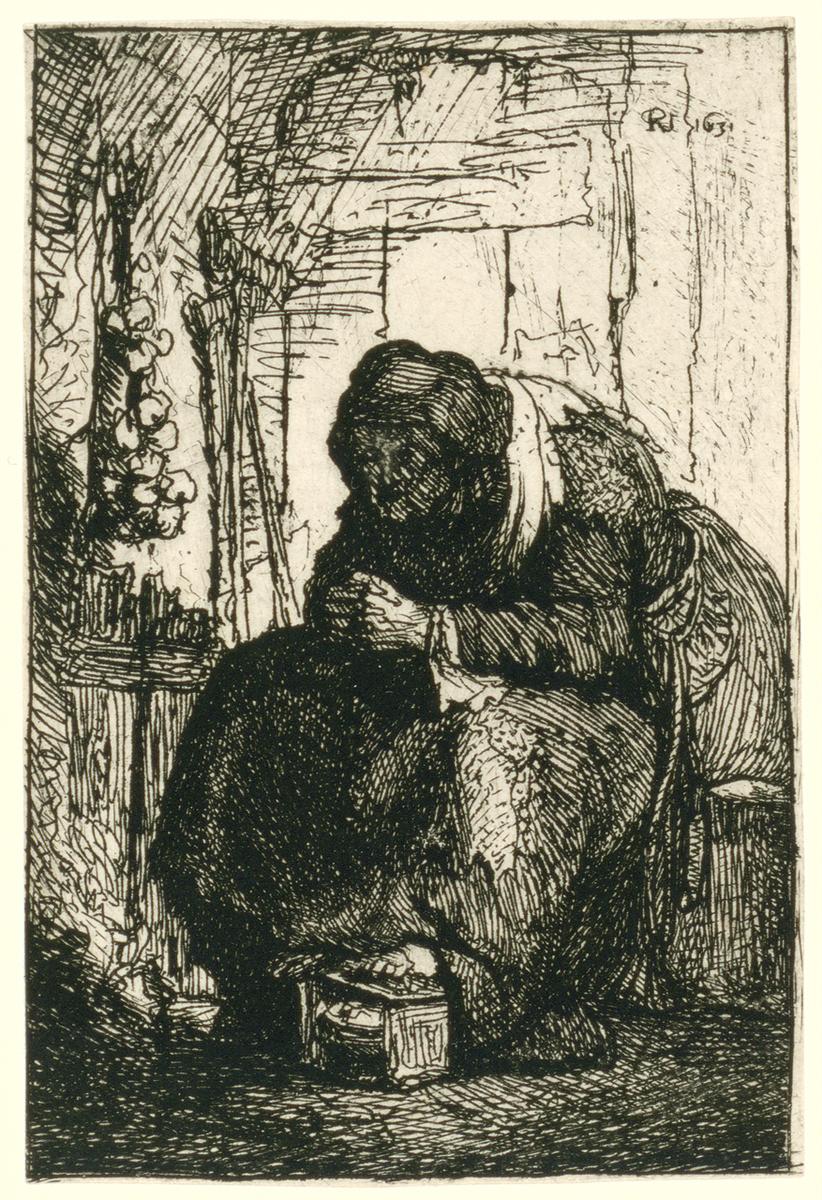
“Old Woman Seated in a Cottage with a String of Onions on the Wall” (1631) is a compact yet emotionally resonant etching from Rembrandt’s early career. Within a small rectangle of ink and paper, he stages a quiet drama of endurance and domestic labor. A figure hunches forward in a chair, absorbed in an unglamorous task, while a dangling garland of onions punctuates the wall beside her. The space is cramped, the light is stingy, and every line carries the weight of observation. What appears at first like a simple rustic scene reveals itself, on sustained viewing, to be a meditation on age, poverty, and dignity made tangible through the grammar of etched line.
The Moment In Rembrandt’s Development
The year 1631 stands at the threshold of Rembrandt’s transition from Leiden to Amsterdam. In these years he experimented restlessly with printmaking, probing how much narrative and psychology he could squeeze from a copper plate. The print belongs to a cluster of early images in which he explores humble interiors and anonymous sitters rather than patrician portraiture. In these experiments Rembrandt refined habits that would serve him throughout his life: he trusted texture to carry meaning, he allowed darkness to bear emotional weight, and he made common objects—like onions—act as agents of atmosphere as surely as any saint’s attribute.
Etching As A Language Of Speed And Memory
Etching gave Rembrandt the nimbleness of drawing with the reproducibility of print. A needle scratches through a wax ground, acid bites the exposed lines, and the plate prints whatever the hand recorded in that first encounter. The liveliness of the etched mark—its tremor, its hesitation, its sudden certainty—lets viewers feel thought happening in real time. In this print the hatchings over the woman’s shawl, the wiry strokes describing the onion braid, and the abrupt crosshatching in the hearth read like quick notations made from life. That speed becomes part of the subject: the scene seems caught between breaths, as if the artist looked up, saw the woman in her habitual stoop, and preserved the moment before it slipped back into anonymity.
Composition And The Architecture Of Shadow
The composition compresses the figure into the lower right quadrant, allowing the wall and dark floor to press inward. Rembrandt builds the space with shadow rather than with linear perspective. The black mass of the woman’s skirt forms the composition’s anchor; from it radiate planes of lesser darkness that carve the chair, the basket, and the floor into being. The upper register is sparer, constructed from faint scratches that imply beams and a hearth without pedantic detail. This pyramid of tone—from deepest blacks near the sitter to airy scratches at the ceiling—lifts the eye gently through the cramped interior and prevents the image from feeling airless.
The Gesture Of Concentration
The woman bends forward, shoulders rounded, hands meeting in a tight ellipse of focus. Whether she is mending, peeling, warming her fingers, or simply resting is left ambiguous; the point is attention itself. Rembrandt uses the curve of the back and the tuck of the head to stage concentration as a bodily event. The gesture is protective, like a shell forming around a kernel. It tells us that the interior life of a poor cottage can be as intense as any palace intrigue.
The Face Half Seen
Rembrandt’s handling of the face is a triumph of restraint. It is mostly in shadow, a mask of crosshatchings and small reserves. Yet from those limited means emerges a full psychology: the downward angle of the head suggests weariness; the barely indicated mouth implies a murmur or prayer; the cheekbone catches a tiny glint of light that keeps the figure from dissolving into anonymity. The refusal to define the face completely is not a failure of description; it is an ethical choice. The woman’s identity is held in privacy while her presence is rendered undeniable.
The String Of Onions As Domestic Emblem
The onions, twisting down the wall in a knotted braid, are more than decoration. In seventeenth-century kitchens they were staples that preserved well, flavored humble stews, and warded off winter scarcity. Rembrandt turns them into a visual counterpoint to the woman’s stooped body. Their vertical sequence answers her rounded silhouette, and their pale bulbs offer intermittent highlights against the dim wall. They are humble, necessary, and strongly material—qualities that rhyme with the sitter herself. As a visual emblem, the onions insist that subsistence and care are worthy subjects for art.
Texture As Narrative
Three textures dominate the print: the coarse knit of the shawl, the dense black of the skirt, and the dry tangle of the onion braid. Each receives a different dialect of line. Short, repeated strokes thicken the shawl until it seems able to trap warmth; heavy crosshatching compacts the skirt into a weighty mass that anchors the composition; scratchy, open marks articulate the papery skins of onions with just enough description to make them crackle in the mind. The range of touch reads like a paragraph of lived experience, with each texture adding a clause to the story of the room.
Light That Builds Character
Light enters obliquely, not in a theatrical beam but as a low glow that catches the top planes of forms—the edge of the bonnet, the ridge of the shoulder, the knuckles clasped at center. Rembrandt allows the paper’s whiteness to act as the source of this glow, reserving small passages that read as flickers rather than floods. Because the illumination is meager, each highlight matters. The smallness of the light feels morally accurate to the subject: in modest rooms, brightness is not abundant, but what exists is cherished and carefully used.
The Ethics Of Depicting Poverty
Rembrandt neither sentimentalizes nor mocks. He refuses the easy narratives of vice or virtue that often cling to portrayals of the poor. Instead he presents poverty as a texture of life—a set of materials, a climate of light, a repertoire of gestures. The woman’s patched garment, the cramped room, and the onions speak of scarcity, but the scene is not a complaint. It is a recognition. The image honors attention and endurance, suggesting that dignity can live within limited means when seen with patience.
The Interior As Psychological Space
Rembrandt does not load the cottage with anecdotal clutter. Objects are few and function like stage props chosen for clarity: a hearth, a chair, a wall, a hanging braid. This reduction turns the room into a psychological chamber. The dark mass at the bottom becomes the gravity that holds the woman in place; the lighter wall beyond her suggests thoughts drifting upward and away. The result is a space that seems to have weather and temperature as well as mood. We feel the stove’s faint heat and the draft that sneaks along the floor.
The Hand As Center
At the midpoint of the print, the woman’s hands meet. They are small, nearly swallowed by the mass of clothing, but Rembrandt positions them where the eye settles after circling the composition. The hands become the quiet fulcrum of the scene. They may be sewing; they may simply be clasped to warm. In either case the hands explain the posture and give the image its pulse. Without them the scene would be only a silhouette; with them it becomes a record of purposeful time.
Cropping, Margins, And The Sense Of Witness
The figure sits close to the picture’s lower edge, and her head nearly grazes the mid-height of the plate. This tightness creates a feeling of proximity—as if the viewer stands just inside the room’s threshold, careful not to intrude. The upper margin holds Rembrandt’s tiny monogram and date, a whisper of authorship that also balances the composition’s center of gravity. The margins of the plate mark the scene as framed observation, but the density of line at the bottom tips us into the action, making us participants rather than distant spectators.
The Role Of Negative Space
The print’s top and right passages include stretches of relatively untouched paper. These areas behave like air and quiet. They give the eye rest after the concentrated blackness of the skirt and hearth. Because Rembrandt does so little in those zones, the few marks he does place—scored lines suggesting wall boards, a scatter of diagonal hatches indicating ceiling beams—carry disproportionate descriptive weight. Negative space here is not absence but a resource, and it is the key to how the cramped room still feels breathable.
Comparing The Work To Other Early Interiors
Around the same period, Rembrandt etched beggars, peasants, and old men in sparse settings. This scene shares their commitment to ordinary subjects but distinguishes itself by the intensity of its interior. Many early prints prefer open air; this one corners itself indoors and uses enclosure to heighten empathy. Its closely woven darks anticipate later masterpieces where Rembrandt builds form from almost sculptural blackness. The print thus functions as a seedbed for ideas he would nurse in paint and in more elaborate plates.
Material Poverty And Spiritual Plenty
Though the scene contains no explicitly religious symbols, its mood is devotional. The bowed head, the inward concentration, and the dim but constant light echo the iconography of prayer without declaring it. The onions, fundamental and tear-provoking, bring a faint scent of the biblical everyday into the cottage. Rembrandt often located spirituality in gestures and light rather than in attributes. Here the sacred hides in the ordinary act of getting through a winter afternoon.
The Sound Of The Room
If a print can be said to have sound, this one murmurs in low registers. The dense black at the bottom reads like a quiet rumble; the mid-tone hatchings around the hearth crackle softly; the bare paper above suggests the hush between sounds. Rembrandt’s variation of etched pressure—light and dry in the walls, heavy and saturated in the skirt—creates an aural rhythm that guides the eye. The woman’s small, central action becomes audible like a whisper in a silent room.
The Woman’s Clothes As Biography
The patched sleeve, the layered shawl, and the heavy skirt act as a biography stitched in fabric. They speak of winters endured, garments repurposed, and a lifetime of careful repair. Rembrandt refuses elegance and instead finds beauty in usefulness. The viewer can almost feel the scratch of wool, the weight of piled cloth at the lap, the frayed edge at the hem. Such tactility is not merely descriptive; it signals care—the care given to garments to make them last and the care with which the artist records them.
The Small Stove And The Economy Of Heat
Near the woman’s feet rests a low brazier or foot-stove, the sort used to warm hands and legs in cold rooms. This object, partly swallowed by shadow, functions like a quiet heart within the composition. It explains the woman’s posture and the density of the lower tonal register: heat gathers below, and the figure shrinks around it. The stove introduces a practical physics to the image, making warmth a compositional force. It also anchors the viewer’s empathy in bodily sensation; we feel the desire to pull close to a small flame.
Why The Image Still Feels Contemporary
The print’s power lies in its refusal of spectacle. Contemporary viewers, saturated with images of display, recognize the radicalism of attending to a moment that expects no audience. The woman does not perform; she simply persists. The image honors that persistence with disciplined craft and leaves interpretive space for the viewer’s own experiences of care, labor, and aging. Its modernity is the modernity of respect.
Guidance For Close Looking
Begin at the onions and trace their spiral downward, noting how Rembrandt toggles between contour and interior marks to build papery volume. Drift across the light wall where a few diagonal scratches conjure beams and plaster; feel how little information suffices when placed well. Settle into the black sea of the skirt and notice the changes of grain that separate shoe, stove, and floor from one another even in near darkness. Lastly, rest on the small oval where the hands meet, and sense how the entire image turns around this modest center.
Legacy And Afterlife
Images like this trained later artists to discover drama in ordinary interiors. Seventeenth-century Dutch painters of domestic scenes share its ethics of attention; nineteenth-century realists inherit its sobriety; twentieth-century photographers echo its trust in available light and unposed gesture. The print’s specific vocabulary—onions on a wall, a shawl catching light, hands folded around work—continues to inform how we picture endurance at the scale of the everyday.
Conclusion
“Old Woman Seated in a Cottage with a String of Onions on the Wall” demonstrates how a small etching can hold a large human truth. With a handful of etched lines Rembrandt builds a world of texture, smell, temperature, and thought. The woman’s stooped body, the string of onions, the small stove, and the meager but faithful light become coordinates by which we navigate not only a Dutch cottage in 1631 but also the perennial experience of making a life in close quarters. The image endures because it respects the ordinary, records it without fuss, and discovers in its grain the dignity that outlasts fashion.