Image source: wikiart.org
Introduction
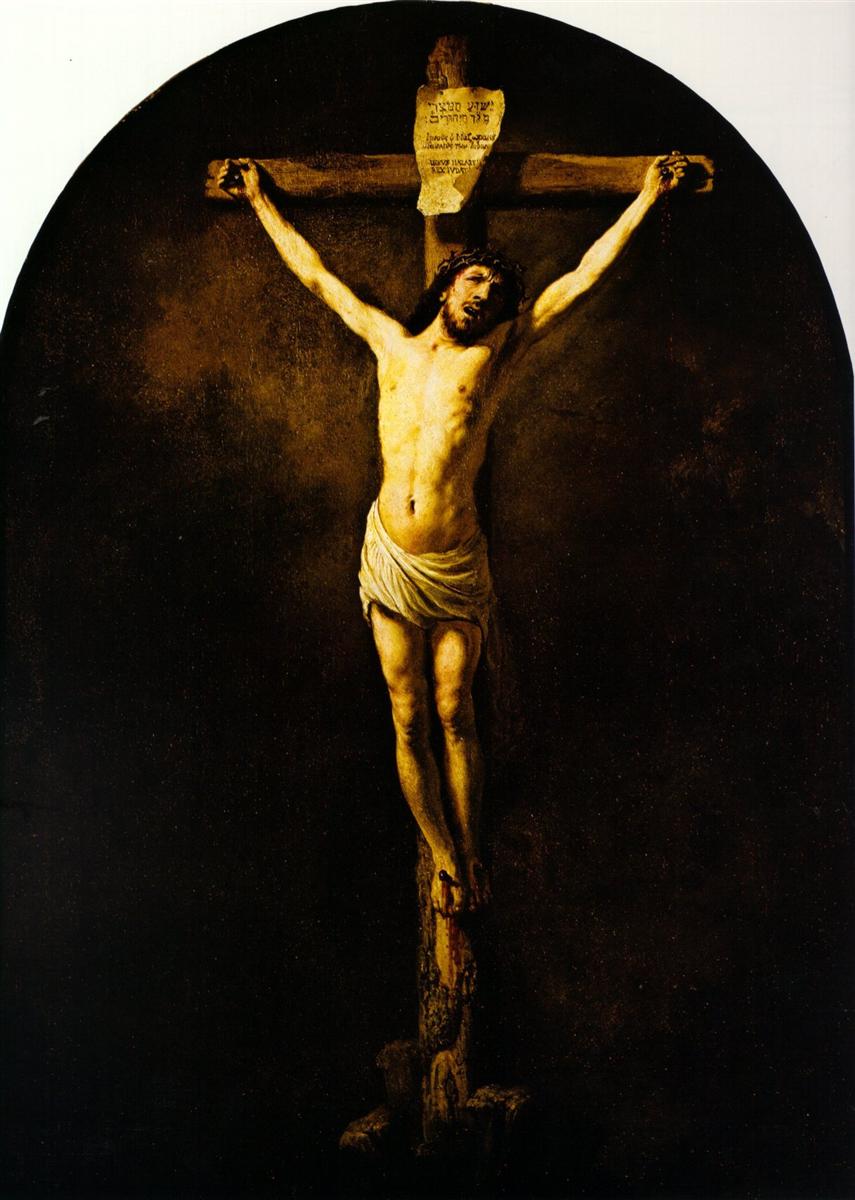
Rembrandt’s “Christ on the Cross” (1631) captures the pivotal Christian image with a candor and intimacy that redefines the devotional picture for the seventeenth century. Painted early in his career, the work demonstrates how a young artist from the Dutch Republic could adopt an age-old subject and make it feel both immediate and profoundly spiritual. A single figure illuminated against a cavernous darkness, it distills the Gospel narrative to the moment of surrender and transforms it into an encounter between viewer and suffering Redeemer. The painting is not only a statement of faith; it is a technical manifesto about light, anatomy, and human emotion.
The Radical Simplicity of the Composition
At first glance, the composition seems almost austere: a tall vertical panel crowned with a rounded arch, a cruciform structure centered within it, and the solitary body of Christ suspended in a pool of light. Rembrandt eliminates the bustling staffage common in many crucifixion scenes—no Roman soldiers, no weeping Marys, no distant crowds. This reduction serves dual purposes. It converts a historical episode into a universal icon and directs the entirety of our attention toward Christ’s suffering and the mysterious radiance that frames it. The wooden cross slices the darkness like a pillar, while the cross-beam creates a stable horizontal that anchors the outstretched arms and introduces the geometry of perfect sacrifice: a vertical of divine descent intersected by the horizontal reach of redemption.
Chiaroscuro as Theology
Rembrandt’s language of light is never merely optical; it is theological. Here, light gathers around the living body and fades as it reaches the edges of the cross and the sepulchral background. This is not the sunlight of midday Jerusalem but a metaphysical illumination that seems to emanate from the figure itself. The contrast between glowing flesh and surrounding gloom dramatizes the paradox of the Passion—life shining within death, hope within forsakenness. The arched top intensifies this illumination, acting like an apse that cups the radiance and suggests a chapel-like setting. By painting darkness not as emptiness but as velvety depth, Rembrandt makes the light look merciful and deliberate, as though grace has chosen its focus.
The Speaking Body
One of the remarkable features of the painting is how decisively the body communicates. Christ’s torso angles slightly to the left, the ribs visible under taut skin, the abdomen gently contracted. The head droops and twists, mouth parted as if on the edge of speech or breath. The right knee bends forward and the feet overlap at the nail, a pose that introduces the faintest spiral through the otherwise rigid geometry of the cross. The anatomy is both studied and compassionate. Muscles tense where weight pulls at the wrists; shoulders strain without bravura display; the belly’s soft recession refuses the athletic ideal. In a century awash in heroic nudes, Rembrandt chooses vulnerability. His Christ is frail enough to suffer, human enough to die, and beautiful precisely because the painter has resisted ornament.
The Crown, the Title, and the Instruments of Mockery
The details are few but loaded with significance. The crown of thorns sinks into hair and forehead, a ring of pain that punctures the halo convention. Above the head hangs the titulus, the trilingual placard declared by the Gospel: “Jesus of Nazareth, King of the Jews.” Rembrandt renders it as a ragged piece of parchment tacked to the cross-beam, its script a flicker of marks that read as both history and indictment. In the right hand, a cluster of dark beads or a broken chain hangs loosely, an ambiguous reference that intensifies the sense of dereliction and the body’s exhaustion. These objects are not displayed like museum pieces; they are absorbed into the painting’s moral weather, reminders that every insult has been endured.
The Loincloth and the Ethics of Modesty
The white drapery wrapped around Christ’s waist is a masterclass in tonal painting. It is neither a decorative flourish nor a concession to propriety; it is a theological garment. The cloth’s folds catch light and lead the eye to the center of the composition, establishing a luminous focus that both veils and reveals the body’s vulnerability. In Rembrandt’s hands, the linen becomes an emblem of humble kingship—the poor man’s mantle and the High Priest’s vestment. The way it knots and twists suggests the hurried roughness of Roman hands yet sits with a quiet dignity that aligns with the painting’s overall gravity.
Northern Devotion and Dutch Context
Created in the Protestant Dutch Republic, the painting navigates a complex devotional environment. Public church interiors in the north largely rejected narrative altarpieces; yet private collectors cultivated intense, personal piety through paintings and prints. Rembrandt meets this desire for inward devotion with an image designed for close contemplation. The single figure placed close to the picture plane, the absence of anecdotal distractions, and the candlelit atmosphere speak to the domestic chapel and the meditative corner rather than the grand altar. At the same time, the work converses with Catholic baroque painting from the Southern Netherlands and Italy—particularly the Caravaggisti of Utrecht—who practiced tenebrist drama. Rembrandt absorbs that drama but purifies it, limiting the theatrical to serve the meditative.
Brushwork, Surface, and the Tactility of Faith
Up close, the painting reveals a sensuous handling of paint. The flesh is modeled with translucent layers, glazed to achieve an inner glow, while the cross is built from more opaque, rugged strokes that mimic splintered wood. The background is a field of soft, irregular touches, as though the painter breathed darkness onto the panel. Such handling matters for more than aesthetics. The physicality of the paint mirrors the physicality of the subject. We are meant to feel the difference between human skin and dead wood, between the warmth of life and the cold of instrument. Even the tiny highlights on the nails at wrist and foot function as tactile punctuation, the paint catching light where iron pierces flesh.
The Moment Depicted: Abandonment and Offering
Rembrandt avoids the climactic gestures often favored in crucifixions—no storm-tossed sky, no angels collecting blood, no swooning witnesses. Instead he selects the quiet agony of endurance. The parted lips and upturned eyes hint at the “My God, my God, why have you forsaken me?” while the resigned slump of the head suggests the later “It is finished.” Caught between cry and consummation, the figure contains both. This ambiguity is not indecision but comprehension: the Passion is both abandonment and offering, both human despair and divine self-gift. Rembrandt’s restraint lets the viewer dwell in that paradox.
Geometry of Salvation
Look at the silent architecture of the image. The outstretched arms generate an expansive triangle whose apex is at the feet, directing the eye downward to the rock base that grounds the cross. The head, slightly off-center, forms a secondary, smaller triangle with the nailed wrists, focusing the drama where humanity and wood meet. These triangular structures stabilize the pathos, ensuring the painting does not collapse into melodrama. Instead of a flurry of narrative lines, we get a measured geometry that reads like a visual creed: vertical (God’s descent), horizontal (the world embraced), triangle (love poured out).
Color as Emotional Temperature
Though the palette is limited—ochres, umbers, a faint red in the lips and wounds—it is keyed with exquisite sensitivity. The warm gold that skims Christ’s torso sets a humane temperature against the cool, dead browns of the timber. The loincloth’s pale notes are not pure white but a web of warm and cool grays; this chromatic humility heightens the body’s quiet glow without cheap contrast. The result is an atmosphere of evening—neither day nor night, but the hour when shadows lengthen and meanings intensify.
Comparisons and Influences
Rembrandt’s crucifixion invites comparison with contemporaries. Rubens often filled the stage with sinewed heroism and spectacular witnesses; van Dyck favored noble elegance. Rembrandt, while aware of these models, chooses inwardness. Compared with his own later print “The Three Crosses” (1653), which thunders with apocalyptic light and crowds, the 1631 painting is a whispered prayer. It anticipates the psychological naturalism that will mark his mature works: faces that think, bodies that carry history, light that behaves like grace.
The Viewer’s Place Before the Cross
Because the ground plane is shallow and the cross nearly touches the picture’s base, the viewer stands close—uncomfortably close. We look slightly upward, as if kneeling at the foot of the cross. The darkness surrounding us is our darkness, not merely the painting’s. This deliberate staging transforms spectators into participants in the drama of redemption. The painting does not ask us to analyze; it asks us to witness. Yet witnessing here is not passive. The intimacy of distance invites examination—of the wounds, the breath, the weight. Seeing becomes a form of prayer.
The Labor of Wood and the Weight of Flesh
The cross is rendered with an almost portrait-like attention: knots, cracks, sap lines, the blunt stump at its foot. Such emphasis reminds us that crucifixion is not metaphysical alone; it is a craft of execution. The beam’s mass presses into our perception of Christ’s weight. This material honesty intensifies the tragedy and avoids abstraction. Salvation occurs through a particular body on a particular tree. By honoring the wood with as much attention as the flesh, Rembrandt prevents the scene from becoming merely allegorical. It is historical, physical, and therefore morally binding.
Silence, Sound, and the Suspended Breath
One can almost hear the painting. There is the soft rasp of breath hinted by the parted lips, the faint creak of rope or wood, the absolute silence of the surrounding dark. Rembrandt choreographs these imagined sounds through visual means—open mouth, tensile arms, drooping head—so that the viewer’s own breathing subtly syncs with the depicted rhythm. In a work designed for private devotion, such embodied empathy is powerful. It creates an interior dialogue where words fail and presence suffices.
Devotional Function and Private Patronage
Given its format and rhetorical intensity, the painting likely served as a private devotional image rather than a public altarpiece. The arched top suggests it may have been mounted within a niche or domestic frame, encouraging daily contemplation. In the home, this image would function as a spiritual anchor: a reminder of mortality and mercy, of sin and absolution, of the love that holds when all other lights recede. Rembrandt’s early clientele included prosperous merchants and learned burghers who prized such inward piety; this painting meets their spiritual hunger with uncompromising seriousness.
The Ethics of Looking
Rembrandt challenges the viewer to look without spectacle. There is no gore. Blood is suggested rather than showcased. The pathos is carried by posture, not by display. Such restraint is an ethical choice. It resists both sentimentalization and sensationalism. The depiction invites compassion and repentance rather than curiosity. The lesson is not simply that Christ suffered, but that suffering can be seen truthfully—without turning pain into ornament or theology into rhetoric.
From Leiden to the World: An Early Masterpiece
Dated 1631, the painting belongs to the years when Rembrandt was forging his identity, moving from Leiden toward Amsterdam’s larger stage. Already his signatures are visible: the fusion of psychology and light, the respect for ordinary bodies, the capacity to make a single figure bear a universe of meaning. “Christ on the Cross” thus offers a preview of the mature artist who will later paint prodigal sons and Jewish brides with the same economy and depth. What begins here as a tightly focused devotional picture becomes, across his career, a method of seeing the world—one in which love illumines sorrow and truth is the shortest path to beauty.
Why the Image Endures
The painting’s endurance lies in its refusal to resolve the Passion into an easy message. Rembrandt keeps us in the tension between horror and hope, darkness and illumination, history and sacrament. Its light is not the bright certainty of doctrine but the warm persistence of love that refuses to leave the suffering alone. In that steadfast glow, many viewers across centuries have recognized their own nights and found, if not answers, then companionship. “Christ on the Cross” is a painting to return to, because it returns to us—with the patience of a gaze that knows what it costs to be human and what it means to be held.
Conclusion
Rembrandt’s “Christ on the Cross” gathers line, light, and silence into an image of inexhaustible depth. It is at once a confession of faith and an inquiry into what paint can do: reveal the living heart in the body, carve space with darkness, and turn a wooden cross into an instrument of revelation. Few images speak more quietly or more powerfully. In its humble radiance we glimpse the artist’s lifelong conviction that truthfulness—about bodies, about suffering, about grace—is the most persuasive beauty.
