Image source: wikiart.org
Introduction
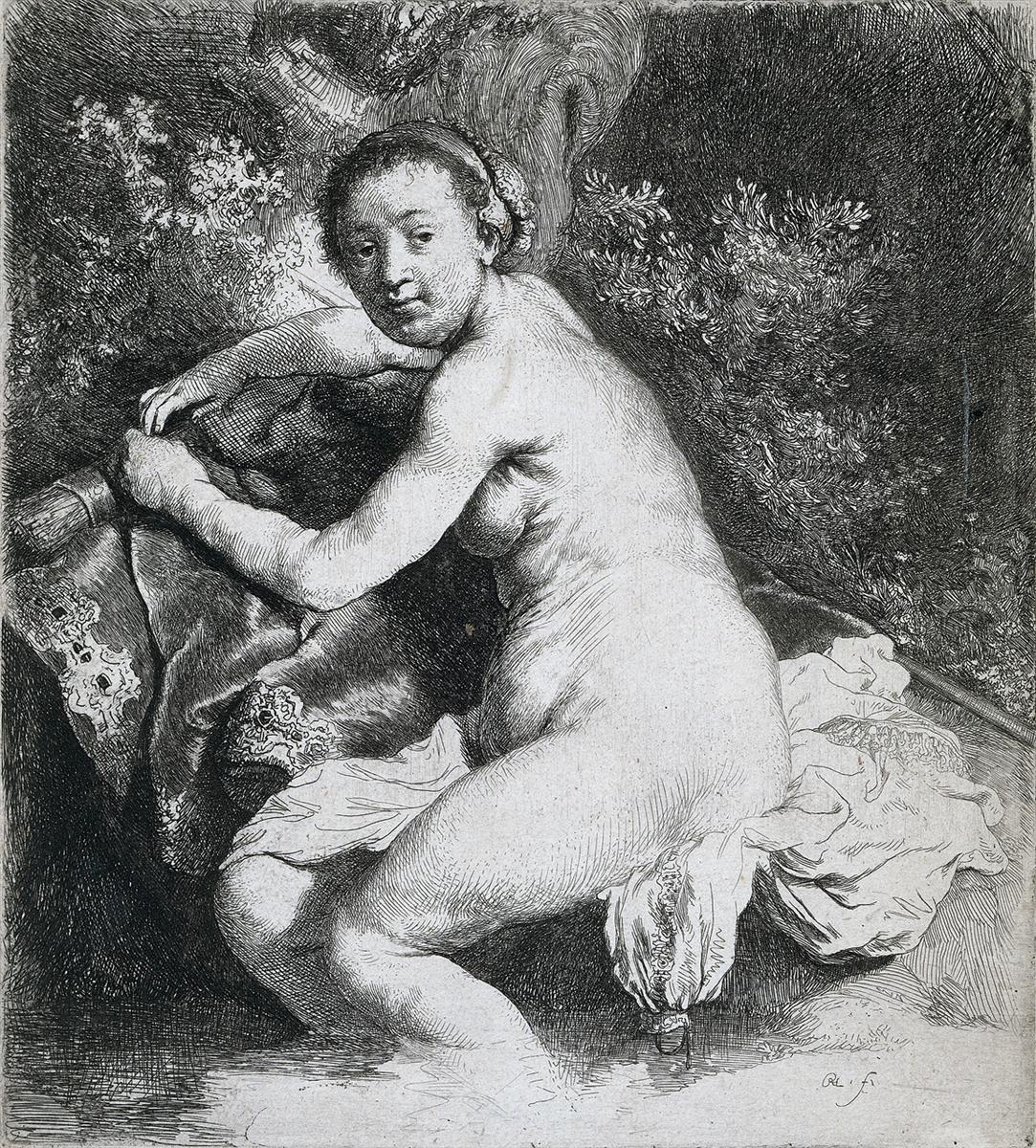
“Diana at the Bath” (1631) is one of Rembrandt’s most audacious early explorations of the classical nude in print. The Roman goddess of the hunt, usually armored with bow, quiver, and a retinue of nymphs, is here astonishingly human: a single figure in a private moment of bathing, twisting on a bank with wet feet touching a mirror-like pool. The subject belongs to antiquity, yet the treatment feels startlingly modern—unidealized flesh, a candid glance, and textures described with the nervous brilliance of a steel point biting into copper. In this etching Rembrandt shows how a mythic theme can be recast as a study of light, touch, and embodied presence.
Myth Reimagined as Intimacy
Diana (Artemis) is typically associated with chastity and distance. Artists before Rembrandt often kept that distance by idealizing her figure and staging her in a ceremonial crowd. Rembrandt inverts the convention. He draws the goddess alone and close to us, mid-turn, the torso spiraling as she looks over her shoulder toward an unseen disturbance. The result is not a tableau of divine aloofness but an intimate incident—perhaps the split second before Actaeon’s intrusion, perhaps simply the surprise of a rustling branch. The ambiguity is the point: myth becomes a vehicle for psychological immediacy.
The Turned Pose and the Language of the Body
The pose is a masterpiece of rotational anatomy. Diana’s pelvis faces forward, the ribcage pivots diagonally, and the head swivels back, creating a chain of counter-twists that animate the whole figure. The left arm braces on bundled fabric while the right leg tucks beneath, drawing the viewer’s eye along a curve from shoulder to knee and down to the toes skimming the water. This spiral is not decorative. It communicates alertness and self-possession, reminding us that the bathing goddess is also the vigilant huntress. Even at rest, the body is ready to move.
Flesh Without Idealization
Rembrandt’s candor about the body distinguishes the work from contemporary Italianate nudes. The skin is firm yet real, marked by faint dimples where muscle meets fat, by the soft fold at the waist as the torso twists, by the way the breast flattens under the pressure of the arm. Lines do not outline a marble statue; they caress living weight. This humane approach doesn’t diminish the goddess; it enlarges her. She is not an abstract emblem of chastity but a woman in a landscape, thinking and feeling, her sacredness grounded in the truth of her body.
Light, Shadow, and the Drama of Privacy
Chiaroscuro drives the drama. Rembrandt lays down dense cross-hatching in the foliage and drapery, reserving a luminous field for the figure. Light grazes her shoulder, flares across the back, and skips to the thigh, leaving the lower torso and the wedge under the right breast in half-shadow. This partial concealment intensifies the sense of privacy—portions of the body are offered to sight while others recede, as if the light itself respected modesty. The water at her feet is a small theater of reflection: a few horizontal strokes turn ink into shine and remind us that the scene is built from the simplest means.
The Studio of Textures
A central delight of the print is its encyclopedic play of textures. Look at the cushion and the rolled-up cloth beneath Diana’s left hand: quick, jagged strokes suggest nap and fringe; a few circular curls describe embroidery. The foliage becomes a mesh of broken lines, some etched deeply to bite black, others feathered to create a mist of leaves. The bark of the tree behind her is a vertical river of short slashes, contrasting with the smooth planes of skin. By orchestrating such differences Rembrandt turns material description into compositional energy.
The Gaze That Meets Ours
The goddess looks directly out with an expression that is neither coy nor accusatory. Her eyes are open and level; the mouth, unposed, rests between breath and word. Because the iris and pupil are defined with minute touches against lightly hatched eyelids, the stare feels alive. The effect is quietly revolutionary. Instead of being looked at as a passive spectacle, the goddess looks back, establishing reciprocity. The viewer is implicated in the scene’s interruption, yet invited, too, into its honest nearness.
Water, Cloth, and the Sign of Diana
Rembrandt drops the traditional crescent moon and quiver, yet he evokes Diana’s identity through subtler cues. The watery edge pooled around her feet and the thick, outdoor drapery identify a woodland bath rather than a domestic interior. The headband that restrains her hair and the practical, heavy cloths echo a hunter’s kit stripped for washing. These choices keep the narrative intact while allowing the emphasis to rest on the human encounter with light and touch.
Composition as a Field of Forces
The figure is set diagonally from lower right to upper left, countered by the slant of the tree and the dark wedge of foliage in the opposite corner. This creates a pinwheel of forces centered on the torso, so that the composition feels both grounded and in motion. The triangular blank of water at the bottom—a pale, quiet shape—acts as a breathing space where the eye can rest before traveling back up the arc of the shin and into the explosion of lines around the shoulder. The composition is not symmetrical, but it is exquisitely balanced.
Etching Technique and the Bite of the Line
“Diana at the Bath” showcases the bite of the needle at several registers. In the shadows Rembrandt piles cross-hatching until the copper holds dense reservoirs of ink; in the skin he uses long, gently curved strokes with ample gaps, letting paper supply the light between lines. There are also passages that feel almost drawn with a brush—the drapery’s broad shadows are formed by closely spaced, parallel strokes that soften into tone when printed. This sensitivity to how etched lines print as grays rather than black outlines is what gives the flesh its breath.
Plate Tone and the Atmosphere of Secrecy
Surviving impressions often carry a veil of plate tone—thin films of ink left on the surface to create atmosphere. In this subject the plate tone contributes a forest dusk: the sky darkens toward the corners, the foliage densifies, and the figure gleams as though the cloud had parted. Rembrandt’s printing decisions are therefore part of the art itself; the same plate can yield different moods. With Diana, he tended to preserve tone in the background and wipe the figure clean, sharpening the psychological contrast between the world’s thicket and the body’s clarity.
A Conversation with Earlier and Later Works
This etching belongs to a sequence in which Rembrandt tests the expressive potential of the nude. Earlier works often carry religious subjects; around 1631 he turns to classical themes that allow a freer, more secular intimacy. “Diana at the Bath” anticipates later paintings such as “Danaë” and, more poignantly, “Bathsheba,” where flesh is presented without varnish and the moral center is found in thought rather than pose. What begins here as a technical triumph in etching grows, over the next decades, into a philosophy of seeing the human body as a site of consciousness.
The Ethics of Realism
Rembrandt’s realism has an ethical dimension. By refusing to idealize, he grants dignity to what is actual. The softness of the abdomen, the compression of skin at the armpit, the slight irregularity of the shoulders—these are not flaws, but truths that make the figure persuasive. The humility of that truthfulness protects the scene from voyeurism. Instead of showcasing a perfect body for consumption, Rembrandt shows a person present to herself, caught for an instant between inwardness and alertness.
Diana and the Threshold of Narrative
The image hovers at the threshold of a story without crossing into illustration. We are neither told that Actaeon intrudes nor that a nymph will arrive with a towel; we perceive only the moment’s suspended potential. That openness invites contemplation. Viewers complete the narrative according to their own moral imagination: some will hear the first snap of a twig; others will sense a quiet recognition of being seen. The etching’s power lies precisely in this poised instability.
The Hand That Touches Cloth
A small but telling detail lies in the left hand gripping cloth. The fingers curl not elegantly but functionally, compressing fabric so that wrinkles radiate from the knuckles. Rembrandt often anchors psychological states in such tactile moments. The pressure of the hand signals the body’s weight and the mind’s readiness; it also gives us a place to empathize physically, as if we could feel the damp textile under our own palm.
The Landscape as Partner, Not Backdrop
The trees, shrubs, and bank are not merely scenery. Their textures echo the figure’s rhythms: the bushy bursts near the shoulder rhyme with curly hair, the long vertical of the trunk counters the diagonal of the spine, and the rippling grasses at the water’s edge pick up the undulations of skin. This environmental sympathy is a hallmark of Rembrandt’s prints. He lets landscape participate in the emotion of the scene, turning setting into a chorus rather than a stage set.
The Sensation of Breath
What makes the print feel alive is its modulation of density. Where the lines crowd, the image tightens; where they relax, the image breathes. The most open zones—the water and the sunlit planes of the torso—glow with untouched paper. This alternation creates the pulse of breath. You can sense it in the subtle rise and fall of the belly, in the catch of the shoulders as the head turns. The goddess is not frozen; she is living through a second that has not yet decided what will happen next.
Print Culture and Collecting
Etchings like “Diana at the Bath” circulated widely in Rembrandt’s lifetime, reaching collectors who prized both virtuoso draftsmanship and the intimacy of hand-inked impressions. The artist himself experimented with different states and wipings, treating the press as a laboratory. This work would have rewarded close, domestic viewing—held in the hand rather than hung on a wall—making the private subject matter especially resonant. The very scale of the sheet aligns with the modesty of the scene.
The Humanism of a Goddess
By bringing a goddess so near, Rembrandt aligns myth with humanism. Diana’s divinity is not denied; it is recalibrated. Her power is located not in supernatural iconography but in the integrity of her presence, the steadiness of her gaze, and the right of her body to exist without apology. In this sense the etching reads as a gentle argument for seeing the sacred in the ordinary particulars of human life.
Enduring Significance
For modern viewers, “Diana at the Bath” feels fresh because it refuses formula. It balances candor and tenderness, virtuosity and restraint, narrative implication and open-endedness. Above all, it demonstrates how etching can achieve effects often reserved for painting: the warmth of flesh, the glitter of water, the soft tyranny of shadow. Rembrandt takes a metal plate, a needle, acid, and ink, and conjures an encounter that still looks back at us nearly four centuries later.
