Image source: wikiart.org
Introduction
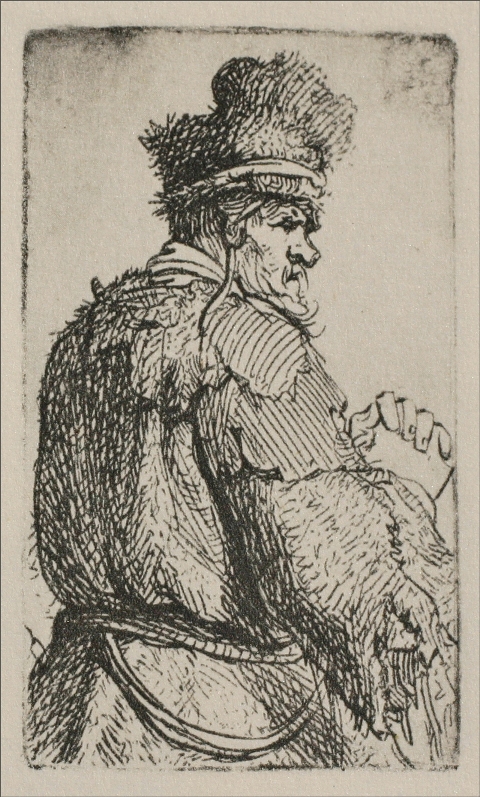
Rembrandt’s “An Old Man Seen from Behind” (1631) is a small etching with outsized presence. The figure fills the plate like a weathered cliff, his turned back and angled profile creating a paradoxical portrait: intimate yet withholding, descriptive yet elusive. In a period when artists typically staged faces to catch the eye, Rembrandt builds drama by denying us a full view. He composes character through contour, texture, and posture. The result is a study that feels both immediate—drawn from a living, breathing model—and archetypal, a meditation on age, experience, and the act of looking itself.
A Moment In Rembrandt’s Early Career
The date 1631 places the print at the threshold of Rembrandt’s move from Leiden to Amsterdam. He had already won attention for his psychological portraits and beggar studies, for his quicksilver handling of etching, and for a new kind of human closeness. This sheet belongs to that formative burst. It shares DNA with the artist’s early “tronies”—character heads not intended as named portraits—and with his sequences of old men wearing exotic caps, mantles, or furred garments. Rembrandt was refining how a single body could carry narrative weight without anecdote, and how etching could mimic the touch of a brush while retaining the incisive logic of line.
Composition That Commands A Small Page
The composition is built from two powerful diagonals. The back sweeps up from lower left to upper right, while the right arm curves diagonally down toward the lower edge, ending in a loosely clenched hand. This creates an open < shape that cups a wedge of blank paper around the head and hat. That reserved space is not empty; it is the figurative “air” that lets the form oxygenate. The old man’s profile peeks from the edge of the fur brim, a beaklike nose and pressed lips cutting into the void. By setting the figure off-center and cropping the left shoulder, Rembrandt suggests a body extending beyond the plate, as if we have intercepted him mid-turn.
The Expressive Logic Of Seeing From Behind
To show a person from behind is to stage a paradox. We are near, but not invited. The back can be a mask or a revelation. Rembrandt exploits that ambiguity. The heft of the mantle, the droop of the fur collar, the elastic curve of the hat’s nap tell us about age without the need for wrinkles. The posture intimates stubbornness or self-containment; the slight twist of the neck implies that something—perhaps a voice or a flash of movement—has caught his attention. Because the face is only half visible, we search other cues for psychology, and in so doing become more aware of the eloquence of shoulders, nape, and hands.
Etching As A Language Of Touch
The print displays Rembrandt’s early mastery of etched mark-making. Short, choppy strokes up the back and mantle suggest matted fur; longer, elastic hatchings around the sleeve create the sensation of woven cloth under light tension; the hat bristles with dry, upstanding burr-like marks that imitate a plush pile. The face, by contrast, is rendered with sparer, tighter lines, holding back detail so the profile reads as a sharp silhouette. The plate’s outer border shows a faint beveled tone that frames the figure like a vignette. Everything is calibrated to let the viewer feel the difference between wool, fur, skin, and air with the eyes.
Chiaroscuro Without Shadow Theatrics
Light here is not a beam but a persuasion. Rembrandt relies on density of line to carry shadow and on sparing reserves of paper to produce light. The upper right is comparatively open, letting the head breathe; the left back and lower coat thicken into a low, velvety dusk. Instead of spotlighting, the artist orchestrates a slow gradient that travels up the figure, creating volume without sacrificing the spontaneity of drawing. The technique suits the subject: an old man whose presence is sturdy rather than flashy, built from accumulated layers rather than a single gleam.
The Hat, Mantle, And The Fiction Of Costume
Rembrandt often dressed models in studio props that read as “Eastern” or timeworn—fur caps, embroidered cloaks, scalloped collars. These garments may not define a precise identity, but they create a timeless register in which physiognomy matters more than fashion. The hat here is magnificent in its modesty, slightly askew, its fur catching the light in little barbs of line. The mantle’s border, stitched with repeated marks, behaves like a frame-within-the-frame, curving around the shoulder to echo the plate’s top edge. Costume becomes an instrument for rhythm and contrast, a way to organize the field of hatches and to anchor the figure’s mass.
The Hand As Counterpoint
The hand on the right side may be the print’s quiet heart. Its knuckles are knotted, its grip neither tense nor slack, the thumb tucked under the fur edge. This small detail counters the dominant sweep of the back with a compact structure of planes. It is also a clue to temperament: a person who holds his wrap in wind or weather, who cinches what needs cinching, who manages the material world with practiced economy. Rembrandt frequently uses hands to reveal character; here he does so with a handful of strokes and superb restraint.
Profile, Character, And The Ethics Of Description
The face is given in profile, almost a cameo cut from a dark field. The nose projects decisively, the lips press forward, the eyebrow knits into the hat’s shadow. The profile is proud but not cruel, and because the eye is nearly lost in shade, we cannot over-interpret motive. This is descriptive ethics in practice: the artist provides enough information to kindle imagination, not enough to fix the sitter into caricature. The print refuses the easy story of “grizzled curmudgeon,” leaving us instead with the dignity of a person en route to or from some unrecorded task.
Spatial Economy And The Power Of The Margin
One of the joys of Rembrandt’s small prints is how he uses the plate margin as a compositional device. The figure’s back crowds the left border, creating pressure and a sense of immediacy. The hat almost grazes the top edge. The right margin, by contrast, is open, so that the turn of the head feels directed toward space rather than wall. This choreography of edges conjures a room or lane without drawing it. We understand environment by how the body behaves within the rectangle.
Kinship With The Old-Man Studies
Rembrandt produced numerous etched studies of aged heads and figures in these years—some frontally lit, others in deep shadow. Many share a fascination with texture and with the theatrical potential of simple props. “An Old Man Seen from Behind” is distinctive in its viewpoint, but kinship is evident in its moral tone: respect for age, curiosity about how time writes itself onto clothing and posture, and delight in the visual symphony of rough and smooth, thick and thin. It is less a portrait of one person than a portrait of the human condition as it appears in the late chapters of a life.
The Narrative You Bring To It
Because the print is narratively open, viewers inevitably supply stories. Is he pausing at a doorway, about to step into light? Is he listening to someone behind him? Is he simply adjusting his wrap on a cold morning? Rembrandt gives enough drama—the twist, the profile hook, the clutching hand—to start a plot, then steps aside. This strategy keeps the image fresh across centuries: each act of looking writes the next line.
The Drama Of Texture
If one had to summarize the sheet in a single word, it might be “texture.” The variety of fur marks alone—tufted, scumbled, serrated—feels like an inventory of possibilities. Yet the virtuosity never struts. Every passage serves form. The mantle’s shaggy fields swell where the shoulder pushes; the sleeve’s parallel hatchings curve around the arm’s cylinder; the hat’s nap rises along the rim, then quiets toward the crown. These rhythms lead the eye in loops and arcs, so that looking becomes almost tactile. You do not merely see the coat; you wear it in your attention.
Scale, Intimacy, And The Viewer’s Role
The print is small enough to be held in one hand. That scale asks for close attention, the kind given to a letter or a keepsake. You lean in; the figure, already near, becomes nearer still. Intimacy here is a function of size and craft, not sentimentality. Because of the viewpoint from behind, that nearness carries a hint of trespass—an ethical frisson that Rembrandt resolves by keeping the face shadowed, the gesture ordinary, the textures absorbing. The viewer’s curiosity is satisfied by form rather than by gossip.
A Lesson In Restraint For Draftsmen
Students of drawing can learn much from this etching. The lesson is not to pile detail onto the face but to let the back and clothing carry weight. The lesson is to exploit negative space—especially above the shoulder and behind the head—to set off dense hatching. The lesson is to vary line direction to model volume, to let contours breathe, and to stop when the image begins to speak. Rembrandt’s economy is active, not austere: he uses just enough means to make the maximum sensation.
Reception And The Print As Portable Thought
Prints like this circulated widely, cherished by collectors for their intimacy and by artists for their instruction. They are portable thoughts—capsules of observation and invention. “An Old Man Seen from Behind” would have fit comfortably in albums devoted to character studies, serving equal parts as conversation piece and studio reference. The sheet’s survival across centuries testifies to the enduring appetite for images that feel both candid and considered.
Why It Matters Now
In a world saturated with faces, a portrait that withholds the face feels startlingly modern. Contemporary photographers often exploit the back-view to suggest anonymity, privacy, or protest; Rembrandt reached similar psychological terrain with copper, acid, and ink. The print reminds us that identity is a choreography of many parts—the way a body turns, the way fabric sits on bone, the way a hand steadies its own weight. It honors the dignity of people not by magnifying their features but by attending to how they inhabit space.
Conclusion
“An Old Man Seen from Behind” distills Rembrandt’s early genius into a few square inches: fearless observation, tenderness toward ordinary humanity, an orchestral command of line, and a dramatist’s instinct for staging. By shifting the portrait’s center from face to back, he asks us to read character through posture and texture, to feel age in the grain of cloth and the curve of a shoulder. The print is humble in scale and generous in meaning—a brief, unforgettable encounter that deepens with every return.
