Image source: wikiart.org
Introduction
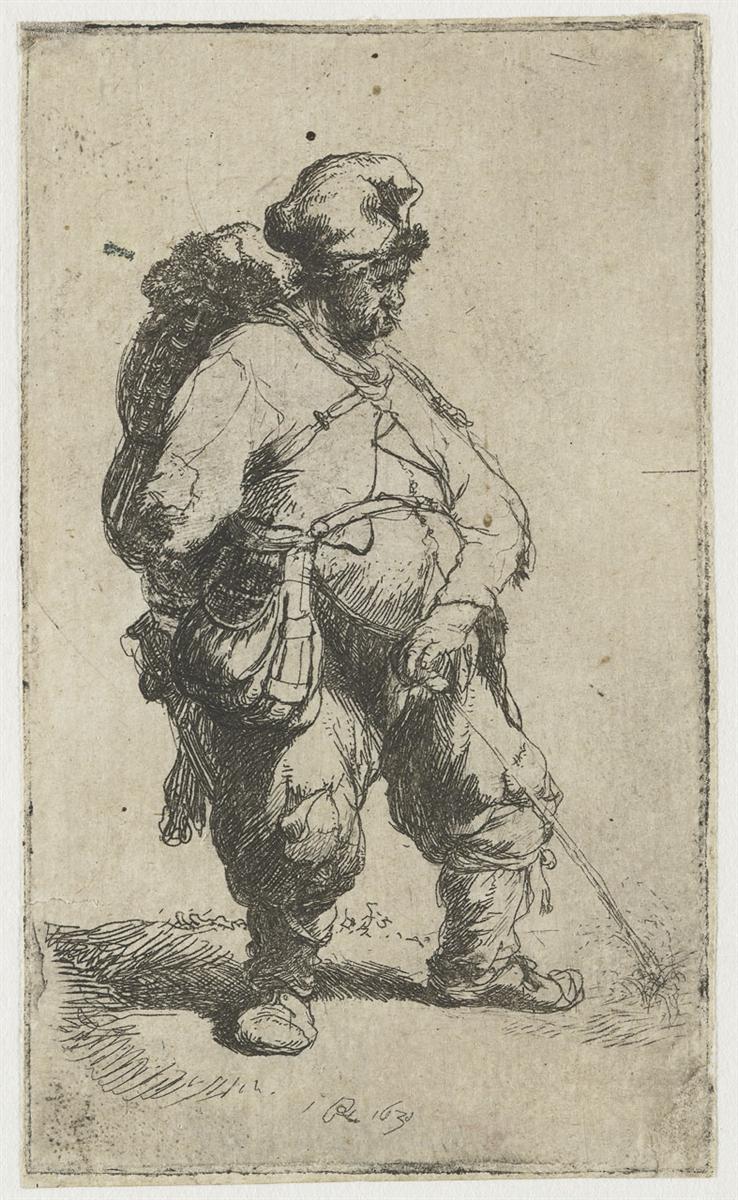
Rembrandt’s “A Man Making Water” of 1631 is at once disarming and profound. The small etching shows a lone figure, hat pulled low, body bundled in heavy garments, pausing at the roadside to urinate. The artist chooses neither a heroic theme nor a polished pose, but an ordinary, private act treated with the same attention he devoted to prophets and scholars. The image is not a prank; it is a statement about seeing the whole of human life. With a few inches of copper and a disciplined needle, Rembrandt turns a fleeting moment into a study of weight, balance, texture, and dignity. In doing so he reveals why his prints remain among the most searching records of the seventeenth century.
Subject, Title, And The Everyday Turned Monumental
The title uses a period euphemism—“making water”—which signals the artist’s intent to show, not to shock. Dutch art of the early seventeenth century had already embraced lowly subject matter in peasant scenes and tavern pictures, yet this print is more concentrated than those bustling panels. Here there is no crowd, no narrative pretext, only a single figure observed mid-action. Rembrandt isolates the gesture so the body’s mechanics can be studied: the forward lean, the slight bend in the knee, the supporting thrust of the planted foot, and the downturned head that implies privacy even in open air. The man is not caricatured; his features are occluded by hat and beard, protecting his personhood and focusing attention on posture rather than identity. In this restraint lies the work’s dignity.
Composition That Builds From Weight And Balance
The composition is a narrow vertical, ideal for the columnar mass of a bundled traveler. Rembrandt stacks forms like a sculptor: cap as rounded crown, shoulders bulging under fabric, belly pushing outward, and stout legs planted apart. The man occupies the left two-thirds of the plate, leaving a pocket of empty ground at lower right where the stream meets the soil. That small wedge of space completes the narrative while creating a diagonal that stabilizes the figure’s squat triangle. The etched boundary of the ground plane anchors the feet and prevents the man from floating in an undefined field. Everything in the print insists on physical truth—the pull of gravity, the press of clothing, the shift of balance as the body accommodates a simple need.
Line As Builder Of Cloth, Beard, And Body
Rembrandt’s line does not merely describe; it builds. Short, angled hatchings knit the folds of the cloak; longer, parallel strokes stretch across trousers to suggest coarse, worn fabric; ragged, scribbled touches conjure the frizz of a beard and the matted wool of the bundle swinging from the shoulder. He avoids fussy cross-hatching in large areas, preferring an economy that lets the white of the paper participate as light. Around the left hip—where cloak, belt, and pouch converge—the marks thicken into a knot of tone that reads as weight, the carriage of tools or provisions pressing against the body. The small bag at his waist and the heavy roll on his back are rendered with crisp edges and denser shadows, visual cues that these objects are hard and full compared to the softer folds of his clothing.
The Gesture And Its Time Signature
This is a picture of time measured in seconds. The man is caught not at the start or end of his act but in its unremarkable middle. Rembrandt suggests this tempo through the continuity of the line that marks the stream, a thin, slightly wavering stroke that meets the ground at a bright nick of untouched paper. The rest of the figure is equally present-tense: the forward foot braces, the rear heel lifts a hair’s breadth, the hand tugs at fabric to clear a path. That precision of timing is part of the print’s poetry. It reminds the viewer that drawing can operate like a shutter, fixing an instant without turning it into a spectacle.
The Ethics Of Looking
Showing a man urinating risks humiliation, yet nothing in Rembrandt’s treatment is cruel. The angle, slightly above and to the side, respects the sitter’s privacy. The face hides in shadow beneath the hat’s brim; no grin or leer intrudes; the countryside is indicated only by a scuffed patch of ground. This discretion transforms the act from vulgarity into anthropology: a record of how a body stands, how clothes hang, how a traveler behaves when alone. The print proposes that even the least elevated moment in a life can bear the weight of close observation.
Clothing And Social Status Encoded In Texture
The man’s attire speaks. The cap is floppy and practical; the cloak and trousers are patched and heavy; the shoes are sturdy and collapsed at the toes. This is not a gentleman on a promenade but a worker or wayfarer traveling with his kit. Rembrandt uses texture to differentiate materials and to point toward class without moral judgment. The cloak receives loose, repetitive strokes that imply thick, weatherproof cloth; the pouch on his belt is hatched more tightly and glints with a faint highlight, suggesting oiled leather; the roll at his back is a nest of wiry marks that read as brush or bedding. These descriptions are never pedantic, yet they let the viewer imagine the rustle and weight of the outfit.
Humor Without Mockery
There is humor in the very choice of subject, though it is a softened, humane humor. Rembrandt trusted that his audience could recognize themselves in the body’s necessities. The joke, if there is one, is not at the man’s expense; it is a wink at the universality of the moment. That generosity keeps the print from sliding into the bawdy satire common to some peasant pictures of the era. Even the small flourish of the stream is politely understated. Rembrandt’s light touch allows the image to function simultaneously as genre scene, figure study, and sympathetic record.
The Market For Prints And The Artist’s Experiments
By 1631 Rembrandt was increasingly invested in printmaking as both art and livelihood. Small etchings like this circulated widely, were priced within reach of merchants and artisans, and could be reprinted as demand required. The format offered the young master a laboratory for testing subjects unsuitable for formal commissions. In copper he could try radical crops, unidealized bodies, and earthy episodes that would have looked out of place on a patrician panel. “A Man Making Water” fits that experimental portfolio. Its success would have encouraged Rembrandt to push further into the world of beggars, mendicants, and wayfarers, treating them with the same seriousness he brought to prophets and princes.
Chiaroscuro And The Modesty Of Light
The light in the print is modest and diffuse, more like daylight than stage illumination. Shadows gather in the hollows of the clothing, under the belly, and behind the man’s right leg, but no sharp spotlight carves the form. This choice reinforces the scene’s everyday character. A harsh chiaroscuro would have theatricalized the body and invited melodrama; Rembrandt opts for a daylight that lets the eye wander without pressure. The brightness of the ground at lower right doubles as a compositional accent, a white triangle that balances the denser blacks of the man’s garments.
The Ground Line, Shadow, And Sense Of Place
A single scratched ground line and a patch of sideways hatchings establish the earth. From this minimal notation the viewer infers a roadside or field edge. The cast shadow to the left of the forward foot pins the figure to the ground and creates a foothold for the composition. Even in a subject so unpretentious, Rembrandt’s spatial sense is acute. The man’s mass, the arc of the stream, and the triangle of the ground form a convincing shallow stage that needs no further scenery.
Kinship With The Beggar Etchings
The print belongs with the run of beggar subjects Rembrandt produced around 1630–1631. Those plates—men with crutches, figures warming hands over a brazier, couples conversing behind a bank—are united by an ethic of attention. In each, the artist studies the ways poverty and labor wear on posture and attire, granting individuality to people rarely granted it in high art. “A Man Making Water” strengthens that corpus by admitting an even more intimate activity into the record. It also demonstrates Rembrandt’s commitment to describe without condescension, one hallmark of his art that later painters and photographers would emulate.
Anatomy Without Heroics
Though heavily clothed, the figure reveals a great deal about Rembrandt’s understanding of the body. The splay of the feet, the twist in the hips, the droop of the shoulder under the backpack, and the torque through the belly are accurately observed. Nothing is idealized; the midsection is ample, the stance ungainly. Yet the drawing treats this anatomy as worthy of the same rigor applied to saints or soldiers. The ordinary person carries architecture within, and the print makes that architecture seen.
The Plate’s Surface As Atmosphere
Subtle speckles and smudges in the background likely arise from plate tone and the wear of printing. Rather than scrubbing the copper to a sterile blankness, Rembrandt allows this lived surface to remain. The result is an atmosphere that feels outdoor and unstudio-like, a faint weather of ink that belongs with a dusty roadside. That tolerance for the plate’s materiality becomes one of the signatures of his printmaking, lending warmth and hand-made presence even to the most economical designs.
Decorum, Censorship, And The Dutch Viewer
That such a subject could be marketed at all says much about Dutch openness to everyday themes and printed wit. The Republic’s picture market was broad and not controlled by a single court or church patron. Viewers understood the difference between derision and description, between the bawdy and the humane. Rembrandt’s print sits on the gentler side of that spectrum. Its decorum comes from everything it refuses to do: it names no identity, it avoids explicit anatomy, and it keeps the act within the circle of necessity rather than entertainment. The work’s reception would have depended on a viewer willing to see through the momentary to the universal.
Comparisons To Painted Genre Scenes
Where tavern pictures often crowd the canvas with noise, this print swaps noise for attention. The solitary figure invites a slower look than a painted brawl or dance. Because the image is small, the audience must come close; because the act is private, the viewer must look with tact. That demand on the viewer—to meet the subject with the same care the artist did—turns a genre scene into a moral exercise. You do not gape; you observe.
The Image’s Contemporary Resonance
Centuries later, the print feels surprisingly modern. Street photography has taught us to value the unposed moment; documentary ethics have taught us to see dignity in ordinary lives. Rembrandt anticipates both. He does so not by chasing novelty but by applying classical discipline—clear design, truthful anatomy, controlled light—to a humble theme. The image’s staying power lies in that marriage of craft and candor.
Printing Variations And The Life Of Impressions
As with many of Rembrandt’s plates, impressions of this print likely vary in mood depending on inking and wiping. A heavier plate tone will make the scene duskier, the figure more enveloped; a cleaner wipe will render the lines wirier and the daylight crisper. This variability is not a defect but a feature of the medium and a reason collectors prize these prints. Each pull becomes an interpretation within the composer’s score.
Conclusion
“A Man Making Water” is a quiet declaration that nothing human is beneath art. Rembrandt turns a roadside pause into a meditation on weight, balance, clothing, and time. He honors a working man’s privacy while documenting his presence with lines that know when to whisper and when to press. Texture differentiates coarse cloth from leather, beard from backpack; light settles across the figure without theatrics; the ground and stream complete the scene with a few exact strokes. The print belongs to a constellation of works in which Rembrandt insisted that attention itself is a form of respect. In this small, unpretentious sheet, the artist’s gaze is steady and humane, and the result is an image that brings the viewer closer to the world as it is—ordinary, necessary, and worthy of being seen.
