Image source: wikiart.org
Introduction
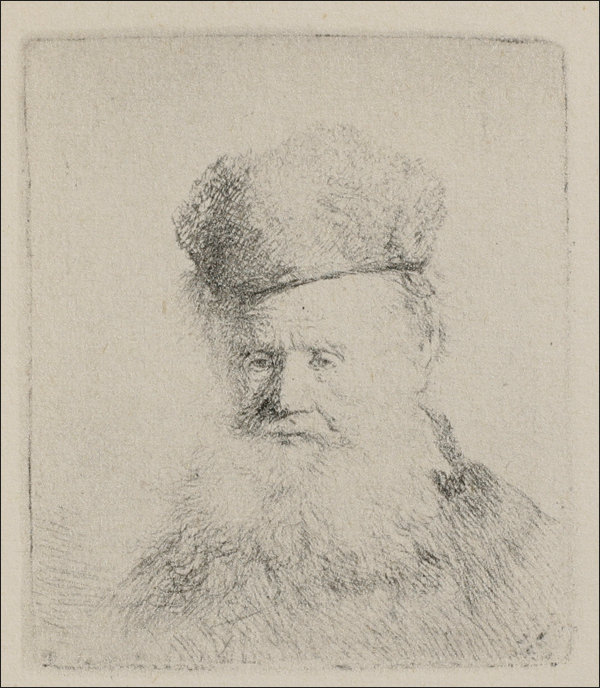
Rembrandt’s “A Man with a Large Beard and a Low Fur Cap” (1631) is a small print with an outsized presence. At first glance it looks modest—thinly worked, nearly monochrome, barely more than a handful of strokes. Yet the image gathers power the longer you look. A soft halo of tone coalesces into the shape of a hat, a whisper of lines becomes a weathered face, and the generous beard settles like winter fog across the sitter’s chest. Rembrandt builds all of this with an extreme economy of means, letting the plate’s surface do as much psychological work as his needle. The result is a portrait that feels both immediate and meditative, an encounter with an individual who has stepped out of the seventeenth century and into your personal space.
Historical Moment And Artistic Priorities
The year 1631 sits at the hinge between Rembrandt’s Leiden years and his move to Amsterdam. He had already become a sensation for small narrative panels and a growing corpus of etchings that treated beggars, scholars, saints, and self-portraits with unprecedented sympathy. In this print he distills those interests into a single head. The image looks nothing like a courtly commission; it belongs to the tradition of the tronie, a character study that explores expression, costume, and physiognomy without claiming to be a formal likeness. That tradition suited Rembrandt’s curiosity about faces and gave him permission to search for humanity where other artists sought flattery.
The Subject And The Choice Of Costume
The old man’s low fur cap, tugged down toward the brow, compresses the silhouette and emphasizes the breadth of the head. The cap is not ostentatious; it is functional, a winter hat for a practical life. Its soft mass provides a dark canopy over the brighter planes of the forehead and nose. Paired with the extravagant beard, it creates a vertical rhythm—cap, face, beard—that Rembrandt exploits to organize the composition. The costume is deliberately unremarkable in detail, which keeps attention on the structures of light and the temperament of the sitter rather than on decorative trivia.
Composition That Prefers Presence Over Gesture
Rembrandt uses a simple bust-length crop and a frontal orientation that meets the viewer head-on. The shoulders dissolve into a mist of strokes and plate tone, and the background remains a quiet field that barely declares itself. Such restraint is strategic. It removes narrative scaffolding and asks the viewer to concentrate on the silent communication of the head. The face is slightly tilted, the eyes peer from beneath the brim with calm alertness, and the mouth rests between resignation and thought. The entire composition is an exercise in the power of stillness.
The Medium Speaking In Its Own Voice
Although the image is commonly described as an etching, its softness suggests that Rembrandt likely leaned on drypoint in addition to the etched line. Drypoint involves drawing directly into the copper with a sharp needle, raising a burr along the line that holds ink and prints as a velvety blur. That burr, fragile but luscious, is ideal for fur, hair, and quiet shadow. In this sheet the cap and beard read like passages where the burr carried much of the tonal load, while the firmer, cleaner marks in the features feel etched. The combination allows Rembrandt to toggle between clarity and atmosphere with elegant control.
The Beard As A Landscape Of Markmaking
The title calls attention to the beard, and Rembrandt responds by making it the most complex terrain in the print. He refuses to draw every hair; instead he lays down clusters of soft, feathery marks that pile up into convincing volume. The edges break irregularly, as real hair does, and scattered, stray strokes suggest flyaway wisps around the perimeter. Where the beard turns under the chin, the hatching tightens and darkens, creating a shallow grotto of tone that supports the head and pushes the face forward into light. The beard is not merely accessory; it is the stage on which the drama of the eyes plays.
Light And The Psychology Of Half-Tone
The light in this print behaves like a slow dawn. It does not crash across the face in theatrical beams; it seeps. The forehead receives a modest glow, the bridge of the nose catches a narrow highlight, and the cheeks sink into breathable half-tone. Rembrandt is particularly sensitive to the way light thins at the edges of a form. He leaves paper showing through just enough at the temples and beard to suggest air between us and the sitter. This diffusion turns the portrait contemplative. The face seems not posed under studio illumination but discovered in lived space.
Plate Tone And The Atmosphere Of Silence
Rembrandt often manipulated plate tone—the film of ink left on the plate during wiping—to build atmosphere. In this impression the background appears muffled and slightly granular, as though a faint cloud were left intentionally across the copper. That decision turns the blank paper into air and grants the head a gentle aura that keeps it from reading like a cutout. Around the eyes and along the upper bridge of the nose the wipe is cleaner, sharpening the gaze without hardening the expression. The alternation between soft tone and crisp wipe acts like dynamics in music, giving the small print a range of volume.
The Eyes And The Ethics Of Looking
Few artists could do as much with as little line around the eyes as Rembrandt. Here the sockets are shadowed by compact cross-hatching; the lids are suggested with barely a pair of strokes; and each iris receives a tiny, dark nick to register the pupil. The eyes look not at us so much as through us—calm, appraising, without defensiveness. This refusal to theatricalize the gaze is an ethical statement as much as a stylistic one. Rembrandt’s art insists that dignity resides in observation, not in spectacle. The old man seems to have been allowed to be exactly himself for the time it took to draw him.
The Hat As Structural Counterweight
The low fur cap does important compositional work. Its dark, suede-like tone compresses the top of the sheet, counterbalancing the expanding beard below. The cap’s lower edge nearly aligns with the eyebrows, tightening the band of shadow that supports the eyes. The sloped crown lifts slightly to the left, introducing a subtle diagonal that keeps the otherwise symmetrical bust from becoming static. Texture in the cap is achieved not by drawing fur but by stippled burr and lightly scumbled strokes, a textural echo of the beard that binds the image together.
Minimalism That Refuses Emptiness
So much of the sheet is barely marked that one might expect it to feel empty. It never does. Rembrandt’s sparse notation is not neglect; it is concentration. Every mark carries narrative weight. The faint outline of the cheekbone is enough to sketch a life lived outdoors; the softened corner of the mouth implies a temperament practiced at patience; the scattered, almost absent shoulder suggests a body more shadow than muscle, a man whose authority is wisdom rather than force. The portrait achieves an almost Japanese elegance, where restraint becomes eloquence.
Kinship With Contemporary Heads And Tronies
Around 1630–1631 Rembrandt produced a constellation of etched heads: old men with heavy beards, scholars in soft caps, figures wrapped in fur-lined cloaks. These sheets do not aim for individual biography as much as for types—age, pensiveness, knowledge, humility. “A Man with a Large Beard and a Low Fur Cap” belongs to this family but stands out for the quiet of its surface. Other plates from the period indulge in richer cross-hatching and stronger contrasts; this one breathes. It anticipates the later Rembrandt who will dare to leave large fields of paper or canvas barely touched and trust the viewer to meet him halfway.
Scale, Intimacy, And The Viewer’s Experience
This is a print designed to be held, not stared at from across a gallery. The small scale cultivates intimacy. You lean in, your breath slows, the world outside the sheet falls away. In that proximity, the old man’s face ceases to be historical and becomes companionable. The image asks not for a quick read but for fellowship. That kind of viewing time transforms the print into a devotional object—not in the sense of religious doctrine but in the sense of a sustained attention that honors another human being.
Printing Variations And The Life Of The Plate
Rembrandt often reprinted popular plates many times, and the fragile drypoint burr could soften quickly under the press. Early impressions would show luxuriant velvet in the beard and cap; later pulls might lose some of that richness and rely more on etched line and plate tone for depth. Rather than fearing this change, Rembrandt sometimes embraced it, adjusting wiping to compensate and letting the image evolve. The print therefore exists not as a single “ideal” state but as a range of moods, all anchored by the same drawing.
The Old Man As Image Of Wisdom
The sitter’s age is not incidental; it is the portrait’s subject. Rembrandt treats age not as decline but as a distinct kind of beauty. The slightly sunken cheeks, the furrowed brow, the teeming beard—these are not defects to be corrected but signatures to be honored. The low fur cap serves almost as a crown of experience. In a culture that prized youthful elegance, Rembrandt’s insistence on the loveliness of age was radical and would become one of the defining ethics of his art.
Echoes In The Painted Oeuvre
Resonances with Rembrandt’s paintings from the same period are easy to trace. The preference for soft light, the fascination with fur-lined garments, and the engagement with elderly sitters appear in his oils on panel as well. Yet the print clarifies something the paintings sometimes hide: how much Rembrandt can accomplish with line alone. In this reduction to essentials, you can watch him think. The etched and drypoint marks are sentences in a language of looking, and the print is a short poem that says exactly enough.
Why The Image Feels Contemporary
Despite its seventeenth-century costume, the portrait reads with a modern frankness. The close crop, the quiet background, the unvarnished physiognomy, and the acceptance of incomplete description all anticipate later traditions from modern drawing to candid photography. The print refuses the rhetoric of grandeur and instead cultivates trust. It looks at a person the way a friend might—without drama, without judgment, in good light.
Legacy And Continuing Appeal
Collectors of Rembrandt’s prints have always cherished the intimate heads for their combination of technical subtlety and human warmth. “A Man with a Large Beard and a Low Fur Cap” explains why. It is a work you can return to indefinitely, finding new softness in the cap’s edge, new order in the beard’s apparent chaos, new patience in the sitter’s eyes. The plate turns a moment of quiet scrutiny in 1631 into an evergreen exchange across time, a small miracle of copper, ink, and attention.
Conclusion
Rembrandt’s “A Man with a Large Beard and a Low Fur Cap” is a lesson in how little a great artist needs to say everything. With a lightly etched framework, passages of velvety drypoint, and plate tone handled like breath, he draws a head that seems to think while you look. The hat anchors the composition, the beard becomes a landscape, the eyes maintain an honest and unflinching calm. In the process, Rembrandt demonstrates that truth in portraiture lies not in display but in presence. This small print is a quiet triumph—an image that repays closeness with closeness, inviting the viewer into a fellowship of seeing that feels as necessary now as it did in 1631.
