Image source: wikiart.org
Introduction
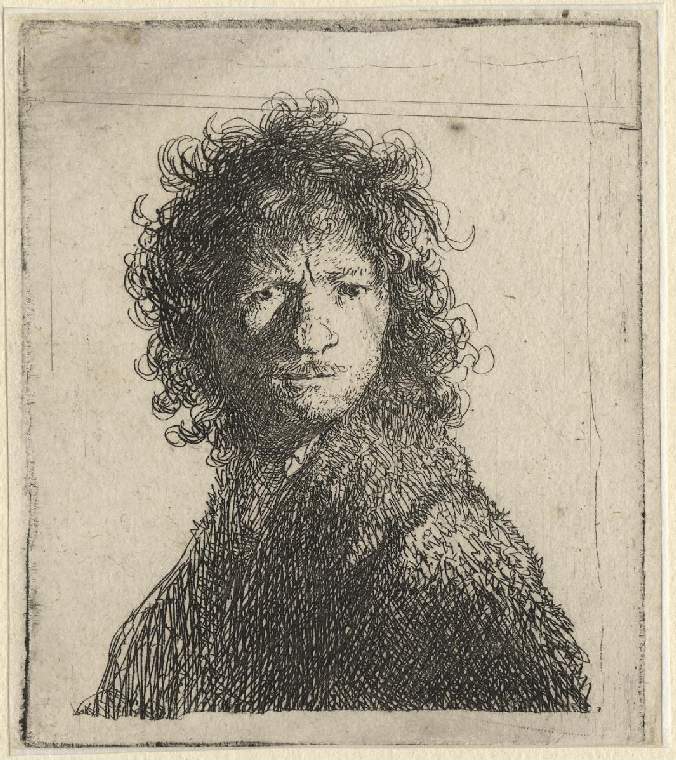
Rembrandt’s “Self-portrait frowning, Bust” (1630) captures a young artist testing the expressive limits of his face and the technical possibilities of the copper plate. The head is turned sharply over the shoulder, hair a tangle of curls, eyes narrowed beneath a knitted brow. The mouth is set in a tense line that sits halfway between challenge and concentration. Composed in the intimate scale of an etching, the image still feels startlingly immediate—like a thought that has not yet decided whether to speak. In this print Rembrandt explores how line alone can construct light, volume, psychology, and presence.
The Leiden Laboratory And The Self As Model
In 1630 Rembrandt was still in Leiden, building a reputation through small panels and brilliant prints. Lacking the budgets and obligations of large commissions, he turned repeatedly to the most available sitter: himself. These early self-portraits are not vanity projects; they are exercises in anatomy, emotion, and light. The face is a field of experiment, and each state on the plate lets him adjust a frown, deepen a shadow, or refine a highlight. “Self-portrait frowning, Bust” sits among a cluster of 1630 studies in which he tests surprise, laughter, suspicion, and thought. Here the chosen emotion is focused intensity, and the method is pure etching—needle-drawn lines bitten into copper to deliver a dense, shimmering fabric of tone.
Composition That Turns A Study Into A Drama
The composition is brutally efficient. The bust cuts off just below the shoulder; the head twists in a three-quarter turn; the background remains largely unworked, so the figure rises out of an abstract field. This starkness is the secret to the print’s drama. The unmodulated paper behaves like a hard light source surrounding the head, while the dense hatchings at the chest and hair supply the counterweight of shadow. A triangular rhythm emerges from the shoulder up to the brow and back down through the cloak, producing momentum without movement. The strong contour of the jaw and the blunt line of the nose become directional arrows that lead the eye to the furrowed brow.
Line As Light: The Architecture Of Hatching
Because there is no paint to smear or glaze, all light in the etching is built from line—the thickness, spacing, and direction of strokes. Rembrandt organizes his hatchings like a topographical map. Short, clustered strokes around the eye sockets sink the gaze into shadow; more open, parallel lines on the forehead permit thin light to pass; cross-hatching at the cheek stacks tone until a roundness emerges. The coat is a dense thicket of strokes laid at slight angles to one another, a knitted texture that anchors the composition and prevents the head from floating. In the hair he loosens the line, allowing forceful curls to erupt in whorls and hooks. The result is a hierarchy of mark-making in which each region of the print receives a distinct handwriting suited to its material.
The Frown And The Invention Of Expression
The title emphasizes the frown, but what makes it compelling is that it is not an isolated gesture. The brows pinch, yes, but so do the lids; the nose seems to tense along the bridge; the lips pull into a minute torque that skews the mouth off-center. Taken together, these micro-adjustments animate the whole skull. Rembrandt is studying cause and effect: what happens to the volume and light of a face when muscles contract? The answer, recorded in lines that deepen and splay as they approach the furrow, is that expression is sculptural. The frown throws ridges into relief and drives other planes back, and the artist lets his lines honor that mechanics rather than flattening it into a cartoon.
The Turned Head And The Energy Of Attention
The head is not merely turned; it is turned in response to something. That implied stimulus—the unseen presence beyond the frame—charges the print with narrative energy. The shoulders continue in one direction while the eyes cut back, and the tension between those vectors translates as alertness. This is not vanity mirrored in a studio; it is an actor’s rehearsal of an instant of attention. The viewer completes the script by standing where the etcher’s gaze lands. We feel looked at, and our looking becomes part of the composition.
Copper, Acid, And The Performance Of The Hand
Etching has a peculiar advantage for a young artist: it records the hand’s speed as well as its direction. The quick, scratchy strokes in the hair read like audible decisions—fast, improvisational, nervy—while the more deliberate hatchings in the face slow down to a measured tempo. The plate preserves that rhythm through the bite of acid, and the press transfers it to paper with microscopic fidelity. The energy of Rembrandt’s drawing becomes the energy of the print. That is why the portrait feels alive even though it is built from fixed lines: the velocity is baked into the marks.
Plate Tone, Wipe, And The Aura Around The Head
Although the background looks blank at first glance, traces of plate tone—the thin film of ink left intentionally on the plate during wiping—halo the head and provide an atmospheric half-tone. Rembrandt exploits this residue to soften the transition between the figure and the paper. Around the top of the curls he leaves just enough tone to make the hair’s outer edge glow, like backlight on a stage. Along the shoulder he wipes more cleanly so the edge bites against the white. These subtle variations, controlled by cloth and hand at the printing stage, give the print spatial breath without a single extra line.
Youth, Ego, And The Ethics Of Looking At Oneself
A self-portrait risks narcissism, but Rembrandt’s early prints steer another course. He uses his own face as a laboratory specimen, not as an advertisement. The frown is not heroic; it is analytical. There is even a humility in the way he allows the imperfect planes of his nose and the asymmetry of his mouth to stand without correction. By refusing to beautify himself, he legitimizes the observational rigor that will later dignify beggars, scholars, and old men with equal seriousness. The ethics of this approach matter for the history of portraiture: character beats glamour; truth beats polish.
Relationship To The Painted Self-Portraits Of 1629–1631
Placed beside Rembrandt’s painted self-portraits from the same years, the etching clarifies his program. In oil he experiments with warm, internal light and the tactile possibilities of impasto; in copper he experiments with how pure line can do the same work. The knitted brow appears across media, as if he were testing the portability of an expression. Where the paintings luxuriate in the glow of flesh and the glitter of costume, the print strips the situation to a face, a coat, and the white of paper. The two forms of study inform each other: the painterly sense of volume feeds the etched hatching, and the graphic economy sharpens the painter’s decisions.
The Cloak As Counterweight And Frame
The heavy, fur-like cloak is more than period dressing. Graphically it is the dark counterweight that lets the face occupy a basin of light. The cloak is drawn with close-set, downward strokes that become denser as they descend, effectively nailing the bust to the lower edge of the sheet. Its top line slopes upward toward the head, forming a ramp that ushers the eye back to the expression. Without this engineered mass, the youth’s wild curls might lift the head off the page; with it, the composition feels grounded and architectural.
Micro-Anatomy Of The Eyes
The eyes, though small, carry disproportionate weight. Rembrandt surrounds them with a compact network of short, slanted lines that simultaneously model the lids and darken the sockets. Each iris is a tiny oval cut with a single darker nick to suggest pupil and glint. Importantly, the whites are not white; they are lined so that they recede into shadow, preserving the believability of the lighting scheme. That refusal to use the paper’s whiteness for the eye whites—tempting in etching—keeps the gaze from popping artificially and maintains the realism of the frown’s deep-set effect.
Hair As Gesture
The hair in this print amounts to a storm system. Curls fly out in individual gestures—hooks, loops, commas—drawn with a freer wrist than the measured work in the face. The hair’s disorder amplifies the psychology: thought is active, attention is seized, and the body records that seizing. Yet the chaos is managed; the outer silhouette of the hair describes a swelling mass that echoes the curve of the shoulder, welding the composition into a single, rounded entity. Even wildness has architecture when the draughtsman is this shrewd.
The Paper Window And The Edge Of The Plate
Rembrandt leaves faint guide lines and plate edges visible near the top. Instead of hiding the mechanics, he lets them live on the sheet as a reminder that this image has a body. Those vestiges read like studio notes and reframe the self-portrait as process: an artist caught in the act of making, not posing. For modern viewers, those edges humanize the print and underscore its handmade origin.
Printing, States, And The Life Of An Image
Etchings exist not as a single object but as a population of impressions. Each pull can vary in the amount of plate tone left, the pressure of the press, and the wear on the copper’s lines. That variability turns the print into a living medium. Early impressions may show the richest blacks; later ones display softer, velvety tones as the burr and minute irregularities wear. The image can thus age, which suits a self-portrait by an artist who will return to his face over decades, watching it shift with light and time.
Why The Image Still Feels Contemporary
Despite its seventeenth-century costume, the print speaks with a blunt modernity. The close crop, the raw expression, the unresolved background, and the trust in the mark’s energy anticipate later traditions from Goya to modernist drawing and even street photography. The frown reads not as a codified emotion but as a private thought caught unguarded. It is this refusal to prettify emotion that keeps the picture alive for viewers accustomed to candid imagery.
The Lesson Of The Print: Attention Is Action
What, ultimately, is the frown doing? It concentrates sight. The eyebrows compress to narrow the field; the eyes fix; the head turns. The portrait is an anatomy of attention—attention as an action that reorganizes the face. For a young artist, that is a credo: to look hard enough that your body records the looking. The etched lines are the fossil of that action, a permanent record of the moment when concentration became form.
Conclusion
“Self-portrait frowning, Bust” distills Rembrandt’s early ambition into a handful of lines that carry disproportionate power. The composition is tight and active; the hatching reads as light and volume; the expression feels studied yet spontaneous; the technical means are exposed rather than disguised. Etching here is not a secondary craft but a primary language. With copper, acid, and ink, the twenty-something artist proves that character can be built from nothing but decisions of the hand. The result is a print that still startles: a young face turned abruptly toward us, not to show itself, but to show what looking can do.
