Image source: wikiart.org
Introduction
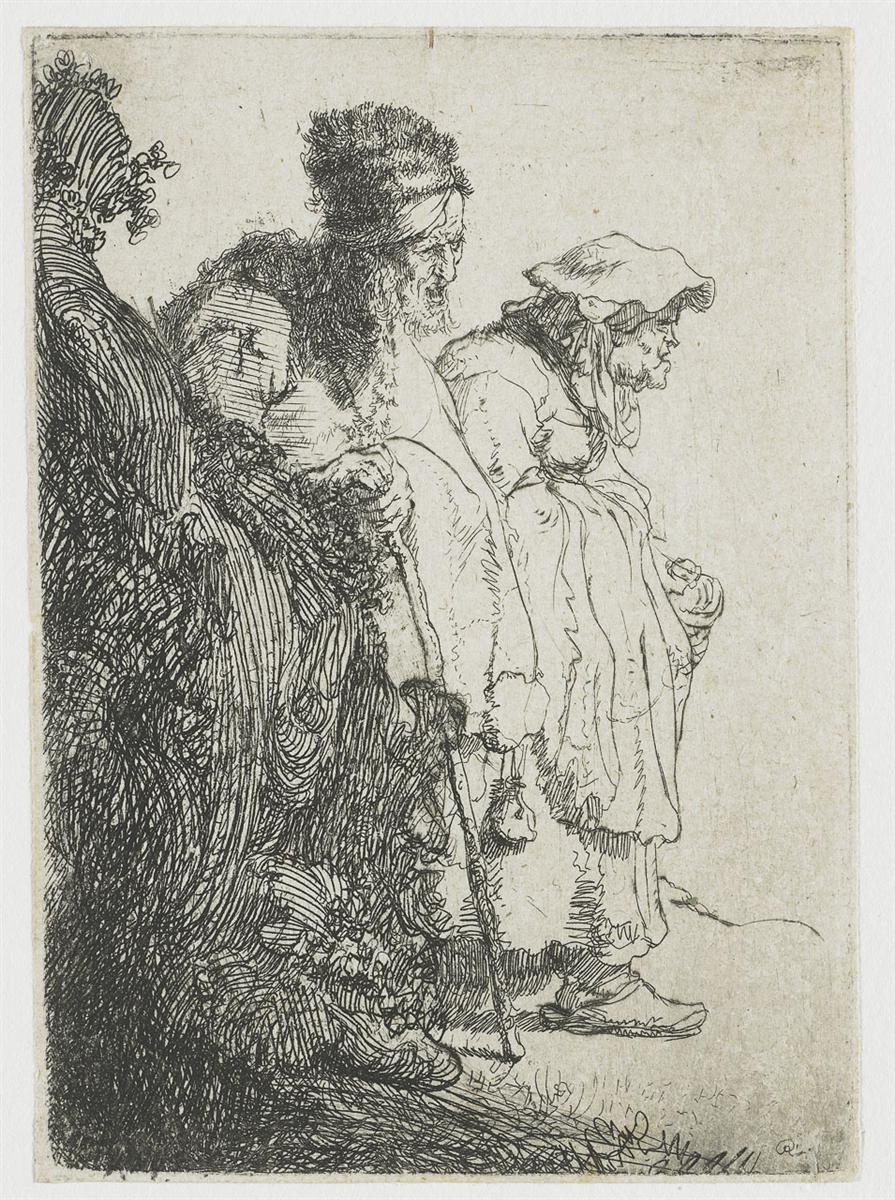
Rembrandt’s “Beggar Man and Woman behind a Bank” (1630) is a small etching that carries the gravity of a novel. On a sheet scarcely larger than a hand, the young master places two figures—an old man and a woman—half concealed by a rising bank of earth. The man leans on a stick; the woman gathers her garment to the body as if to hold warmth or dignity in place. Nothing in the print is theatrical, and yet every stroke is charged. The etched lines record not just the textures of worn fabric and tangled scrub but also the weight of time, the etiquette of survival, and the silent pact between two people moving through a hard world together. This image belongs to Rembrandt’s sustained engagement with the poor and the marginal during his Leiden years, when he explored human character outside the sphere of commissions and courtly display. It is a study in sympathy that does not sentimentalize and in observation that refuses to flatter, converting the everyday into a moral drama of attention.
The Leiden Context And Rembrandt’s Compassionate Eye
The year 1630 marks an inflection point for Rembrandt. Still in Leiden, he was producing small-scale narrative paintings, self-portraits, and a remarkable series of etched studies of beggars, peasants, and old men. These sheets were not charity propaganda or social reportage in the modern sense. They were exercises in seeing, in which the artist tried to understand how bodies register scarcity and how dignity persists under strain. “Beggar Man and Woman behind a Bank” fits this program exactly. The figures are not isolated against a blank ground; they are embedded in a place—an earthen bank with bristling shrubs—that seems to have grown around them. The bank is not merely a setting; it is a participant, a slanted wall that explains posture and directs the eye. In such works Rembrandt demonstrates that empathy begins with context, with the conditions that press on a body before one judges the body itself.
Composition Built On A Diagonal Of Necessity
The composition pivots on a strong diagonal that runs from the lower left, where the bank is densest, to the upper right, where the open field thins to paper. The two figures stand along this diagonal, their feet near the edge of the bank as though stepping out from cover. The man’s staff plants on the declivity, a thin vertical counterstroke that stabilizes the slant. The woman, slightly behind, turns her head forward while her torso lags for half a beat, creating a rhythm of hesitation. This architecture of lines does more than organize space; it stages the moral geometry of the scene. Survival, for these two, is a matter of moving along edges, finding purchase on uncertain ground, and balancing visibility with concealment. Rembrandt’s decision to leave the right half of the plate nearly blank intensifies this effect. The emptiness is both path and peril—an open space they must enter and a void that could swallow them.
The Forest Of Lines And The Language Of Texture
One of the first sensations before the etching is the luxuriant density of the bank. Rembrandt’s needle describes the undergrowth with swirls, tight curls, and cross-hatched nests that feel almost sculptural. The mass is not decorative; it has weight and depth, a micro-landscape that presses on the figures. By contrast, the woman’s dress is rendered with fewer, longer lines and open reserves; the fabric falls in panels that read as coarse but light, catching air at the hem. The man’s fur cap and beard are handled with short, burr-like strokes that speak of warmth and age. This orchestration of marks becomes a vocabulary: dense knots mean resistance and shelter; long lines mean motion and exposure; short hatches mean wear, warmth, and the fatigue of years. The viewer learns to read the print, and in learning, shares the artist’s way of paying attention.
Gesture As Biography
Rembrandt does not rely on facial expression alone. The man’s body leans just enough to transfer weight to the staff, suggesting a chronic reliance rather than a momentary stumble. The left shoulder pushes forward more than the right, describing a gait shaped by habit and probably pain. The woman’s hands gather her clothing at the midsection, not to display it but to keep it from catching as she steps. Her jaw lifts with a ghost of defiance while the brow pulls down in concentration. Between them passes a thread of awareness: they move in the same direction and within the same field of risk, but each carries a private calculation about the next step. In this choreography, Rembrandt captures the paradox of shared hardship—intimacy without ease.
Faces That Refuse Caricature
Seventeenth-century images of beggars often veer toward grotesque stereotype: gawping mouths, exaggerated noses, dangerous grins. Rembrandt resists this tradition. His old man’s features are precise without cruelty; age is registered as fine cross-hatching around the eye, a pouch beneath the cheekbone, and a beard that has the airy irregularity of real hair. The woman’s mouth tightens because of concentration, not malice; her nose is strong but unexaggerated; the eye socket is a deep, inhabited shadow. These faces are memorable because they are not masks. They are in the middle of an act—moving, calculating—and the lines that define them serve action rather than mockery. The refusal of caricature is an ethical decision disguised as style.
Clothing As Evidence
Fabric is biography in these prints. The man’s coat droops at the hem and frays at the edge where it drags against shrubs. The woman’s dress shows patches of repair and a seam that pulls awkwardly across the torso, evidence of a garment often re-fitted to a changing body. The fur cap—oddly handsome—suggests a past purchase or a gift preserved beyond fashion because warmth survives taste. The belt pouch at the man’s side hangs limp; it contains little or nothing. Rembrandt does not itemize these details to shame the figures or to indulge a voyeur’s appetite. He records them as a historian of the visible, trusting objects to carry quiet testimony about means and priorities.
The Bank As Shelter And Stage
The earthen bank is more than backdrop. Its outsized, curling vegetation seems to brush the old man’s sleeve, as if the place were reluctant to release him into exposure. The density of marks around the bank also acts as a visual muffler. Sound feels trapped there, as if the space absorbs and softens noise—an advantage to people who must move without drawing attention. When the pair step past the lip, the textures evaporate into light paper. The move from left to right thus reads as a transition from secrecy to risk, from murmuring cover to the bright, judgmental openness of a road. Rembrandt composes the scene so that viewers feel the change not only as a spatial fact but as a bodily sensation.
Light And The Ethics Of Attention
Although the print is monochrome, Rembrandt manipulates value to direct feeling. The left half is compacted darkness; the right half breathes. Against that breath the profiles of the man and woman stand out with dignified clarity. He does not spotlight them as curiosities. Instead, he carves their silhouettes gently from the charged air so that our attention arrives without violence. The brightest reserve of paper falls near the woman’s face and the space ahead of them, suggesting both vulnerability and possibility. In Rembrandt, illumination is never neutral. Here it offers respect, the visual equivalent of making way on a crowded street.
The Line Between Study And Story
Rembrandt’s beggar sheets often function as both life studies and narrative seeds. “Beggar Man and Woman behind a Bank” carries that double identity. One can read it as a straightforward observation of two models, drawn outdoors with particular interest in costume and posture. Yet the staging, the bank, and the directional emptiness produce an undeniable story. The pair have paused, assessed, and resumed. Something lies ahead that matters—a town gate, a market, a fire to warm their hands, a door that may close or open. The victory of the print is that it stops on the threshold of that story, allowing the viewer to complete it without forcing any single outcome.
Kinship With Other Prints And A Wider Humanism
This sheet belongs to a cluster of 1630 etchings in which Rembrandt records beggars seated, warming hands at a chafing dish, hobbling on a wooden leg, or simply leaning on a stick. Together they amount to a human atlas of precarious movement. The figures are not props for moralizing but neighbors in the republic of bodies. Rembrandt’s interest in them passes into his biblical scenes as well, where apostles and matriarchs sometimes bear the faces and textures of the poor. His humanism is not slogan but practice: he trains his hand on those whom polite society indulged as curiosities and instead grants them the same visual seriousness as scholars and saints.
Etching Technique And The Weather Of The Plate
The technical accomplishment of the sheet deserves notice. Rembrandt varies his etched line as if he were using several instruments at once. The bank is drawn with looping, almost calligraphic strokes that physically echo the spiraling growth of plants. The figures are defined with firmer contours and economical interior hatching to keep them legible against the turbulence of the bank. In some impressions, plate tone—the thin film of ink left on the plate before printing—will pool slightly at the left edge, deepening the dusk around the bank and heightening the sense of emerging light to the right. Such “weather” changes the mood without compromising the composition’s logic. The print remains a living object, capable of many atmospheres.
Movement, Pause, And The Ethics Of Representation
What distinguishes Rembrandt’s approach from caricatured broadsheets is the respect for pause. The figures are neither frozen for ridicule nor sped up for melodrama. They are caught in the human tempo of moving through a day. That tempo is the print’s ethics. To show someone in the time it takes to take a step is to grant them interiority, the space of decision. The old man presses down with the staff and feels the earth give a little; the woman adjusts her bundle and tests the air ahead. In representing these small seconds honestly, Rembrandt argues that attention is a form of justice.
The Viewer’s Position And The Invitation To Witness
The etching places the viewer slightly below and to the right of the pair, as if we were the ones they might encounter as they step out. This vantage point raises a question: how will we receive them? The print does not answer; it only makes our gaze part of the scene. Will we turn away, or will we make room? The bank, like a curtain, is already pulled back. The next action is ours. In this way the sheet, quietly and without rhetoric, converts spectatorship into responsibility.
Modern Resonance And The Durable Power Of Empathy
The scene’s modernity lies in its refusal of spectacle and its trust in the persuasive power of particulars. Contemporary audiences recognize the dignity of these two because their bodies are true to gravity and their clothing true to wear. The lack of didactic signage or theatrical pathos keeps sentiment in check and honors complexity. The image does not ask for pity; it asks for recognition. In the economy of a few square inches, it performs the task we still need from art: to slow the eye until we notice, to notice until we understand, and to understand until our understanding changes how we move among others.
Conclusion
“Beggar Man and Woman behind a Bank” is a masterclass in how little a picture needs to say in order to speak volumes. A slanted earthwork, a staff, a gathered skirt, profiles cut from dusk—these are the elements Rembrandt assembles to stage a drama of endurance and mutual regard. The bank shelters and obstructs; the figures weigh and proceed; light withdraws from judgment and becomes hospitality. The etching is not a detour in Rembrandt’s career but a foundation for everything that follows, including the large biblical scenes and the grave late portraits. It shows an artist learning to see with patience and to draw with justice, offering viewers across centuries a chance to join him in that work.
