Image source: wikiart.org
Introduction
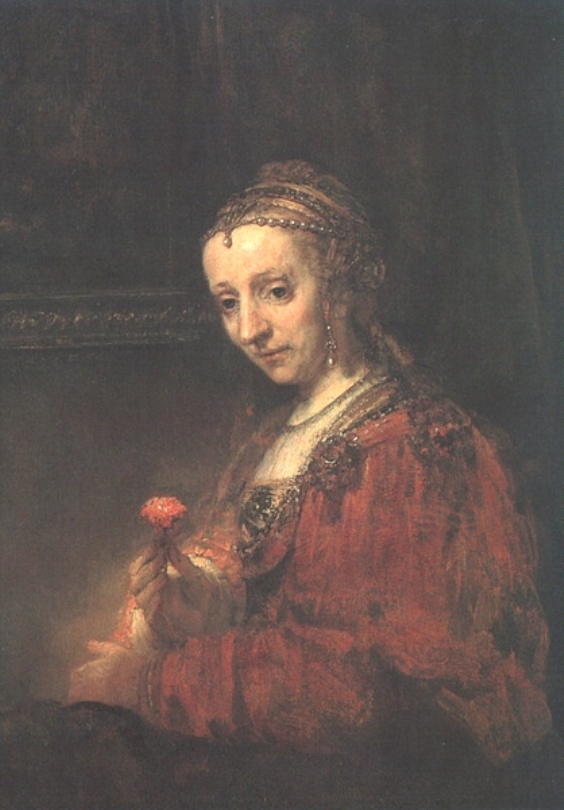
Rembrandt’s “Woman with a Pink” (1630) is a small, intimate canvas that glows like an ember in a darkened room. A young woman, richly dressed and delicately adorned, holds a single pink carnation between her fingers. Light rests on her face, breast, and the petals she contemplates, while the rest of the world recedes into Rembrandt’s characteristic dusk. Painted during his Leiden years, just as his reputation was accelerating, the work compresses several of the artist’s preoccupations into one concentrated scene: the dialogue between light and interior life, the tactility of paint as a stand-in for fabric and flesh, and the power of a single object to charge a portrait with meaning.
The Moment in Rembrandt’s Career
The year 1630 sits near the end of Rembrandt’s Leiden period, a time defined by small scale, experimental lighting, and intense psychological focus. Many of his portraits and tronies from these years are studies in expression under dramatic illumination. “Woman with a Pink” shares that atmosphere but pursues a different register: less theatrical, more contemplative. Before moving to Amsterdam and flooding his canvases with broader social ambition, Rembrandt examined how a private gesture could contain a whole narrative. This painting, likely executed for a discerning patron or as a studio exemplar, demonstrates the young master’s command over mood and texture while hinting at the emotional expansiveness of his later portraiture.
Composition and the Architecture of Intimacy
The composition is built from a gentle diagonal that moves from the lower left—where her hands cradle the flower and a small posy or tassel—to the upper right, where her head turns and light pools along the brow and cheek. The woman’s torso forms a soft wedge that anchors the lower half of the canvas; her sleeve broadens like a velvet river, carrying the eye upward. The background dissolves into near-black save for a faint rectangular glimmer that may be a framed panel or mirror, offering a mute counterbalance to the figure’s warmth. Rembrandt keeps the figure close to the picture plane, as if we were sitting opposite her. The compressed space and half-length format invite a conversational distance—near enough to see the ridge of impasto on a highlight, far enough to honor the sitter’s inner privacy.
The Role of the Pink
The pink carnation is a small thing with large resonance. In Northern painting, the carnation often appears in betrothal images and portraits associated with love, fidelity, and the sanctified bond of marriage. It can also refer to Christ’s Passion in devotional contexts, since the flower’s serrated edges were linked to the crown of thorns. Rembrandt refuses to force a single reading. The woman’s thoughtful gaze could be the inwardness of a bride, the reverie of memory, or the soft attention of someone drawn to beauty’s fragility. The flower’s color—a glowing ember of red—echoes the warm notes in her garment and becomes the chromatic hinge of the composition. It is both symbol and lamp: meaning and illumination in one stem.
Psychology in a Tilted Head
Rembrandt builds character not through caricature but through slight asymmetries. The sitter’s head tilts forward and slightly to the viewer’s left, an angle that softens the neck and opens the face to light. Her eyes do not fully meet ours; they rest just past the flower as if thought and attention traded places. The small down-turn at the corners of the mouth implies a private seriousness rather than melancholy. A glint of moisture at the lower eyelid, caught in the warm light, gives the face the vulnerability of living skin. This is not the frozen smile of court portraiture; it is a human presence gathered into reflection.
Light as Character
Rembrandt’s light is never mere illumination. Here it falls from the left, grazing the cheekbone, catching the pearl headpiece, and lodging in the flesh of the hands. It pauses on the carnation and then slides into the layered fabric where it tugs metallic threads into momentary brilliance. Darkness is not a void but a companion—thick, velvety, protective. The painter uses this chiaroscuro to stage an emotional gradient: brightest where life and attention converge (face, hands, flower), softer where memory or anticipation deepens (the chest and laces), and dark where worldliness recedes (the room beyond). The viewer reads the painting as a movement from public form to private thought.
Costume, Ornament, and the Pleasure of Paint
The sitter’s dress is sumptuous without being ostentatious. Rembrandt piles layers of red and warm brown, then abrades, drags, and stipples the paint to simulate velvet’s nap, brocade’s stiffness, and lace’s airy edges. Small encrustations at the shoulder suggest jeweled clasps; a string of pearls threads through her hair and falls beside the ear with quiet gravity. He models metallic details with tiny reserves of bright paint rather than drawn outlines, so that the ornaments flash like real metal briefly catching light. The handling is sensuous and economical at once: the eye recognizes material quickly, then wanders across the surface to enjoy the painter’s varied touch.
The Hands as Mirrors of Temperament
The hands in Rembrandt’s portraits often carry the sitter’s inner state. In “Woman with a Pink,” the fingers encircle the flower gently, the thumbs and forefingers forming a small cradle rather than a grasp. The other hand holds a small object—a locket, posy holder, or glove—tucked close to the body. The combination reads as a gesture of care and deliberation: the flower is noticed and protected, the secondary object kept in reserve. Texturally, the hands glow with thinly scumbled flesh tones over warmer underpaint, while cool notes at the knuckles describe bone beneath the skin. The effect is a living balance of tenderness and poise.
Color and Temperature
Rembrandt restrains his palette and lets temperature do expressive work. The red garment dominates, tuned across a range from deep claret to ember-bright scarlet. Flesh tones are creamy with warm undertones, cooled at the hairline and neck with gray-olive shadows. The background is a brown-black that feels breathable rather than flat, mottled with faint hints of umber and smoky blue. The carnation carries the painting’s hottest note. That small shock of color set against the neutral ground and the cooler highlights transforms a quiet portrait into a living drama of warmth against dusk.
The Background and the Echo of the Frame
A vague rectangular motif behind the sitter—possibly a framed painting or mirror—serves as a compositional ballast and a thematic echo. If we read it as a frame within the frame, the device invites reflection on portraiture itself: the woman, presented to us, holds a flower that also frames a thought; behind her, art silently witnesses life. If it is a mirror, it hints at self-awareness rather than vanity; the sitter is conscious of being looked at and holds the emblem of affection like a quiet answer. In either case, the background reinforces a mood of cultivated inwardness typical of Rembrandt’s domestic interiors.
Texture as Narrative
Rembrandt’s textures are purposeful. The heavy impasto along the sleeve cuff and shoulder gives the garment sculptural presence, marking the body’s volume and the weight of circumstance—station, ceremony, occasion. By contrast, the thinly painted carnation and the soft glaze on the face suggest ephemerality and spirit. Where paint is thick, time feels slower and the world more material; where paint thins, time quickens and thought surfaces. The alternation allows the portrait to hum with subtle narrative: the tangible richness of the sitter’s world set against the fragile bloom she contemplates.
Iconography and Possible Identity
The painting’s iconography—youthful woman, rich attire, single carnation—encourages speculation about identity: a bride or betrothed, perhaps, or a portrait with allegorical accents. Rembrandt often blended portrait and tronie, using a specific sitter as a springboard for character types. Whether this is a named person or an idealized figure matters less than the truthfulness with which the personality emerges. The artist trusts that gesture, light, and the small theatre of objects can communicate inner life regardless of documented identity. The result is a portrait that invites personal recognition rather than mere historical curiosity.
The Face as Landscape
Close looking reveals the face as a landscape of luminous small decisions. Tiny warm accents tip the eyelids; a thin stroke clarifies the philtrum; the edge of the upper lip retains a cool note so the lower lip’s warmth reads as moisture. A near-invisible highlight at the tear duct makes the eye feel alive. These micro-events collaborate to create a presence that resists idealization. The skin reveals fine lines and the gentlest fatigue under the eyes—traces of a life of attention rather than blemishes to be erased. Rembrandt dignifies the human face by letting it be human.
A Conversation with Silence
One of the painting’s most striking qualities is its quiet. No extravagant gesture interrupts the introspection; no narrative accessories clutter the frame. The silence is not emptiness but concentration. The woman leans slightly into the space we share, as if to offer the flower for our sight while keeping the thought it triggers for herself. The viewer senses the room around her—a warm, private interior—even though Rembrandt paints almost none of it. Such economy is a hallmark of his early mastery: suggest environment through light and posture rather than through architectural detail.
The Viewer’s Position and Emotional Access
Rembrandt places us at a respectful distance, level with the sitter’s gaze but not inside her space. Our angle, slightly to the left of the light source, lets us see the flower glow and the shadow pass softly across the far side of her face. This is the vantage of a confidant, not a courtier. The painting thereby modulates our participation: we are invited to appreciate her beauty and dignity, to sense the private meaning of the pink, but we are not licensed to pry. That ethical positioning is part of the painting’s grace.
Pictorial Time and the Breath Between Moments
The canvas captures an in-between moment: the instant after the flower is lifted and before it is pinned, smelled, or set aside. Rembrandt loves these suspended seconds because they let viewers bring their own scripts. The sitter could be assessing the fresh bloom’s perfection, recalling the giver, or simply enjoying its color against her gown. This openness keeps the painting alive across centuries; each viewer’s narrative can inhabit the pause.
Affection, Devotion, and the Double Reading of the Pink
The carnation’s double inheritance—secular affection and sacred devotion—gives the picture a layered tone. If we read the pink as a token of love, the painting becomes a tender study of fidelity and modest joy. If we read it as a Passion symbol, the glow takes on a devotional charge, the woman’s lowered eyes resembling humility before sacrificial love. Rembrandt often built portraits that could travel between civic and spiritual registers. He does not force the choice; he allows atmosphere to carry both at once.
Brushwork as Music
The painting’s brushwork has its own music: long, legato strokes in the gown’s broader planes; staccato touches where trim catches light; soft, brushed glazes across the cheek; and bright, high notes on the pearls and petals. The tempo varies as the eye moves, creating an experience more like listening than dissecting. This musicality is one source of the work’s serenity. Even where the pigment is assertive, the rhythm remains calm, consonant with the sitter’s mood.
Relationship to Contemporary Portraiture
Compared to many contemporary portraits that flaunt status through meticulously cataloged objects, “Woman with a Pink” is restrained. Rembrandt replaces inventories with insight. He paints enough finery to establish station but devotes his main energy to the communion between face, hands, and flower. This prioritization would increasingly define his Amsterdam portraits of the 1630s and 1640s, where even powerful patrons appear as complex individuals rather than mannequins of wealth. The 1630 painting thus foreshadows a career-long redefinition of dignity in portraiture: not rich display, but rich humanity.
The Painting’s Modern Appeal
For modern viewers, the painting’s magnetism lies in its intimacy. Many people recognize the sensation of pausing over a small object—the way color pulls thought to the surface, the sweetness of a moment privately savored in a busy day. The scene feels true to lived time. Its palette, too, anticipates contemporary taste: warm reds, subdued browns, a humble light that does not shout. Rembrandt bridges the centuries by depicting a human interval that requires no translation.
Conclusion
“Woman with a Pink” distills the powers that make Rembrandt enduring: light used as intelligence, paint used as touch, symbolism used as an invitation rather than a command, and psychology carried in the smallest bend of a wrist or tilt of a head. The flower she holds is a spark in the dusk, an emblem of love and life’s fragility, a visual rhyme for the warmth that gathers in her face. The background withdraws so that the drama of attention can play unencumbered. We are left with a portrait that feels both formal and familiar, ceremonial and profoundly human. In a decade when Rembrandt would soon dazzle Amsterdam with ambitious commissions, this modest canvas proves that his highest gift had already matured: the ability to make a silent room glow with the presence of a person thinking.
