Image source: wikiart.org
Introduction
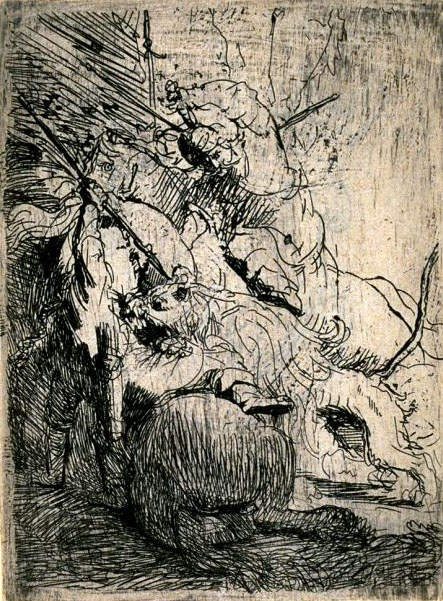
Rembrandt’s “The Small Lion Hunt” (1630) is a compact etching that detonates like a thunderclap. In a space scarcely larger than a hand, the young master compresses a cavalry charge, a lion’s desperate counterattack, and the centrifugal panic of men and horses into a single, whirling mass of line. There is no panoramic distance, no heraldic display, and almost no sky; the scene erupts inches from our eyes. The immediacy is purposeful. Rather than narrate a hunt in stately chapters, Rembrandt makes us feel the proximity of hooves, the flash of steel, and the sudden, intelligent violence of the cat. The print is an early manifesto of his narrative method: begin inside the event; make light, shadow, and line carry the story; let the viewer reconstruct the rest from sensation.
The Leiden Moment and the Appeal of the Hunt
Created during Rembrandt’s Leiden years, the etching fits a period in which he tested how far copper, acid, and ink could go in representing motion and psychology. Lion hunts were popular subjects in Northern art, fueled by antique reliefs, prints after Rubens, and travelers’ tales. For a painter who had never seen an organized hunt in North Africa or the Near East, the theme offered a universal theater of extremes—courage and fear, discipline and panic, power and vulnerability. Rembrandt approached it not as a courtly entertainment but as a study in collision. His small format, far from limiting him, enhances the shock: the closer we lean, the more we feel the crush of bodies and the hot breath of the struggle.
A Composition That Spins Like a Vortex
The composition operates as a vortex anchored by the lion’s body and the rounded rump of a fallen horse in the foreground. Spear shafts rake diagonally across the plate, reins draw taut like slings, and the cat twists within a tangle of human limbs. Rembrandt sets almost every line on a slant, refusing the horizontal calm of landscape. A few short verticals—posts, weapon handles—act like snapping metronomes inside the swirl, measuring the tempo of the fight. The eye cannot rest; it is thrown from hoof to paw to flaring mane and back again. This centrifugal arrangement produces a paradoxical clarity: even if we cannot count all combatants, we understand immediately what the mêlée feels like.
Chiaroscuro as the Engine of Impact
As in his best early prints, Rembrandt builds depth and focus by rationing darkness. Dense cross-hatching gathers at the lower left, under the fallen horse and behind the lion, where shadow becomes weight. Higher in the plate, hatching thins into streaks that behave like air slashed by spears. Across this gradation, a few reserves of paper—left bright—strike like percussion: a highlight on a horse’s flank, the edge of a paw, the gleam of a blade. Light does not merely model form; it names the danger points. We read the composition almost by touch, moving from bright hits to the next, guided across the turbulence by the logic of illumination.
Line That Stings, Smears, and Sings
Rembrandt’s pen-like needle changes character with each material. For the horses he drags the line in long, muscular curves that suggest bulk and tension; for manes and tails, he lets the stroke fray into wiry sprays; for the lion’s pelt, he uses short, claw-like hatches that change direction in quick bursts, registering the animal’s twist of torso. In areas of greatest crisis—where a spear meets fur, where a hoof skids—the line breaks into agitated scratches, as if the metal itself were startled. This orchestration of mark-making is not decoration. It is how the print tells time: smooth lines are the long notes of body and mass; jagged nests are the trills of impact.
Anatomy and the Credibility of Violence
Although the scene is stylized and compressed, Rembrandt grounds it in believable anatomy. The fallen horse rounds into a true barrel; the nearer hind leg tucks under with the stiff awkwardness of weight losing traction. Riders hunch into their saddles to protect the torso, and the twist of the lion’s spine reads as a real turn rather than a symbolic flourish. Because the mechanics are right, the violence convinces. We do not see generic beasts; we see muscular bodies doing what bodies do under threat and force.
The Lion as Thinking Protagonist
Unlike many heroic-hunt pictures where the cat is a glorified emblem, this lion feels quick-minded. Its head snaps toward the nearest threat; the open mouth aligns with a paw that hooks like a grappling hand. Rembrandt refuses to treat the animal as pure ornament or villain. The cat’s intelligence dominates the center of the sheet, claiming a dignity equal to that of the horsemen. This parity intensifies the drama: the victory is not inevitable, and the risk to human bodies is real.
Horses as Barometers of Panic
The horses are not merely mounts; they are emotional barometers. One plunges headlong, eyes wide, its forelegs angled like the arms of a man falling; another rears back into the mass, its rider hidden by the tangle; the fallen animal in front compresses into a rounded boulder of muscle, hooves skidding as it seeks purchase. Rembrandt’s choice to give the foreground to a horse’s massive backside—decidedly unheroic—says everything about his priorities. He wants weight, friction, and the unglamorous truth of a fight’s near view.
Spatial Compression and the Ethics of Closeness
There is almost no distance in the print. The background is a curtain of marks that imply rock, dust, or foliage without inviting escape. This spatial compression forces an ethical closeness on the viewer. We are not allowed the moral comfort of watching from afar. Our gaze becomes a kind of participation, and with it comes the recognition that hunts—however romanticized in court art—are chaotic, risky, and morally ambiguous affairs.
The Role of Negative Space and the Breath Between Blows
Amid the density, Rembrandt leaves tiny pockets of unworked paper. These white islands act as breath between blows, allowing the eye to reset before plunging back into shadow. One such pocket at the lion’s cheek throws the snarl into relief; another along a spear shaft sharpens its trajectory through the crush. These decisions keep the small plate legible and keep the violence from turning into abstract noise. The viewer experiences brutality articulated by rhythm rather than drowned by it.
Technique, States, and the Weather of Impressions
Rembrandt’s etchings are living things across their editions. Depending on how much plate tone remains after wiping, impressions of “The Small Lion Hunt” can feel dustier and more nocturnal, or cleaner and more graphic. A darker wipe thickens the air around the combatants, making the tangle feel hotter and more suffocating; a lighter wipe clarifies the count of spears and hooves, emphasizing the choreography over the atmosphere. Either way, the etched decisions—where to charge darkness, where to leave light—govern the feeling of shock that gives the print its identity.
Dialogue with Rubens and Antique Reliefs
Rembrandt knew hunt imagery by others, above all the sweeping tableaux of Rubens. Where Rubens opens space into wide, sunstruck theaters and arranges bodies in noble arcs, Rembrandt chooses the crush and the snarl. Yet the two share a love of diagonals, of plunging horse necks and rearing forelegs. One could read Rembrandt’s small plate as a counter-argument: what if we bring the viewer to the ground inside the dust, remove the banners and trophies, and record what the moment of hazard feels like rather than how it should look in a palace? The result is not anti-heroic but keenly human.
Symbolic Possibilities without Program
Seventeenth-century viewers could read lion hunts as allegories of courage, dominion, or the subduing of sinful passions. Rembrandt leaves the door open to such readings without pinning the image to a program. The forcing diagonals, the small glints of steel, the muscular cat that refuses easy conquest—these can serve ethical or political metaphors, but the picture insists first on particularity. It invites us to reflect on valor and control only after we have felt the weight and risk of bodies in conflict.
Sound, Time, and the Sensation of Dust
Though silent, the etching is sonically alive. We can hear the brassy ring of spear on stone, the scream of a horse, the hoarse cough of the lion, the clatter of hooves finding and losing purchase. Rembrandt suggests these sounds not by literal depiction but by rhythmic densities: cross-hatching where noise would aggregate, single clean strokes where a spear slices air, scribbled knots where reins tangle and leather slaps. The print also tells time in bursts—the same scene split into micro-instants the eye stitches together as narrative.
The Viewer’s Body as Measure
The scale matters. To see everything, we must lean close, our breath nearly clouding the paper. The posture mirrors that of the combatants—strained, forward, attentive to risk. Rembrandt uses the format to recruit our bodies as instruments of understanding. We measure the event by our own closeness to it, and in that physical nearness the moral nearness becomes unavoidable.
Kinship with Rembrandt’s Studies of Beggars and Soldiers
In the same period, Rembrandt drew and etched beggars, peasants, and guards with equal sympathy for the pressures their bodies endure. “The Small Lion Hunt” shares that ethic: it is not a fantasy of invulnerable warriors, but a recognition of human limits under stress. The riders are brave, but they are also thrown, blocked, and nearly bitten. This refusal of invulnerability is a hallmark of Rembrandt’s art, one reason his images still speak to viewers suspicious of pageantry and hungry for truth.
The Education of the Hand
For a young artist, the subject is also a classroom. Hooves at multiple angles, twisting feline anatomy, weapons foreshortened into space, torsos bent by torque—all are hard problems solved at speed in acid-proof line. The plate becomes a rehearsal for later, larger compositions where crowds and crises must remain legible. You can sense the satisfaction of solutions: a single triangular shadow pins a hoof to ground; a broken contour lets a flank glint as it turns; a batch of short scratches converts cloth into panic.
Ethics of Predation
The image does not celebrate cruelty, yet it does not moralize against it, either. It simply shows. By withholding scenic consolation and focusing on near-view difficulty, Rembrandt lets viewers decide how they feel about the enterprise of a lion hunt. Some will admire the riders’ resolve; others will pity the cat; many will sense that both responses are possible and necessary. This ethical ambiguity is not weakness but strength; it acknowledges the complexity of power and danger without falsifying either.
Why the Print Still Feels Modern
Four centuries on, the plate’s modernity lies in its trust of essentials. There is no extraneous landscape, no heraldic costumes, no prettified trophies. Line does the work of motion; light does the work of focus; anatomy does the work of conviction. The picture believes that if you get those three right, the rest will follow. Contemporary eyes, trained on photography and used to the intimacy of handheld images, recognize the print’s scale and tempo as their own.
Conclusion
“The Small Lion Hunt” is a dense knot of life caught at the instant when control is least certain. The lion whips around with cunning speed; horses rear and skid; men thrust, guard, and nearly fall. Rembrandt distills the chaos into a legible storm of diagonals, anchoring the tumult with masses of dark and the sharp punctuation of light. The result is not a decorative hunting scene but a study in risk, force, and the intelligence of bodies under pressure. The plate’s smallness intensifies its thunder; its closeness denies us the spectator’s comfort. We are inside the dust, counting breaths between blows, persuaded that art can show the truth of violence without glorifying it. In that clarity, the print announces the Rembrandt to come—an artist who trusts human experience over spectacle and makes the smallest sheet feel larger than any wall.
