Image source: wikiart.org
Introduction
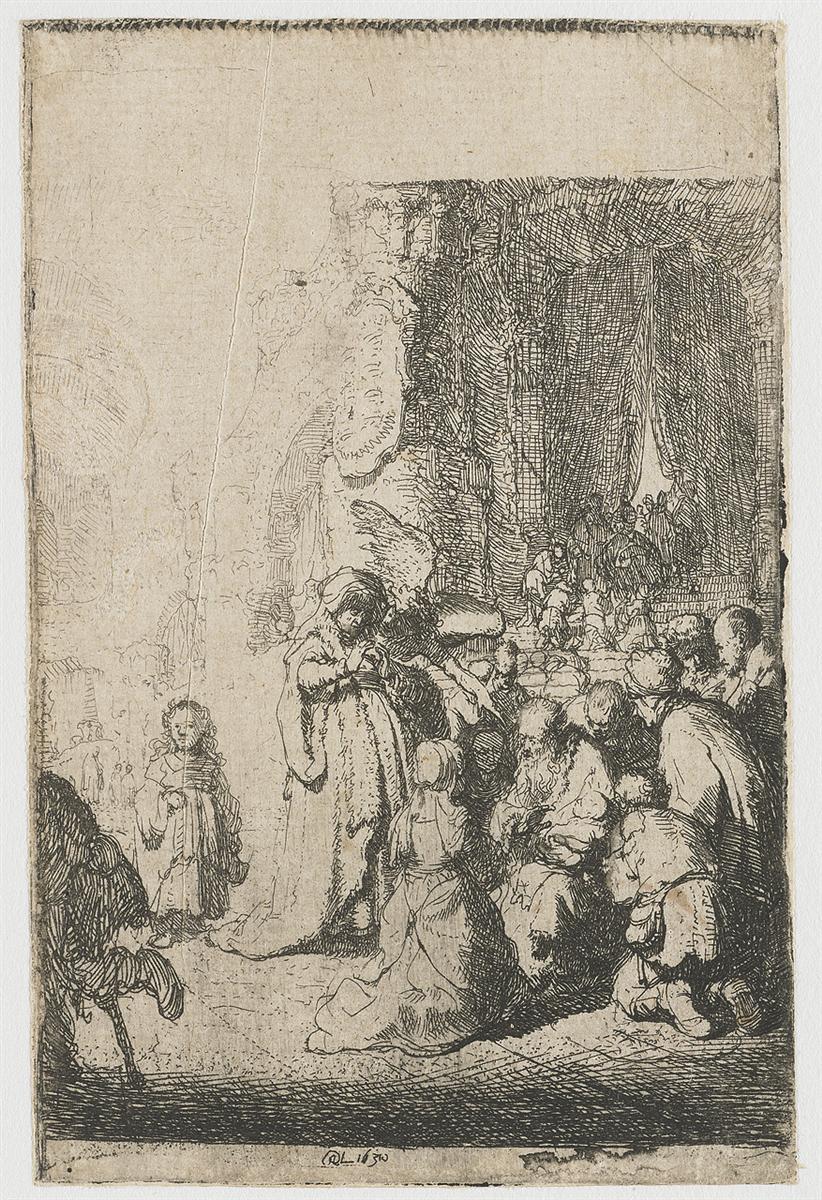
Rembrandt’s “Simeon’s Hymn of Praise” (1630) is a small etching that opens into a monumental world. Within a few inches of copper and paper, the young master stages the biblical moment when the aged Simeon recognizes the Christ child in the temple and breaks into the canticle known as the Nunc dimittis—“Lord, now lettest thou thy servant depart in peace.” The plate compresses architecture, a press of onlookers, steps that recede into shadow, and the rapt figure of Simeon into a single, breathing scene. Instead of treating the subject as a front-row tableau, Rembrandt folds us into the crowd and invites us to witness a recognition unfolding in real space and time. The result is a work of narrative intensity and spiritual hush, achieved with nothing more than incised lines, pools of ink, and the eloquent silence of bare paper.
The Biblical Moment and Rembrandt’s Choice
Luke’s Gospel describes how Mary and Joseph bring the infant Jesus to the temple in Jerusalem. There, Simeon—“righteous and devout”—takes the child into his arms, blesses God, and prophesies that he has seen salvation. Artists before Rembrandt often staged the episode as a ceremonious presentation at an altar, with high priests, candles, and processional order. Rembrandt chooses a different emphasis. He shows a human crush inside a cavernous interior: figures kneel, lean, and listen; some still mount the steps while others turn their faces toward the central exchange. The scene is not a set piece; it is a gathering, irregular and alive. Simeon’s song of praise reads less like a liturgical rite than like revelation arriving in a public place and passing from one listener to another until the whole space vibrates with comprehension.
Composition and the Architecture of Gathering
The composition pivots on a strong diagonal that runs from the lower right, where kneeling figures cluster, up across the steps into a deep, curtained recess at the upper right. This diagonal is countered by the open, pale expanse at left, which behaves like daylight entering from a high temple court. Rembrandt uses this asymmetry to stage attention. The left half of the plate, bright and relatively empty, serves as a launch for the eye; the right half, dense and shadowed, becomes an amphitheater. Near the seam between light and dark stands Simeon, slightly bowed, hands joining the child to his chest in an arc that reads as both embrace and offering. The crowd arranges itself in crescents around him, with tighter hatching marking bodies closest to the foreground and looser lines suggesting more distant groups. The architecture, broken and massive, frames these arcs without dictating them. It feels ancient and lived-in, a memory of a sacred place more than a precise archaeologic record.
Light as Revelation
Etching leaves light where the copper remains untouched, and Rembrandt leverages this fact with theological clarity. Illumination pools on Simeon’s cloak, on the child’s head and the nearest listeners, and on the stone floor that leads toward them. Behind, the steps ascend into a bay of darkness where dense cross-hatching knits shadow into weight. The light does not merely describe surfaces; it organizes belief. It tells us where recognition dawns and where it has not yet reached. This distribution refuses spectacle. There is no single theatrical beam; rather, a tide of brightness slides across figures and architecture, creating a shared atmosphere of disclosure.
The Language of Line
One of the pleasures of the plate is the way Rembrandt assigns distinct “dialects” of line to different elements. The stonework at right is built from compact, vertical hatchings that read as stacked masonry. Drapery is notched with longer, curved strokes that ride the gravity of cloth. Flesh appears with the least pressure—small, varied marks that leave plenty of paper to breathe. Hair is flicked in quick, wiry gestures. The curtain in the deep apse is fabricated from tight, parallel fields that almost hum, giving the recess a velvet density. These separations of mark allow the eye to navigate a crowded plate without confusion. We feel texture, weight, and distance simply by following the cadence of the lines.
The Crowd as Chorus
Simeon’s hymn may be a solo in scripture, but Rembrandt turns the crowd into a visual chorus. In the foreground, kneeling men and women tilt their heads toward the central action, hands pressing together or clasping at their chests. Their postures are varied—one twisted in profile, another leaning forward, another turning to share the news—and the variety conveys the chain-reaction nature of faith. A second ring of figures climbs the steps, and a third ring in the apse looks down from shadow, their presence rendered by a few dense knots of ink rather than individual likenesses. This gradation from clear to collective is crucial. It allows the moment to feel both intimate and public, a revelation for a person and for a people.
Simeon’s Gesture and the Grammar of Praise
Simeon’s pose is all arc and incline. His back rounds slightly; his arms curve; his head bends so that light touches the brow and cheek while the eye socket deepens. The lines that describe him are not loud. They are confident and spare, respecting the quiet of aged joy. Importantly, the gesture contains a double movement—toward the child and toward God. The infant is held close, but the angled inclination of arms and torso reads as offering as much as embrace. Without stating doctrine, the etched posture embodies theology: the salvation Simeon recognizes arrives as something one can hold and yet must lift beyond oneself in thanksgiving.
Architecture and the Sense of Sacred Time
The temple in this print is not an architectural treatise; it is an atmosphere of antiquity. Broken edges of stone, layered arches, and the heavy drape of a curtain form a setting that is simultaneously specific and poetic. The crumbling textures imply age and continuity; the curtain suggests a boundary between ordinary space and a sanctum beyond. By keeping the left side relatively bare and letting structure accumulate to the right, Rembrandt turns the building into a participant in the drama. The architecture itself seems to listen, shadows gathering like silent elders witnessing the song.
Paper White as Silence
Much of the plate remains softly untouched, especially across the left half and in the air above the steps. This reserve of paper is not empty; it is silence—the necessary condition for hearing. Against this pale field, the etched lines of figures and stones stand out with a clarity that would be impossible in a busier composition. The unwritten areas keep the print from becoming a methodical inventory of forms. They temper intensity and let the event breathe. The viewer’s eye enters through quiet and only then encounters the packed chorus at right, exactly as a listener moves from hush to music.
Depth, Scale, and the Theatrical Frame
Rembrandt’s use of the plate edge as a secondary frame is subtle and effective. The narrow printed border boxes the scene as if it were a small stage, yet the internal diagonals break any sense of flatness. The steps rise; the crowd stacks; the recess pulls deep; and the left edge opens into adjacent space. This combination of theater and depth is psychologically potent. We have the sensation of standing just within an archway, privileged but not isolated, witnesses among other witnesses. The format teaches reverence: come near, but not too near; look with care, and look as one among many.
Etching Technique and the Weather of Impressions
Rembrandt’s plates often yield different atmospheres depending on inking and wiping. Impressions of “Simeon’s Hymn of Praise” can carry a soft plate tone that veils the left half in a gentle gray, making the light feel like overcast day; a cleaner wipe heightens contrast, sharpening the child’s small highlight and clarifying faces at the front. Heavier inking can deepen the apse so it swallows figures into a collective dark; lighter inking can let individual heads glimmer from the recess. These variables are not incidental mechanics. They act like weather reports for the same sacred moment—cloudy tenderness or bright clarity—each faithful to the etched decisions.
Humanism Without Pageantry
A striking feature of the print is its restraint. There are no ornate ritual objects brought forward to validate sanctity; no towering altar dominates the frame; no hierarchical pyramid privileges clergy over the people. Sanctity here is carried by faces, posture, and light. The miracle is recognition itself, and it is given to a crowd that contains all grades of attention—children craning their necks, elders leaning close, onlookers at the threshold of understanding. Rembrandt’s theology is gently democratic: revelation is legible in ordinary bodies gathered under common light.
The Child at the Center and the Logic of Scale
The infant is tiny, yet unmissable. Rembrandt ensures visibility by nesting the child within Simeon’s pale robe and lifting the small head into a pocket of light against the darker mass of steps and figures. The surrounding crowd forms a visual shield, a kind of living nimbus whose curving backs and turned profiles protect the concentrated exchange. The logic of scale—small center, large surround—accords with the subject. Salvation, in this reading, is not an overwhelming spectacle. It arrives small and is recognized by the wise, then spreads outward by witness.
The Role of the Onlooker at Left
Near the bright left margin stands a figure who seems to have just entered, still apart from the main press, turning toward Simeon with a posture midway between curiosity and reverence. This person functions as a threshold figure, a stand-in for the viewer whose eye travels from open space toward revelation. The inclusion of such an intermediary is a cunning narrative device. It teaches how to move through the print—cross the floor, attend to the song, kneel among the others—and in doing so it makes the sheet participatory.
Sound and Time in a Silent Medium
Although an etching is mute, this plate feels audible. You can almost hear a rising hush, the rustle of cloth as people settle, the sibilant murmurs from the apse, and then Simeon’s hymn lifting into the stone. Rembrandt achieves this by modulating line density like volume. Sparse marks at left are pianissimo; midtone hatchings across the steps and lower crowd are mezzo; the thick cross-hatched apse is a choral forte that does not drown the solo but holds it. The effect is temporal as well as sonic: the eye reads from quiet approach to swelling response, from arrival to recognition, from recognition to blessing.
Relation to Rembrandt’s Other Sacred Prints
In 1630 Rembrandt also etched youthful scenes of Christ disputing with the doctors and other temple episodes. Those prints share a preoccupation with the life of interior spaces: deep corridors, textured walls, seats of stone that collect and release light. “Simeon’s Hymn of Praise” belongs to this family yet distinguishes itself by its emphasis on a single, tender act surrounded by communal listening. Where the disputations feature argument and gesture, this sheet favors stillness and song. Taken together, the group shows a young artist more interested in the human behaviors of belief—gathering, listening, recognizing—than in external splendor.
Lessons for Draftsmen and Storytellers
The plate offers a small manual on making complex scenes legible. Use a large bank of shadow to hold depth and to push highlighted figures forward. Reserve wide areas of paper to create air where the eye can rest. Give different materials unique line languages so the viewer can separate them in a glance. Arrange the crowd in nested arcs so attention naturally converges on the central act. Above all, tether light to meaning. Let illumination fall where recognition occurs, and let darkness remain where understanding has not yet arrived.
The Enduring Appeal of a Shared Revelation
Nearly four centuries later, the etching feels contemporary because it trusts human faces and shared space. We recognize the way people lean toward news that matters; we recognize the instinct to come closer, to crouch, to lift a child for a better view. The print honors those instincts without sentimentality. Simeon is not aglow with supernatural aura; he is aglow with comprehension, and that is miracle enough. By giving the sacred story the shape of a believable gathering, Rembrandt ensures that the moment continues to meet viewers where they stand.
Conclusion
“Simeon’s Hymn of Praise” proves how far a few etched lines can go when guided by sympathy and structure. Rembrandt places revelation inside a lived temple, stacks a chorus of bodies in listening arcs, and allows light to travel exactly where understanding blooms. The plate is modest in scale but vast in feeling—a hymn translated into architecture and crowd, a canticle held in copper. The viewer enters through silence, crosses a sunlit floor, and joins those who have turned toward a song that is as much about seeing as about singing. In this way the print becomes more than an illustration of scripture; it becomes an experiential guide to attention, the form of praise that art and faith share.
