Image source: wikiart.org
Introduction
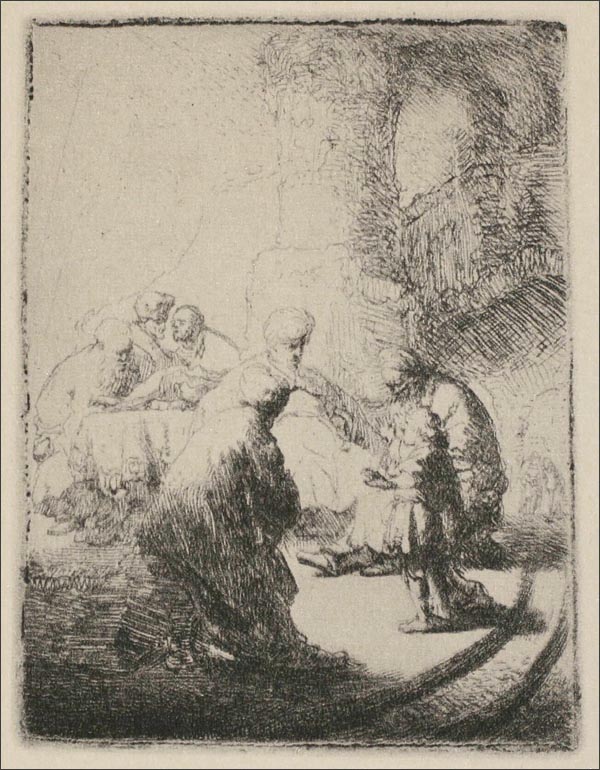
Rembrandt’s “Jesus Disputing with the Doctors” (1630) is a small etching that expands into an epic of thought. In a shadowed architectural space evoked with a handful of nervous strokes, the youthful Christ stands among scholars and teachers of the Law. Their bodies lean and cluster, their hands count and question, their heads form a ring of attention that focuses the scene into a single pool of light. The sheet’s modest scale belies the magnitude of what it stages: the first public revelation of Christ’s authority as wisdom, achieved not through miracle but through conversation. The young artist, still in Leiden, uses the calligraphy of line, pockets of white paper, and the pressure of shadow to transform a Gospel episode into a human drama where ideas are visible.
The Gospel Moment and Rembrandt’s Focus
The story derives from Luke 2:41–52. After Passover, Mary and Joseph discover that the twelve-year-old Jesus has remained in Jerusalem. They find him in the Temple, “sitting among the doctors, both listening to them and asking them questions,” and those who heard him “were astonished at his understanding and answers.” Traditional depictions often set Jesus on a small dais, enthroned like a prodigy. Rembrandt prefers a subtler emphasis. His Christ stands within the circle, no taller than the seated elders, yet no less central. Authority appears as attention granted rather than as rank displayed. Instead of ceremony, we sense the friction and warmth of genuine inquiry. The moment of astonishment is not a theatrical gasp; it is the inward pivot when conviction shifts and old premises loosen their hold.
Etching as a Theater of Marks
Etching preserves the pace and pressure of the hand with extraordinary fidelity. A needle scratches through wax into copper; acid bites the lines; ink and paper convert those bites into visible thought. Rembrandt deploys this medium as an orchestra of mark-types. Architecture is scored with long, parallel hatchings that create masonry and shadow. Clothing becomes a weave of shorter strokes that flex with the body’s movement. Faces are indicated with tight, flickering lines that make attention palpable. Across the sheet, white paper is never a void. It is the room’s air and the scene’s spiritual space, the bright reserve where understanding resides. The alternation between inked zones and untouched fields is not just tonal; it is narrative.
Composition Built on Curves and Convergence
The composition is a spiral. Starting from the lower right, two dark arcs sweep upward and inward like rails, guiding the viewer toward the gathering. The right-hand arcade, shaped with dense cross-hatching, serves as a threshold. Within it, the doctors lean in accreted semicircles, each figure a chord that resolves at the small standing Christ. The eye moves along this choreography almost musically: foreground sweep, middle-ground ring of shoulders, bright node of the child, echoing vault above. The left side of the plate opens into a comparative hush—a soft clearing where, at a table, bystanders move in a second rhythm of watching. The result is a balance of weight and breath, crowd and space, argument and listening.
Light as Measure of Insight
The brightest passages are the least drawn. Christ’s figure and the immediate ground around him are defined by delicate edges and an envelope of preserved paper white. The elders are darker, not as condemnation but as tradition: a mass of learning gathered across years, now absorbing new clarity. The architecture at upper right deepens toward black, a backdrop against which the disputants’ gestures read sharply. The entire debate is written in values. Insight is brightness; experience is halftone; habit is shadow. In such a scheme, the eye cannot help but recognize the boy as the source of clarity, even as the composition keeps him humbly embedded within the group.
The Rhetoric of Hands and Heads
In Rembrandt’s biblical scenes, hands often speak more intelligibly than mouths. Here an elder counts points on his fingers, another braces his palm against the table, a third cups his hand as if weighing an argument. Christ’s hands are level and modest, poised not to declaim but to offer. Heads bend toward him at different angles—skeptical, curious, conceding, delighted—creating a polyphony of response. The viewer reads the conversation without a single letter. Gesture is grammar; pose is syntax; light supplies the punctuation that turns gesture into meaning.
Christ as Youth and Teacher
One of the plate’s marvels is its refusal to age Christ prematurely. He is unmistakably a child: slight in stature, simple in dress, earnest in posture. Yet he is also teacher. The authority comes not from a throne, a halo, or an elevated platform but from the quality of attention he commands. He listens as much as he speaks; his head tilts in inquiry rather than in rebuke. In this balance lies Rembrandt’s theology of character. Wisdom is not domination. It is clear-seeing joined to generosity, a readiness to meet the other where they stand. The etching allows viewers to feel the disarming force of such wisdom without resorting to emblem or ornate stagecraft.
The Doctors as Individuals, Not Foils
Even at this small scale, the doctors resist typecasting. Their bodies echo one another yet remain distinct. There is a bald scholar whose gaze narrows into skepticism; a bearded elder whose hand hesitates between refusal and acceptance; a figure who leans so far forward that his authority seems to slip—the posture of someone on the verge of being convinced. These differentiations matter because they prevent the scene from becoming a moral cartoon. Rembrandt insists on the dignity of the elders even as he centers Christ’s insight. The astonishment Luke mentions is credible precisely because those astonished are intelligent.
Architecture as Resonant Shell
The temple interior is invented rather than archaeological. It functions as an acoustic chamber for speech and thought, its curved vaults collecting the sound of the debate. Long hatchings build the darkness of the right-hand structure; gaps of light open in the upper left like windows of air. Stairs, railings, and wall textures are indicated with the minimal lines needed to anchor space. The architecture is not stage decoration; it behaves like a character—steady, listening, a record of earlier debates and future ones. The setting says: here, arguments matter; here, words echo and return.
The Left Field as Breath and Chorus
At the left, a group at a table sits within a haze of softer marks, their contours almost dissolving into the paper. They function as a chorus, registering the conversation at one remove. Their mood is less intense than the close ring around Jesus, and their position in the brighter clearing signals an openness that will spread outward from the central encounter. This left field also gives the composition pulse. Without it, the right-hand architecture and crowded figures would crush the page. With it, the image breathes and the viewer has a path into and out of the scene.
Time Suspended in a Question
What moment has Rembrandt chosen? Not the discovery by Mary and Joseph, not the climactic pronouncement that silences all speech, but the hinge within discourse—the instant between challenge and response. Christ’s hands are raised just enough to suggest an answer; the nearest elder’s body is tensed in reception. The etched line itself seems to pause, most delicate where the answer will form, darker where tradition still holds. The print invites the viewer to inhabit that pause, to feel the graciousness of an exchange that does not humiliate but illuminates.
Comparisons with Other 1630 Treatments
Rembrandt etched the subject more than once during this period, and in each version he refines the choreography of attention. Here the ring of figures is tighter, the arena of light smaller, the architecture more present. The emphasis is less on spectacle and more on the mechanics of discourse—how people arrange themselves around an idea and how light clarifies the arrangement. The sheet belongs with contemporaneous etchings of beggars conversing or warming themselves, where the ordinary acts of talking and listening become subjects in their own right. In all of them, Rembrandt treats communication as a human miracle.
Printing Variants and Atmosphere
As with most of the artist’s plates, impressions can vary with inking and wiping. A plate tone left on the surface can veil the left field in a faint gray, giving the scene a dusky intimacy; a cleaner wipe can make the paper blaze around Christ, sharpening his aura of clarity. Heavy inking deepens the vault’s shadow, emphasizing the weight of tradition; lighter inking lifts the figures into air. These variables are not afterthoughts. They allow the same copper to speak in different weathers while preserving the essential drama of insight.
Lessons for Draftsmen and Viewers
The etching offers practical instruction. Use curves to choreograph attention; let architecture serve as a sounding board rather than a cage; reserve paper to represent light; vary stroke direction to separate cloth from stone and skin from cloth; stage hands as arguments. For viewers, the sheet models a way of looking that is also a way of listening. To follow the lines is to trace the debate; to savor the white is to dwell with understanding. The print teaches that seeing clearly often requires silence.
Humanism and the Ethics of Dispute
Seventeenth-century Holland prized debate—in guild halls, universities, churches, and marketplaces. Rembrandt’s scene honors that culture while quietly revising it. The dispute is not a duel in which one side annihilates the other; it is an encounter in which insight spreads by contact. The elders’ dignity remains; Christ’s clarity enlarges it. This ethic resonates beyond the biblical frame. The etching becomes a compact manifesto for civil argument: bring light, keep humility, allow astonishment.
The Sound of the Image
Look long and the sheet grows audible. Dense hatchings in the vault murmur like background noise; the table group on the left hums in a lower register; the ring around Jesus sharpens into articulate consonants; the preserved whites between figures register as pauses. Rembrandt’s lines control tempo. They slow at the edge of faces, quicken across drapery, and fall silent around Christ’s hands. The viewer feels the cadence of a thoughtful exchange, not the clamor of a spectacle.
Why the Image Endures
“Jesus Disputing with the Doctors” endures because it translates spiritual truth into recognizably human behavior. We know what it is to be surprised by the clarity of someone young, to lean forward against the gravity of expertise, to feel a room change temperature when insight arrives. Rembrandt captures that temperature with the simplest means: arcs of shadow, small faces, open paper. The result is more than illustration. It is a meditation on understanding itself.
Conclusion
In this 1630 etching, Rembrandt condenses the Gospel scene into a choreography of light and listening. Curved architecture, a ring of leaning scholars, and the modest figure of Christ conspire to make thinking visible. Authority is shown as the power to illuminate rather than to overwhelm; tradition appears as a weight willing to be moved by clarity. With spare lines and carefully preserved whites, the young master offers a drama that refuses bombast and honors the patience of conversation. The viewer leaves the scene with the quiet conviction that wisdom, once recognized, spreads like light across faces—first to those near it, then to those watching from the margins, and finally to the room itself.
