Image source: wikiart.org
Introduction
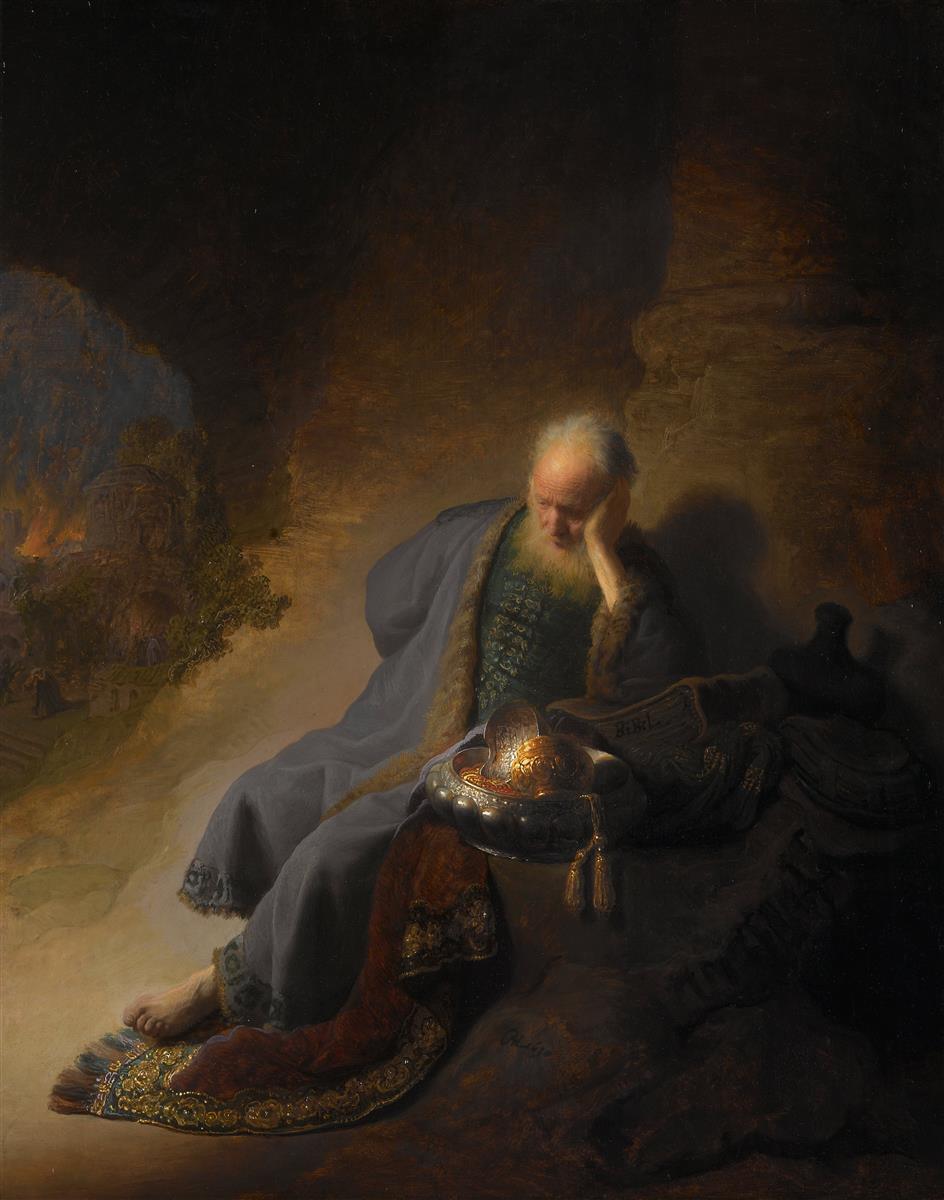
Rembrandt’s “Jeremiah Mourning over the Destruction of Jerusalem” (1630) is one of the most searing early statements of his dramatic vision. Painted when he was still in Leiden, the work fuses biblical narrative, psychological portraiture, and theatrical chiaroscuro into a single, concentrated moment. The prophet sits in shadowed seclusion, collapsing into his hand while the gold of sacred vessels and the threadbare fringe of a carpet glimmer at his feet. Far in the distance, barely legible through dusk and smoke, Jerusalem burns. The composition is at once intimate and epic: grief is staged as a private weight that bends the body, yet its cause is a catastrophe writ across the horizon. Rembrandt’s genius lies in making those scales meet. The light that touches Jeremiah’s head is the same light that remembers the temple’s former glory; the shadows that engulf him belong to a world that has failed.
Historical Context and Subject
The story derives from the biblical Book of Jeremiah and Lamentations, which recount the prophet’s warnings to Judah and his anguish when Jerusalem falls to the Babylonians. Seventeenth-century Dutch viewers—steeped in scripture, civic upheaval, and recent memories of war—recognized in Jeremiah a figure of conscience who speaks truth to a deaf society and must live with the sorrow of being right. Rembrandt’s choice of this subject in 1630 aligns with his fascination for characters at moral crossroads: aged scholars, penitent saints, fathers and sons whose fates hinge on a single, human moment. Here he avoids the spectacle of siege engines and tumbling walls. The catastrophe appears only as a flicker at the painting’s fringe. What commands the stage is the spiritual aftermath—the pause after news arrives, when the mind tries to hold what cannot be held.
Chiaroscuro as Moral Atmosphere
The lighting is a masterclass in early Rembrandt. A warm, concentrated beam falls from the upper left, igniting the prophet’s forehead, cheek, and beard, sliding over the fur trim of his robe, and catching the hammered facets of a golden vessel. The rest of the world recedes into deep, breathable shadow. This is not merely an optical device; it is moral atmosphere. Light behaves like mercy: it locates the person who bears responsibility without condemnation and makes visible the objects that symbolize a violated covenant. Shadow, conversely, becomes history—immense, heavy, and indifferent. Rembrandt controls this balance with exquisite judgment. The brightest spot is the prophet’s head, not the metal; it signals that consciousness, not treasure, is the true center of the scene.
Composition and the Arc of Grief
The composition is angled like a question mark. From the burning city at left, the eye climbs along a pale slope of earth toward the reclining figure, rounds the glittering bowl and tassel, and arrives at the hand that props Jeremiah’s head. The body forms a slow curve from bare foot to bowed skull, an arc that enacts grief. At the center, a shallow stone ledge doubles as a table for the temple vessels and as the physical obstacle against which the prophet’s body leans. This ledge is more than furniture; it is the hinge of the narrative. On one side is the world’s event—Jerusalem’s destruction—and on the other is the soul’s event—mourning. The ledge holds the gold that survived the sack, turning survival into accusation. By seating Jeremiah between ruin and relic, Rembrandt makes the body itself a site of theology.
Costume, Texture, and the Tactile Language of Loss
Every texture contributes meaning. The prophet’s robe is a river of matte blues and greens, hemmed with fur that drinks the light; the carpet beneath his feet glows in reds and saffron, its border embroidered with a wealth now stripped of purpose; the metal vessels gleam with a sharp, almost painful brilliance, their surfaces too perfect for the dark they inhabit. Rembrandt paints these textures not to dazzle but to argue. In this world, matter records moral history. The threadbare fringe at the carpet’s edge hints at long use and recent neglect; the slightly dented rim of a bowl registers touch and transport; the fur, warm and heavy, contradicts the coldness of the cavernous rock. The senses confirm what the mind knows: Jerusalem’s loss is not abstract but material, inscribed in objects and felt by skin.
Gesture and Expression
Jeremiah’s face—worn, intelligent, and resigned—barely looks out. His eyes are downcast; his mouth rests in a line too tired for tears. One hand props the head while the other hangs slack, palm open, as if surrendering the argument he long pursued. The bare feet extend from under the robe and touch the carpet like quiet witnesses to a human threshold. There is no theatrical tearing of garments, no outward display of lamentation. The grief is internalized, and Rembrandt makes the viewer do the work of approaching it. The prophet’s posture is a refusal to perform and an invitation to be near. In this reticence is the painting’s extraordinary power.
Space, Rock, and the Threshold of History
The setting reads as a rocky grotto or cave at the edge of the city. Large, warm planes of stone crowd the right half of the canvas, narrowing the space around the figure and deepening the sense of enclosure. This compressed room has narrative force. Jeremiah is both sheltered from and exiled by the event; he watches at a remove he did not choose. The cave becomes a threshold between civilization and wilderness, between former order and present chaos. Rembrandt organizes the stones with broad, quiet strokes, as if to coat the scene with ancient dust. The world’s geology has outlasted the city’s walls; the prophet mourns under a chronology larger than politics.
Color, Temperature, and Emotional Rhythm
Though known for dramatic chiaroscuro, Rembrandt is equally masterful in color temperature. Cool blues and greens dominate the robe; warm ambers and russets glow in the carpet and vessels; the rocks hover in a spectrum of muted earths that hold the extremes together. These temperatures alternate like breaths: cool interior, warm exterior; cool resignation, warm memory. The flicker of fire in the far left injects a narrow band of hot color, reminding us that catastrophe is active while grief sits. The palette creates an emotional rhythm: the eye warms in sympathy with the past’s splendor, cools under the weight of present thought, then warms again in the company of human touch.
Symbolism Without Caption
Rembrandt refuses overt iconography. There is no scroll unfurled with written lament, no angel, no explicit emblem of Babylon. Instead, symbolism is embedded in use. The vessels recall the Temple and portend their desecration in exile. The carpet and robe speak to what is fit for a sacred house and what becomes meaningless outside it. The bare foot on precious fabric is a quiet paradox: holiness has fled, and decoration can only keep company with sorrow. Such understatement accords with the Dutch taste for realism and with Rembrandt’s belief that objects preach best when they simply exist truthfully.
Narrative Time and the Choice of Moment
The painting arrests time at the most human instant—the pause after loss is known and before action is possible. Jeremiah has already spoken; Jerusalem already burns. What remains is the interior reckoning: the prophet must forgive a people who did not heed him and live with the accuracy of his warnings. Rembrandt’s moment is not the Lamentations’ public cry but the private gathering of words that will become scripture. The light that gathers on the forehead feels like a premonition of text. Vision precedes utterance; silence prepares speech.
The Influence of Leiden and Lastman
This canvas belongs to the final year or so of Rembrandt’s Leiden period, shortly before he relocates to Amsterdam. The influence of Pieter Lastman—Rembrandt’s former teacher—lingers in the richly costumed figure, the archaeological flavor of props, and the narrative clarity. Yet the young master pushes beyond Lastman’s crowded theatricality. He prunes the scene to a single figure and lets light and texture tell the story. Where Lastman might have diagrammed the temple’s fall, Rembrandt turns the tragedy into spiritual portraiture. The shift anticipates his mature style, where human inwardness becomes the primary site of drama.
The Role of the Vessels and the Problem of Beauty
The glittering bowl and goblet near the center are painted with almost scandalous beauty. Their surfaces mirror light like captured fire; the tassel of a cord drapes with calligraphic grace. Why this seduction in a scene of mourning? Because beauty here is double-edged. The vessels are remnants of holiness and instruments of profanation. Their beauty accuses us: we are drawn to their shine even as we know they testify to the temple’s loss. Rembrandt understands the moral complication of aesthetic pleasure and uses it to press the viewer. We cannot retreat to pious distance; we must feel the pull and judge ourselves for it.
Scale, Proximity, and the Viewer’s Role
Although not monumental in size, the painting creates a sense of nearness that feels almost conversational. The prophet’s foot approaches the frame; the bowl seems within reach; the fringe of the carpet invites touch. This proximity matters. The scene is not a pageant watched from the royal box but a human encounter. Rembrandt’s composition requires that the viewer sit with Jeremiah in the half-dark and take stock. In this way the painting refuses to be merely historical. It becomes a mirror for any moment when a community fails its best possibilities and individuals must live with prophetic sorrow.
Techniques of Surface and the Breath of Paint
Look closely and the surface reveals deliberate variety. The rocks are laid in broad, blended planes; the robe is built from soft, fused color that absorbs light; the metal is edged with tiny, crisp accents that create sparkle; the carpet’s embroidery is articulated with just enough detail to suggest handwork without losing painterly life. This alternation of loose and tight handling creates air between textures and helps the light feel like a physical substance. The paint itself becomes a metaphor for memory: some things are precise and gleaming; others are generalized and dim, as if already receding into the past.
Jeremiah as Every Witness
Though specific to a biblical prophet, the painting elevates Jeremiah into a type recognizable across times: the person who warned, was ignored, and now must endure the world he predicted. Rembrandt grants this type a radical tenderness. There is no triumph in being right; there is only the work of mourning and the hope of future consolation. The painting is therefore not only about judgment; it is also about care. The light that rests on the prophet’s head suggests that grief itself may be a form of fidelity, a way of keeping faith with what should have been.
Relationship to Later Rembrandt Works
“Jeremiah Mourning” anticipates many later Rembrandt achievements: the fusion of landscape and figure into a single mood; the ethical use of light to dignify the vulnerable; the turn toward interiors where thought is visible. Decades later, in works like “Aristotle with a Bust of Homer” or the late self-portraits, Rembrandt will refine this language of contemplative weight. In retrospect, the 1630 painting reads like a young master’s thesis: humans are most themselves when light reveals the cost of their convictions.
Reception and Legacy
The painting has long been admired for its emotional economy and technical bravura. Collectors and scholars often point to it as a touchstone for Rembrandt’s early narrative power. Its enduring appeal lies in the clarity of its feeling. No matter the viewer’s creed, the image communicates a universal human condition: the loneliness of foresight and the tenderness required to live with it. The scene does not instruct through allegory; it persuades through presence. That is Rembrandt’s lasting gift.
Conclusion
“Jeremiah Mourning over the Destruction of Jerusalem” is a study of conscience caught in the light. The prophet’s bowed head gathers the tragedy of a city into a single human gesture, while the gold of the temple glows with beauty that accuses. Stone encloses him; fire flickers far away; the carpet’s fringe remembers former splendor under a bare foot. In this spare constellation of textures and values, Rembrandt makes grief palpable and thought luminous. The painting invites us to sit in the half-dark and learn what Jeremiah knows: that truth, once spoken, does not spare the speaker; that beauty can wound; and that light, even when it reveals ruin, can still be merciful.