Image source: wikiart.org
Introduction
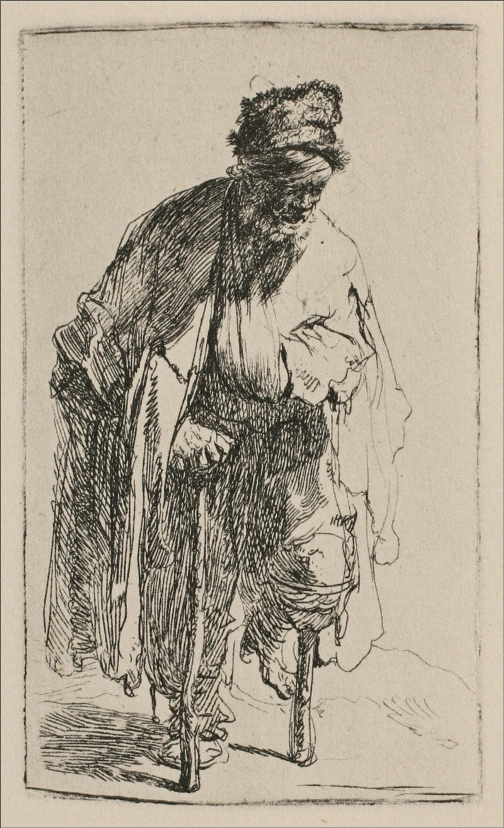
Rembrandt’s “A Beggar with a Wooden Leg” (1630) compresses movement, survival, and dignity into a small etching that feels astonishingly expansive. The figure advances toward us on crutches, clothes gathered in heavy folds, a cap pulled across his brow, and a peg leg planted forward with determined precision. There is almost no setting—just a shallow strip of ground and a halo of unworked paper—yet the scene carries the weight of a city street and the weather of a human life. In a handful of lines, the young artist transforms a passerby into a protagonist. The plate belongs to Rembrandt’s early Leiden years, when he explored the expressive possibilities of etching through a short, audacious series of beggar images. Far from caricatures, they operate as studies in human presence and as manifestos for an art that recognizes the monumental in the marginal.
A Moment in Rembrandt’s Early Career
The year 1630 finds Rembrandt in his early twenties, newly independent, trading studio ideas with Jan Lievens, experimenting with dramatic light in paint, and pushing graphic technique in copper. His small etched heads and street figures functioned as tronies—studies of type and character—circulating widely among collectors who prized virtuoso drawing and scenes of daily life. In this climate, the beggar prints were both exercises and statements. They allowed Rembrandt to prove that a limited toolset—needle, ground, acid, press—could fashion images with the gravity of painting, while also insisting that ordinary people in unadorned moments deserved sustained attention.
Etching as Drawing That Breathes
Etching translates the speed of drawing into inked line. The artist coats a copperplate with wax, draws with a needle to expose metal, and then bites those lines in acid. The resulting grooves hold ink that the press transfers to paper. Because the needle skates with minimal resistance, etching records the hand’s pressure and cadence with startling fidelity. In “A Beggar with a Wooden Leg,” the line alternates between wiry and velvety, quick and measured. Dense cross-hatching binds the left sleeve to shadow; longer, parallel strokes ride the fall of the robe; single assertive contours carve the stick and peg. The entire body seems animated by the very tempo of the marks that define it.
Composition as Forward Motion
The rectangle of the plate is organized like a path. The figure occupies the center and slightly left, angled toward the right margin where his next step will land. The peg leg is lowered in front like the prow of a boat; the crutch on the left lines up as a stabilizing mast; the right crutch trails in a relaxed counter-swing. Rembrandt sets a sliver of ground beneath the feet with quick, flat hatches so thin they read as both earth and shadow. Empty paper to the right becomes room to move into, while the faint rectangular border frames the scene as if we had glimpsed the man through a window. What little there is of space exists to intensify the sense of advance.
The Wooden Leg as Center of Meaning
The prosthesis is more than a prop; it is the etching’s conceptual engine. Rembrandt does not treat it as a spectacle. He gives it brisk description—a tapered peg, a strap, a firm base—and then orchestrates every other element around its function. The crutches and the line of the torso form a triangle that distributes weight; the billow of the robe registers the swing; the tilt of the cap and the beard’s direction rhyme with the forward lean. By making the device the calm center of a dynamic network, the artist shifts the viewer’s focus from disability to movement, from lack to capacity. The wooden leg, far from defining deficiency, defines the logic of the stride.
Clothing as Topography of Use
The garment’s generous folds, patched seams, and frayed edges are rendered with a vocabulary of strokes that describes both texture and gravity. Long verticals on the robe’s front communicate weight; broken, angled lines at the elbow and knee describe bends and stresses; a denser mesh under the left arm gives depth and anchors the composition. The bag or pouch at the figure’s side is evoked by a few confident contours, enough to suggest function without drawing attention away from the body. These marks do not moralize; they report. The robe becomes a map—a relief model of pressure, motion, and time.
Face, Cap, and the Ethics of Partial Disclosure
Rembrandt keeps the features elusive. The cap’s brim casts a shadow; the beard obscures the mouth; the eyes, if present, are nested in a small pocket of darkness. The partial disclosure protects the figure from becoming a specimen. He is not pinned to the plate by an invasive stare; he remains a person passing by. Yet the head’s tilt and the subtle forward thrust of the neck give us a mood: alert, unsentimental, busy with the business of moving. This restraint is an ethical choice. The artist offers just enough information to make an encounter, not an interrogation.
Light, Paper, and the Aura of Air
Because an etching builds its world with darkness and leaves light as untouched paper, the blank field surrounding the figure does real work. It becomes air, echo, and silence. The right side’s openness amplifies the sense of forward motion; the lighter interior of the robe’s folds glimmers as if catching daylight; the crisp lines of peg and crutches read with sculptural clarity against the pale ground. Rembrandt’s varied densities—thick hatching for shadow, open strokes for mid-tones, paper reserved as high light—create a complete atmosphere without scenery.
Balance, Instability, and the Body’s Invention
One of the marvels of the print is how persuasively it renders balance. The weight rides the left crutch and the peg; the right crutch swings in a secondary rhythm; the right foot hovers as a participant rather than a primary support. The viewer can feel the micro-adjustments that walking demands: shoulder raised a hair, wrist flexed, pelvis rotated. The image does not merely depict a man with a wooden leg; it thinks through how such a body invents motion. That thinking is present in the spacing of the crutches, the set of the shoulders, and the exact angle at which the peg meets the ground.
Social Vision Without Anecdote
Seventeenth-century Dutch images of beggars often serve satire or moral instruction. Rembrandt’s figure belongs to the street but is not a caricature and does not carry a sermon. There is no passerby to deny or offer alms, no clever twist to elicit laughter. The absence of anecdote draws the viewer’s attention to the man’s intrinsic dignity. He is not an emblem of vice or virtue; he is a person moving through space, working out his survival with practical grace. That lack of narrative furniture makes the scene feel immediate and contemporary.
Kinship with the Beggar Series
Around 1629–1630 Rembrandt etched several beggars—standing, leaning, carrying children, seated in chairs, warming hands at a brazier. Together they form a suite of variations on posture and need. “A Beggar with a Wooden Leg” sits among the most dynamic of the group, a counterpart to the seated and warming figures whose drama is rest and warmth. Here the drama is locomotion. The same humane eye governs all: quick lines that capture essentials, a respect for silence, and a refusal to inflate misery or decorate it. Seen as a sequence, the plates propose a new category for art: the unspectacular moment as worthy subject.
Technique: The Intelligence of Marks
Every zone of the plate receives the kind of mark it needs. The cap’s furry edge is a brisk fringe of short strokes; the beard is a tangle of curving, overlapping lines; the bag’s strap is a clean diagonal that ties separate areas together; the peg is a unison of decisive contours; the left sleeve is a dense hatch that holds shadow without turning to mud. Even the tiny patch of ground is a lesson: parallel, flattened strokes laid at a low register so they read as weight-bearing plane. This intelligence of marks is what keeps the etching fresh. It never flattens into formula because each passage is solved anew.
Impression Variants and the Life of the Plate
As with many early Rembrandt etchings, impressions vary with inking and wear. A more heavily inked state might give the sleeve and beard deeper volume; a light plate tone could veil the background with a faint gray, pulling the figure into a colder day. These shifts are not mere curiosities; they mirror the variability of the subject’s life—different weather, different light, different steps. The print is an object that changes as it circulates, just as the man’s body changes as it moves.
Comparisons and Anticipations
Placed beside later drawings of old men and self-portraits that explore vulnerability, this early plate reads as a seed. The humility, the delicacy with which a face can be partially hidden and still fully present, the faith in the expressive power of the barest means—all will flower in Rembrandt’s mature work. Compared with contemporaries who sometimes rendered beggars as stock figures, Rembrandt’s version anticipates modern documentary attentiveness. The subject is allowed to claim the center without the artist demanding theatrical justification.
Theological Undertones Without Insignia
Dutch viewers in the 1630s were steeped in Protestant reflections on humility and charity, but Rembrandt refuses to literalize doctrine. The plate contains no halo, no biblical verse, no moral caption. Its theology, if one senses it, is incarnational: grace disclosed in the ordinary. The wooden leg is not a sign of punishment or saintliness. It is a fact around which a life is organized. In this unadorned recognition lies a kind of reverence.
Lessons for Drawing and Seeing
Artists can read the etching as a manual. To convey drapery, ride the form with strokes that follow gravity. To suggest fur, break the contour with short, directional marks. To animate a hand without over-describing, use clustered strokes that hint at joints and knuckles rather than diagramming them. To give a figure space, leave the background empty where motion is headed. To dignify a subject, resist the urge to explain; let posture and balance speak.
The Peg Leg as Metaphor for Art
There is a tacit kinship between the beggar’s device and the artist’s medium. A wooden leg is an invention that compensates for loss by converting matter into motion; an etching is a device that converts incised metal into living line. Both are prosthetics that expand human capacity. Rembrandt’s sympathy for the ingenuity of bodies echoes his sympathy for the ingenuity of marks. The print becomes an allegory of making: with limited tools, one can nonetheless move with purpose.
Presence, Silence, and the Space of Encounter
Part of the image’s power lies in how it constructs a silent space around the figure. The border functions like the intake of breath before a greeting; the rightward openness feels like the pause we grant someone passing. In that space, the viewer’s own body responds—you might lean back a little to make room, or imagine the soft thump of peg on ground. The etching choreographs empathy not by sentiment but by spatial courtesy.
Legacy and Continuing Appeal
Collectors have long valued the beggar prints for their graphic virtuosity, but their lasting appeal comes from their moral clarity. They show that attention itself can be a form of care. In an age saturated with images clamoring for spectacle, this small plate demonstrates how a few lines can hold a human being with respect. The figure strides across centuries unembarrassed, his stride legible, his resourcefulness intact.
Conclusion
“A Beggar with a Wooden Leg” is a masterclass in economy and understanding. Rembrandt arranges motion around a simple prosthesis, balancing crutches, robe, and stride into a geometry that reads at a glance and deepens with study. He avoids anecdote and caricature, letting a person’s way of moving become the narrative. The plate transforms blank paper into air, etched line into weight, and a brief encounter into a durable presence. In 1630, the young artist already knew that the greatness of art need not trumpet itself. It can walk toward us quietly, step by step, carrying the lightest of equipment—a wooden leg, two sticks, and a few indelible lines.
