Image source: wikiart.org
Introduction
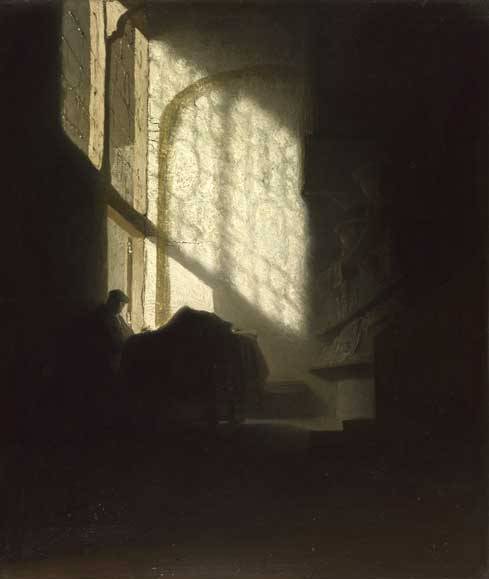
Rembrandt’s “A Man in a Room” from 1630 stages one of the most unforgettable encounters between light and solitude in the Dutch Golden Age. The composition is spare: a tall, mullioned window floods a small interior with angled daylight, projecting a lattice of luminous geometry across the opposite wall. Down at the lower left, almost swallowed by shadow, a solitary figure sits or leans at a table, his head bent toward the window as if reading, thinking, or simply receiving the warmth of the sun. The painting is small in scale, yet it feels architectural because the light constructs the space as surely as stone. What makes the picture extraordinary is how little narrative it needs. The drama is light itself, measured against a single human presence. With a handful of planes and an exact control of values, Rembrandt turns a quiet room into a theater of contemplation.
The Leiden Moment and the Pursuit of Light
The year 1630 places the work in Rembrandt’s Leiden period, when he was in his early twenties and forging an artistic identity through intimate formats and daring chiaroscuro. In these years he painted and etched small scenes of scholars, readers, hermits, and interiors where light behaves like a thinking agent. The painting belongs to that cluster of experiments. Rather than crowd the panel with furnishings, Rembrandt strips the room to its essentials and lets daylight do the describing. The result reveals a young painter interpreting Caravaggesque contrast through a distinctly northern lens: the light is not theatrical torchlight or moonlight, but sober, earthly daylight passing through glass and dust, shaping thought as it crosses the room.
Composition and the Geometry of Illumination
The picture is organized by diagonals and rectangles generated by the window. A high, arched aperture occupies the left, its mullions throwing a grid across the opposite wall at a steep angle. That grid becomes the painting’s skeleton. The largest illuminated shape is a keystone of brightness whose soft edge dissolves into darkness at the lower right. The figure and table occupy the shadowed wedge beneath the window, where the eye discovers them only after following the light’s path. This delayed recognition is central to the picture’s effect. We read the room first as an abstract arrangement of values, then notice the person who inhabits it, as if the act of seeing were reenacting the person’s own emergence into thought.
The Figure as Measure of Space
The man is deliberately under-described. He appears as a silhouette with a slightly bowed head, the faintest glint along the hairline or collar catching the window’s reflection. Because his features are withheld, he functions less as a portrait and more as a unit of scale, a living measure that tells us how large the space must be and how strong the light actually is. Rembrandt often deploys a single small figure to calibrate an interior, but here the calibration becomes poetic. The human presence does not compete with the architecture; it harmonizes with it, as if the room were an extension of the person’s interior life.
Materials, Surface, and the Tactility of Stone and Air
Even at this early date, Rembrandt knows how to make surfaces feel distinct. The stone jambs of the window read with slight granular roughness; the wall that receives the light looks almost velvety, as if dust floating in the beam has softened its plaster. The tabletop disappears into darkness but retains a quiet sense of mass where the light brushes an edge. These tactile differences grow not from fussy description but from the modulation of paint layers. Thin, translucent film invites the ground to glow in the lit passages, while thicker, more absorbent paint drinks the light in the shadows. The viewer experiences not just contrast but atmosphere—the way air itself becomes visible when light travels through it.
Chiaroscuro as Thought
The painting’s chiaroscuro does more than model forms; it proposes a philosophy. Brightness is not merely an optical event; it behaves like understanding spreading across the wall. The figure sits at the hinge between shadow and illumination, poised where the world shifts from obscurity to clarity. This positioning invites readings that range from the spiritual to the intellectual. Perhaps he is a scholar caught at a moment of insight, or a cleric whose devotion is simply being alive to light. Rembrandt leaves the role open because what matters is the experience: the mind receiving the world through the senses, the eye teaching the heart by looking.
Time of Day and the Tempo of Looking
The long diagonal of light suggests a low sun, likely morning or late afternoon, when rays slash across interiors. That slanted beam sets a tempo. It implies that time is in motion—light has crossed the room and will continue to move. The painting therefore holds an instant within a larger flow. The figure’s stillness answers that flow with contemplation, a counter-tempo that makes the scene musical. The viewer’s gaze follows the light to the wall, rests, returns to the window, and then descends to the quiet corner where the man sits, repeating the movement like a refrain.
Silence, Sound, and the Acoustics of Space
Although a painting has no sound, “A Man in a Room” invites the ear. The stone seems to absorb noise, the beam of light to hush whatever small rustles the man might make as he shifts or turns a page. The emptiness of the right side acts as acoustic space, like the quiet after a tone. Rembrandt shapes this silence with the same intelligence he gives to light. The stairs or ledge on the right withdraw into darkness, creating a deep, quiet pocket where sound would pool. The picture persuades us that solitude has weight and texture, and that stillness can be a subject.
The Window as Actor
Windows are frequent protagonists in Rembrandt’s interiors. Here the tall arched opening is not only a source of light; it is a mechanical device that transforms the outer world into a patterned projection. The mullions and tracery break daylight into compartments, so that the wall becomes a screen on which the window performs. This also means the world outside is present even though it is unseen. We infer weather from the quality of the light, and architecture from the cast pattern. The window stages a conversation between interior and exterior, public and private, body and world, all without showing a single external object.
The Discipline of Omission
What the painting refuses to depict is as significant as what it shows. There are no books detectable on the table, no chair details, no household objects to anchor a genre narrative. By omitting these cues, Rembrandt prevents the viewer from getting distracted by story. The restraint pushes the composition toward abstraction without losing the visceral feel of place. The room becomes a thinking machine whose purpose is to receive and shape light, and the figure becomes the machine’s living heart.
The Edge of the Beam and the Poetry of Halation
Few effects in the picture are more memorable than the soft edge where the beam of light meets the darker wall. Rather than a hard boundary, Rembrandt paints a zone of halation where the brightness frays, as if the air itself were illuminated. This softness keeps the light from behaving like a material object; it behaves instead like an event in time. Small flecks and strokes within the bright field suggest the irregularities of the wall, but they also keep the eye from falling asleep in an empty highlight. The spectator’s vision grazes the surface much as the light does.
Human Scale and the Ethics of Modesty
Despite its architectural drama, the painting is modest in size, intended for close looking. This intimacy cultivates an ethics of attention. The viewer does not stand back as if before a monumental scene; one leans in, adjusting to the darkness to discover the man. That act of accommodation is part of the meaning. The painting asks for patience, for the willingness to let the eye find its footing in shadow. In return it offers a rare sensation: the feeling that our own looking participates in the making of the image, that vision is not merely a reception but a collaboration with light.
Relation to the Scholar and Hermit Motifs
Around 1629–1631 Rembrandt made multiple images of scholars in studies, saints in cells, and philosophers by windows. Those works vary in their degree of narrative detail, but they share a deep interest in how light suggests inward life. “A Man in a Room” sits on the most distilled end of that spectrum. Strip away the books and religious signs found in some contemporaneous pictures, and what remains is the bare grammar of insight: a person, a window, a table, a wall of light. The reduction clarifies the motif’s core and gives it an almost timeless applicability. The figure could be any thinking person in any century.
Techniques of Value Control
The success of the painting depends on an exact hierarchy of values. The window casing and the bright wall define the highest lights; the lower left and far right house the deepest shadows; the figure occupies the mid-tones, allowing him to read as a luminous silhouette rather than a flat cutout. Rembrandt manages this hierarchy with thin glazes that let the ground color glow in lights and with dense, absorbent passages in shadows that keep them from reflecting ambient light. The tiny increments within each band of value—the gentle rise from near-black to brown around the figure’s head, the subtle dip from the brightest patch of wall to the less brilliant floor—give the painting its breathing quality.
Spatial Perspective Without Vanishing Lines
Architectural painters often plot interiors with precise linear perspective. Rembrandt achieves depth more through light than through orthogonals. The ledge on the right and the angle of the window frame indicate recession, but they do so quietly, subordinated to the beam’s sweep. Because the light describes the hollow of the room, the viewer senses the recessive volumes without counting floor tiles or ceiling ribs. This approach yields a space that feels discovered rather than diagrammed, a place entered by eye rather than measured by rule.
The Psychology of Bent Head and Turned Shoulder
Although the figure is minimally described, his posture carries psychology. The bent head admits humility, study, or prayer; the slight turn toward the window signals openness; the shoulder line angling away from us protects his privacy. We are not intruders but witnesses. The ambiguity is fertile. The same posture can suggest a scholar at work or a solitary person resting from labor. This openness to multiple human states keeps the picture perennially relevant; it speaks not to a narrow story but to a recurrent human gesture—the leaning toward light.
Comparisons with Later Interiors
Decades later, Rembrandt would paint grander scenes where light crosses interiors with narrative aims: biblical suppers, lessons, and family moments. The seeds of that storytelling power are visible here, concentrated and austere. If the later works amplify richness of color and character, this early panel concentrates the grammar that makes the larger sentences possible. The moral is that mastery begins in restraint. By learning to make a room ring with only a window and a wall, the artist gains the authority to orchestrate larger dramas without losing control of tone.
Theological Resonances Without Insignia
While the painting bears no explicit religious iconography, it resonates with Protestant meditations on inwardness and the sanctity of daily light. The room becomes a devotional space not because it contains a crucifix or sacred book but because the act of receiving light feels akin to prayer. Many Dutch viewers would have recognized this undertone, and modern viewers can sense it without doctrinal knowledge. The scene proposes that grace can arrive as illumination, unadorned and sufficient.
Why the Painting Feels Modern
One reason the image feels strikingly modern is its near-abstract organization. The huge plane of darkness and the hard-edged wedge of brightness could almost belong to a twentieth-century painter’s study in value. Yet the work remains rooted in lived observation. The modernity emerges from confidence in the essentials: light, shadow, and human presence. By paring away anecdote, Rembrandt anticipates later notions that painting can be about the fundamental conditions of seeing.
Lessons for Contemporary Viewers
Looking at “A Man in a Room” trains the eye for subtlety. It teaches patience with slow gradations and the courage to accept emptiness in a composition. It reminds us that rooms shape thought and that our minds, like this figure, incline toward light. It also suggests a way of living with time: to allow the day to draw across our walls and to understand that illumination changes as we do. In an age saturated with images clamoring for attention, this small panel offers the relief of concentration and the pleasure of quiet mastery.
Conclusion
“A Man in a Room” is a meditation built from daylight. The painting condenses architecture, psychology, and philosophy into the simple fact of a window throwing its pattern across a wall while a person listens to it with the body. Rembrandt’s decisions are all acts of discipline—pruning details, balancing values, allowing space to remain dark so that light can take on substance. What endures is the sensation of being present in a room where thinking happens and where seeing itself feels like a form of devotion. In 1630, the young Rembrandt already knew that the most profound subjects do not require grandeur. They require attention. He gives us that attention in concentrated form, and the room glows forever.
